



In 2026, decentralized finance (DeFi) markets have moved beyond simple pass-through yields to highly sophisticated, capital-efficient revenue capture models. Ethena Labs stands at the center of this paradigm shift, commanding a circulating supply of roughly $5.5 billion across its core digital dollar ecosystem. Moving away from traditional fiat-backed stablecoin mechanisms, Ethena's core architecture leverages a delta-neutral backing framework to engineer what the industry refers to as Internet Money. Rather than relying on traditional bank deposits, the system establishes a scalable dollar primitive by pairing spot crypto holdings directly with corresponding short perpetual futures positions.
Driven by a transformative 2026 update to its tokenomics framework, Ethena has officially transitioned from an early-stage liquidity incentive program into a mature, cash-flowing infrastructure engine. The implementation of the long-awaited Intents Fee Switch has permanently modified the value-capture mechanics of the network, creating two distinct asset classes for market participants: sENA (staked ENA) and sUSDe (staked USDe). Choosing which asset to hold requires a comprehensive understanding of your personal risk tolerances, yield expectations, and structural liquidity preferences.
This guide outlines how both assets generate returns, unpacks the mechanics of the 2026 revenue shift, and details how to navigate the protocol’s withdrawal constraints securely.
What Is the Ethena Fee Switch Earning Protocol Revenue in 2026?
The activation of the Ethena Fee Switch in early 2026 marks a fundamental structural shift in how the protocol manages its massive cash flows. Prior to this milestone, Ethena retained approximately 36% of its gross earnings within its treasury or directed them entirely toward expanding its global Reserve Fund. Following a successful governance process initiated by key institutional partners and approved by the Risk Committee, the protocol crossed its vital execution benchmarks, maintaining a steady circulating supply exceeding $5 billion and generating cumulative protocol revenues above $250 million.
The activation transforms the ENA token from a purely reactive governance voting chip into a highly productive asset that captures real-world economic value. Under the 2026 framework, a fixed bracket ranging between 10% and 20% of all gross protocol fees generated by the issuance and management of USDe is directed away from the treasury. Instead, these cash flows are routed directly to open-market buybacks and structural yield distributions. This mechanism effectively creates a sustainable, counter-cyclical floor for the token economy, ensuring that as global digital dollar demand rises, the structural buying pressure on the underlying governance ecosystem scales alongside it.
Read more: What Is Ethena the Stablecoin Protocol Behind USDe?
What Is Ethena Staked ENA (sENA) for Airdrops and Governance Rights?
With the introduction of the new revenue-sharing module, sENA serves as the liquid receipt token for users who lock their native ENA tokens inside the protocol's core staking vaults. Operating on a token vault architecture similar to Rocket Pool's rETH mechanism, sENA is designed to continuously appreciate in value against native ENA as distributions accumulate inside the contract. At launch, the ratio sits at 1 sENA = 1 ENA, but it is engineered to rise over time as protocol rewards are systematically deposited into the vault.
Beyond the direct cash-flow distributions generated by the 2026 fee switch, holding sENA unlocks exclusive access to high-value ecosystem infrastructure rewards. As Ethena expands its footprint via its high-performance trading ecosystem, partner decentralized networks regularly allocate massive percentages of their upcoming token supplies specifically to sENA holders.
Key examples include 15% of the total supply from the upcoming Ethereal perpetuals exchange, alongside specialized infrastructure rewards from Symbiotic restaking modules where locked ENA provides economic security for cross-chain LayerZero messaging gates. Furthermore, sENA holders retain direct governance authority over tokenomics adjustments, collateral types, and future fee distribution ratios.
How to Stake ENA for sENA to Earn on Ethena
Staking ENA locks your governance tokens into sENA, unlocking a shared split of the protocol's fee revenue and exclusive ecosystem airdrops.
- Access the Ethena protocol dApp interface and secure your Web3 wallet connection.
- Head directly to the Staking dashboard and click on the ENA asset portal.
- Enter your desired amount of ENA tokens to stake and select the Stake execution button.
- Verify and sign the contract transaction through your connected wallet interface.
- Hold your newly minted sENA receipt tokens as they automatically appreciate against native ENA.
What Is Ethena sUSDe, the Internet Bond Yield-Bearing Stablecoin?
Positioned as the foundational savings technology of the protocol, sUSDe is the reward-accruing version of Ethena’s synthetic dollar, USDe. When users deposit their flat-pegged USDe into the StakedUSDe contract, they receive sUSDe tokens that automatically compound in value second by second. This setup functions essentially as a crypto-native Internet Bond, offering global, permissionless access to institutional-grade yield without requiring users to manually claim rewards or interact with complex multi-step interfaces.
The underlying stability of the USDe peg is maintained through automated, programmatic delta-neutral hedging. When a user mints USDe using liquid reserve assets like USDC or USDT, the protocol instantly executes a short perpetual futures position of an equivalent notional dollar value across premier derivatives exchanges.
Because the spot asset's price fluctuations are offset 1:1 by the short futures contract, the net asset value of the backing collateral remains perfectly stable at $1.00 under normal market conditions. To minimize counterparty risk, the physical backing assets are held entirely on-chain within institutional-grade Off-Exchange Settlement (OES) vaults, ensuring the protocol never surrenders direct asset custody to centralized trading venues.
Read more: What Is Ethena’s USDe Yield‑Bearing Stablecoin and How Does It Work?
How to Stake USDe and Get sUSDe to Earn on Ethena
Staking USDe converts your synthetic dollars into sUSDe to automatically capture native protocol rewards and yield distributions.
- Navigate to the official Ethena dApp and connect your Web3 wallet.
- Select the Stake tab and choose USDe as your target asset.
- Input the total amount of USDe you wish to allocate and click Stake.
- Approve the necessary token permissions and sign the atomic EIP-712 transaction using your wallet.
- Receive your reward-accruing sUSDe tokens directly into your wallet balance.
sUSDe vs. sENA APY: Comparing Funding Rates and Protocol Fee Share
The core yield profiles of sENA and sUSDe stem from entirely different economic engines, creating distinct risk-reward behaviors across changing market regimes.
|
Feature |
sUSDe (Staked USDe) |
sENA (Staked ENA) |
|
Primary Yield Source |
Perpetual funding rates & ETH LST rewards |
Protocol fee switch & ecosystem airdrops |
|
Asset Volatility |
Low (Pegged to stable USD value) |
High (Tied to volatile market price of ENA) |
|
Target Audience |
Risk-averse savers seeking steady dollar yield |
Long-term ecosystem bulls seeking maximum upside |
|
Compounding Style |
Automatic second-by-second internal value growth |
Discretionary programmatic vault distributions |
sUSDe APY Depends on Market-Driven Volatility
The yield distributed to sUSDe stakers is primarily derived from two variable streams: native consensus layer rewards on staked Ethereum assets and the floating funding rates collected from the protocol's short perpetual futures positions. Because long traders pay short-side positions during bullish periods of high leverage demand, sUSDe yields can surge dramatically, averaging an impressive 11.1% lifetime APY. However, in range-bound or bearish environments, funding rates compress heavily, which drops the baseline sUSDe yield down into a conservative 3% to 8% range.
sENA APY Is Protocol Activity-Driven
Conversely, sENA returns are driven directly by the newly activated fee switch allocations and ecosystem ecosystem airdrops. Rather than tracking daily funding-rate volatility, sENA yield reflects overall protocol utility, transaction throughput, and mint/redeem volume. Based on early 2026 performance metrics, the 10-20% protocol fee diversion generates a structural yield floor for sENA stakers that remains highly insulated from immediate spot price declines.
How to Buy Ethena (ENA) on BingX
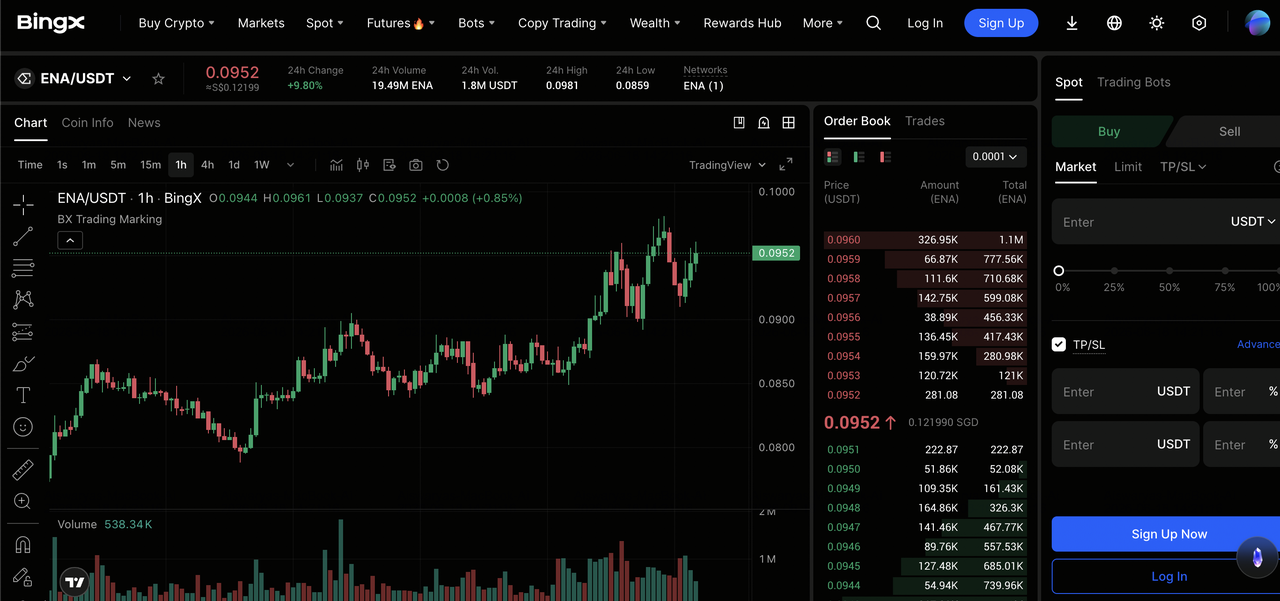
ENA/USDT trading pair on BingX spot market
Purchasing ENA on BingX allows you to easily acquire the ecosystem's native governance token using the platform's advanced AI-driven liquidity matching engines to minimize execution slippage.
- Log into your verified BingX account and navigate to the Spot Market tab.
- Search for the ENA/USDT trading pair in the market directory.
- Select your preferred order type, choosing a Market Order for instant execution or a Limit Order to target a specific entry price floor.
- Input the total amount of USDT you want to spend or the specific volume of ENA you wish to purchase.
- Review the execution details and click Buy ENA to instantly settle the underlying assets into your Fund Account.
sENA, eENA Exit Liquidity: Understanding the 7-day Unstaking Cooldown
While both assets offer high-tier capital productivity, managing your positions requires a strict adherence to Ethena's operational liquidity constraints. When a user decides to exit their sUSDe or sENA position via the official dApp user interface, the unstaking process is strictly partitioned into a two-step cryptographic sequence to preserve system-wide stability.
- Initiate the Unstake Request: Navigate to the Ethena staking interface and click Unstake. Your selected Web3 wallet will prompt you to sign an EIP-712 transaction. Once confirmed on-chain, your staked assets are permanently burned, and your principal is automatically moved into an isolated silo contract.
- Complete the 7-Day Cooldown Period: Your assets must remain inside the withdrawal silo for a mandatory 7-day cooldown period. Crucially, positions sitting in the cooldown silo do not earn protocol rewards or yield distributions of any kind during this window.
- Execute Final Contract Withdrawal: Once the 168-hour cooldown clock completely runs down, return to the interface and click Withdraw. You must sign a second transaction to release the unlocked tokens from the silo directly back into your active wallet address.
Operational Warning on Dual-Layer Locks: If you have opted to place your tokens into advanced LP vaults or specialized restaking positions, note that an additional unlocking cooldown, ranging from 7 to 21 days, may apply before you can initiate the standard 7-day unstaking cooldown. Always audit your asset layer requirements to avoid unexpected capital lockups.
Final Thoughts: How to Balance Yield and Risk in the Ethena Ecosystem
Choosing between sENA and sUSDe ultimately comes down to your overarching market thesis and liquidity horizon. If your goal is to park core stable capital and earn a highly competitive, self-compounding digital dollar return while maintaining an ironclad peg, sUSDe operates as the premier vehicle for your portfolio.
If, however, you want to capture leveraged exposure to the broader growth of Ethena’s ecosystem, secure governance voting weight, and claim a direct share of protocol revenues via the 2026 fee switch, sENA offers an unmatched wealth-generation profile despite its underlying token volatility.
Risk Reminder: Interacting with synthetic dollar protocols involves distinct smart contract, exchange counterparty, and delta-neutral execution risks. Never deploy more capital than you can afford to lose, and routinely account for the 7-day unstaking window when planning portfolio reallocations.
Related Reading
- What Is Ethena the Stablecoin Protocol Behind USDe?
- What Is Ethena’s USDe Yield‑Bearing Stablecoin and How Does It Work?
- What Are the Top Yield‑Bearing Stablecoins to Earn Passive Income in 2026?
- What Are the Top 10 Ways to Earn Passive Income from Crypto in 2026?
- How to Stake Ethereum (ETH) in 2026: Top Ways to Know
