
Nike (NKE) designs and markets athletic footwear, apparel and equipment to consumers through wholesale partners, owned stores and digital channels. Its $6.8 billion quarterly wholesale engine remains central, while performance running, football and training products create a path to renewed growth. The turnaround depends on new product demand outweighing weaker Sportswear, Jordan Brand and Greater China sales without requiring deeper discounting.
The latest quarter showed performance products gaining traction without a companywide sales recovery. Nike fiscal Q1 2027 revenue fell 4% to $11.213 billion, even as the performance portfolio grew high single digits and gross margin rose 60 basis points to 42.8%. Diluted EPS was $0.48, down from $0.49. Nike must prove that stronger sport categories and the Pace cost program can overcome shrinking lifestyle sales and China's 26% currency-neutral decline.
The NKE stock forecast for 2026 now centers on two competing views:
- The sport-led recovery case: Running and football growth, fresher product and tighter distribution restore full-price selling, allowing margin gains to outlast the current sales reset.
- The extended-reset case: China, Sportswear and Jordan declines continue to absorb performance gains, while restructuring costs and promotional pressure delay earnings recovery.
This guide breaks down the NKE stock forecast, 2026 price scenarios, key risks and analyst outlooks, drawing on Nike's October 1 fiscal Q1 2027 release, 10-Q, earnings call and market data through October 20, plus how to buy NKE stocks on BingX TradFi with USDT.
Top 5 Things for Nike Investors to Know in October 2026
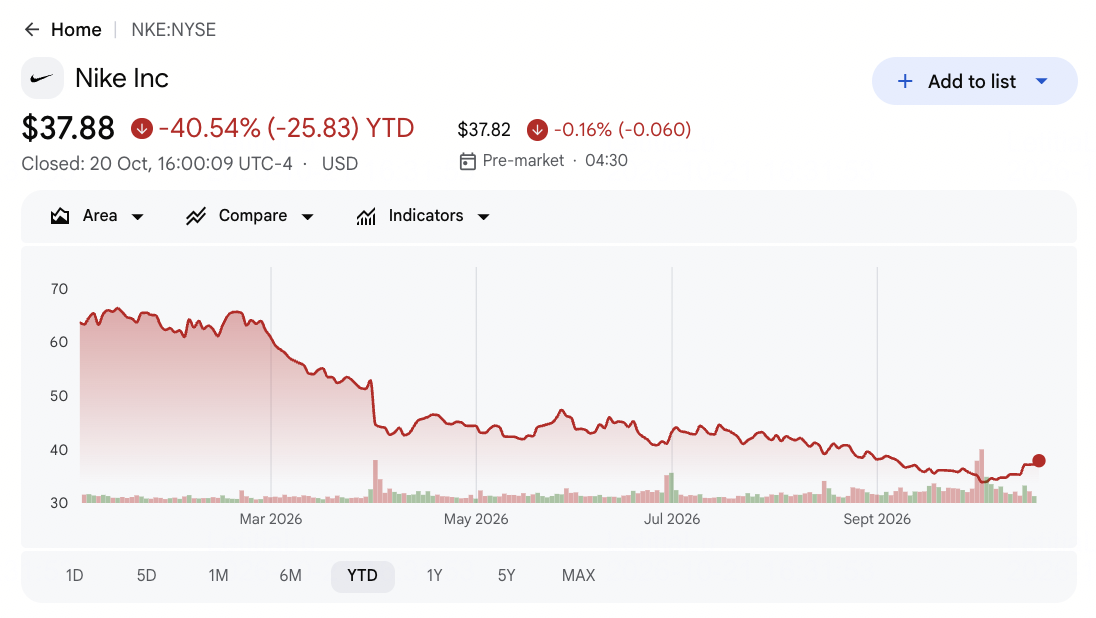
- NKE closed at $37.88 on October 20, down 40.54% YTD: The completed-session close lies between the $31.97 52-week low and $70.44 high. That distance reflects the market's uncertain view of the reset, while the $19 to $60 span in dated analyst targets shows how widely earnings-recovery assumptions still differ.
- Q1 revenue missed by about $107 million despite a $0.05 EPS beat: Nike reported $11.213 billion against a $11.32 billion LSEG revenue consensus and $0.48 EPS against a $0.43 estimate. The split suggests lower logistics costs helped earnings more than underlying demand, which declined 4% year over year.
- Performance grew high single digits from a $16 billion FY2026 business: Running, Global Football, Tennis and Golf each grew double digits in the quarter. Yet Sportswear, just under half of quarterly revenue, declined low double digits, so the sport-led strength has not restored consolidated growth.
- Fiscal 2027 guidance calls for a high-single-digit sales decline: Management expects adjusted EPS of $1.15 to $1.35, excluding roughly $0.15 in Pace charges. It also warned that second-quarter comparisons create an approximately 400-basis-point revenue headwind, making a quick reported rebound harder to assume.
- Pace targets $2.5 billion of cumulative savings through fiscal 2031: The plan also carries around $1.0 billion of pretax implementation charges, with most savings expected in fiscal 2029 and 2030. Near-term investors therefore need evidence of healthier product demand before treating the long-dated savings estimate as current earnings.
What Is Nike (NKE)?

Nike designs and markets athletic footwear, apparel, equipment, and accessories through wholesale retailers and NIKE Direct, which includes owned stores and digital platforms. Converse operates as a smaller subsidiary brand. In fiscal Q1 2027, NIKE Brand footwear generated $6.951 billion in revenue and apparel contributed $3.384 billion, while wholesale sales reached $6.804 billion and Direct sales totaled $4.142 billion. With manufacturing largely outsourced, profitability depends on sourcing costs, inventory management, channel mix, and consumer demand.
Nike's Sport Offense strategy prioritizes innovation across running, football, training, and basketball. Recent launches include the Pegasus Plus 2 in August and the Alphafly 4, Swooshfly, and Apex racing lineup unveiled around September. In Greater China, Nike is streamlining digital distribution through Tmall, JD, Douyin, and its own platforms to reduce discounting. Its Pace initiative focuses on supply chain flexibility and operational efficiency, while sustained recovery depends on converting product innovation into stronger full-price sales.
Nike (NKE) Q1 FY2027 Earnings Overview: EPS Beat and Margin Gains Offset Weaker Sales
Nike reported Q1 FY2027 revenue of $11.213 billion, down 4% year over year and $107 million below consensus, while diluted EPS of $0.48 beat expectations by $0.05. Gross margin improved 60 basis points to 42.8%, supported by lower logistics costs, but Greater China revenue declined 26% on a currency-neutral basis. Management expects a high-single-digit revenue decline for FY2027 and adjusted EPS of $1.15 to $1.35, making demand recovery and sustained margin improvement central to the outlook.
Read More: NIKE (NKE) Q1 FY2027 Earnings Overview: $11.213B Revenue Miss Sends a 3.64% Price Selloff
|
Financial Metric |
Guidance / Consensus |
Reported / Actual |
Surprise |
|
Q1 FY2027 revenue |
$11.32B consensus |
$11.213B |
Miss. $0.107B below consensus; down 4% YoY. |
|
Q1 diluted EPS |
$0.43 consensus |
$0.48 |
Beat. $0.05 above consensus; $0.49 a year ago. |
|
NIKE Brand wholesale |
$6.839B a year earlier |
$6.804B |
Lower. Down $35M; North America rose 9%. |
|
NIKE Direct |
$4.514B a year earlier |
$4.142B |
Lower. Down $372M; digital fell 13%. |
|
North America revenue |
$5.020B a year earlier |
$5.127B |
Higher. Up $107M, or 2%. |
|
Greater China revenue |
$1.512B a year earlier |
$1.180B |
Lower. Down $332M; 26% currency-neutral drop. |
|
Gross margin |
42.2% a year earlier |
42.80% |
Improved. Expanded 60 basis points. |
|
FY2027 adjusted EPS guide |
Not provided |
1.15–1.35 |
Guided. Excludes about $0.15 in Pace costs. |
- Q1 revenue declined 4% to $11.213 billion. Sales fell $507 million year over year and missed the $11.32 billion consensus by $107 million. Weakness in Greater China and EMEA offset North America's growth, making a broader demand recovery important to future earnings.
- Diluted EPS of $0.48 beat estimates by $0.05. Earnings slipped slightly from $0.49 a year earlier, while net income declined to $712 million from $727 million. Lower overhead and logistics expenses helped protect profitability despite weaker sales.
- Performance categories grew while Sportswear remained weak. Nike's performance business grew high single digits from a $16 billion FY2026 base, supported by double-digit Running and Global Football growth. However, Sportswear declined low double digits and Jordan fell mid-teens, limiting the broader recovery.
- Gross margin improved 60 basis points to 42.8%. Lower warehousing and logistics costs contributed approximately 90 basis points, while foreign exchange added 40 basis points. Lower selling prices and royalties partly offset those gains, making full-price demand important to sustaining margins.
- Greater China revenue fell 26% currency neutral to $1.180 billion. The $332 million decline contrasted with North America's 2% growth to $5.127 billion. Management expects a high-single-digit FY2027 sales decline, making China inventory, digital performance, and regional demand recovery central to the outlook.
Nike (NKE) 2026 Investment Outlook: $55 Bull Case vs. $25 Bear Case
Nike's investment outlook depends on whether stronger performance footwear demand can offset weakness in Sportswear, Jordan, and Greater China. Running and football growth support the recovery, while improving product mix and cost discipline could strengthen margins. However, promotional pressure and the timing of Nike's turnaround remain important to future earnings.
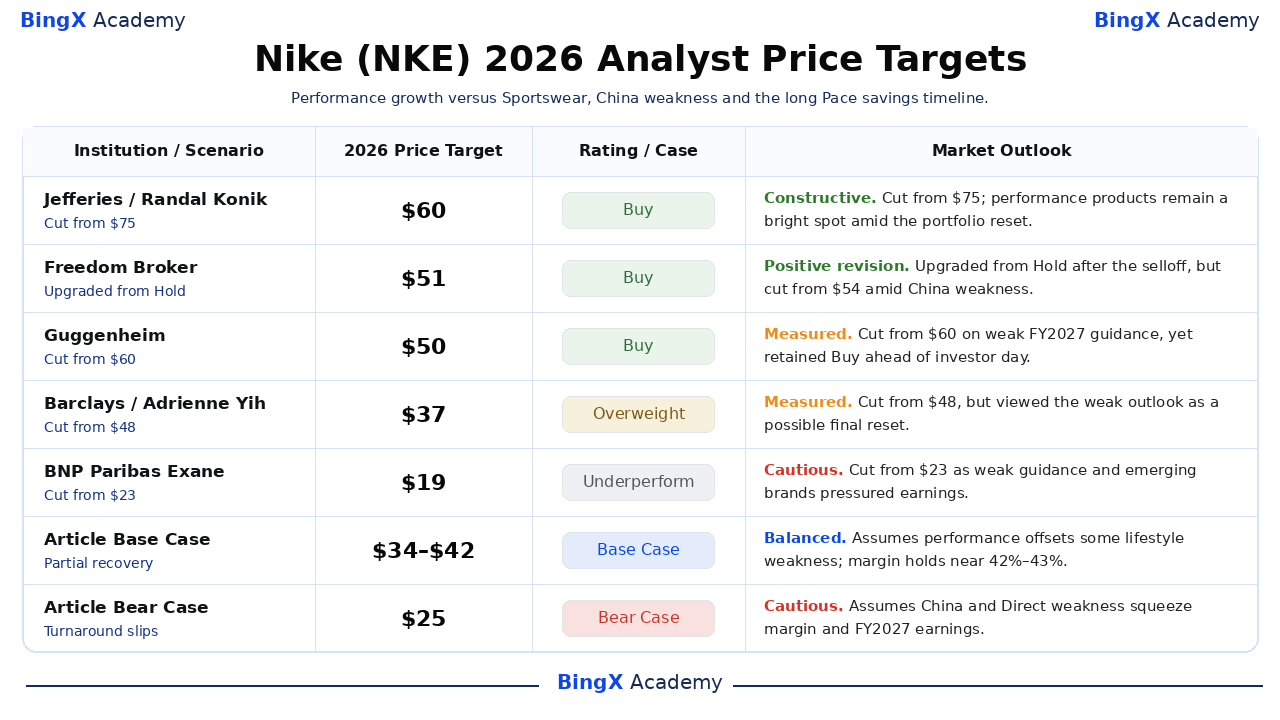
The Bull Case: Strong Running and Football Demand Pushes NKE Toward $55
The Bull Case assumes Running, Global Football, and new performance footwear continue gaining market share, while improving China demand and more selective Jordan releases reduce discounting. Nike's performance business grew high single digits in Q1, and stronger full-price sales could help offset weaker lifestyle products while supporting higher revenue and gross margins.
A move toward $55 would require FY2027 revenue to outperform the high-single-digit decline guidance, Greater China's currency-neutral sales decline to narrow below 10%, and gross margin to exceed 44%. Stronger results and a constructive November investor day would reinforce the recovery outlook.
The Base Case: Gradual Recovery Keeps NKE Between $34 and $42
The Base Case assumes Running and football demand remain healthy, while Sportswear, Jordan, and Greater China recover more slowly. Q1 gross margin of 42.8% and $8.4 billion in cash and short-term investments provide room for investment, although weaker Direct sales and ongoing promotions limit near-term profitability. Benefits from Nike's Pace cost-saving program are expected to emerge mainly after FY2028.
NKE could trade between $34 and $42 if FY2027 adjusted EPS remains within $1.15 to $1.35 and gross margin holds around 42% to 43%. Faster China stabilization could support the upper end, while renewed discounting or weaker guidance would pressure the range.
The Bear Case: China and Lifestyle Weakness Pull NKE Toward $25
The Bear Case assumes Greater China's 26% currency-neutral revenue decline persists while Nike Direct and Sportswear remain under pressure. Continued weakness in Jordan and lifestyle products could offset gains in performance footwear, while promotions and lower sales volumes reduce operating leverage. Delayed Pace savings would provide limited near-term relief.
A move toward $25 would become more likely if China's sales decline remains near 25%, gross margin falls below 41%, or management cuts FY2027 adjusted EPS guidance below $1.15. Sustained weakness across these measures could extend Nike's earnings recovery beyond current expectations.
NKE Stock Price Forecasts for 2026 By Wall Street Analysts
These five dated actions span $19 to $60, illustrating sharply different views of how long Nike's sales reset and margin repair will take. The $37.88 October 20 close is a reference point, not a live quote. The Article Base and Bear rows below are independent editorial scenarios, separate from third-party targets and neither an analyst consensus nor a price promise.
|
Institution / Scenario |
2026 Price Target |
Rating / Case |
Market Outlook |
|
Jefferies |
$60 |
Buy |
Constructive. October 2: Cut from $75, yet performance products remained a bright spot during the portfolio reset. |
|
Freedom Broker |
$51 |
Buy |
Positive revision. October 2: Upgraded from Hold after the selloff while cutting from $54; recovery potential despite China and Direct weakness. |
|
Guggenheim |
$50 |
Buy |
Measured. October 2: Cut from $60 on weak fiscal 2027 guidance while retaining Buy ahead of November investor day. |
|
Barclays |
$37 |
Overweight |
Measured. October 5: Cut from $48 after a difficult quarter but retained Overweight, calling the outlook a possible final earnings reset. |
|
BNP Paribas Exane |
$19 |
Underperform |
Cautious. October 2: Cut from $23 after weak fiscal 2027 guidance and lower earnings estimates amid emerging-brand competition. |
|
Article Base Case |
34–42 |
Base Case |
Balanced. Assumes performance growth partly offsets lifestyle declines and FY2027 adjusted EPS remains $1.15 to $1.35. |
|
Article Bear Case |
$25 |
Bear Case |
Cautious. Assumes China and Direct weakness cut gross margin below 41% and force a lower EPS guide. |
How to Buy Nike (NKE) Stock on BingX
Buy and hold Nike shares through BingX Stocks Trading using USDT or USDC. Nike offers exposure to global athletic footwear, sportswear, and performance innovation, with growth opportunities tied to new product launches and improving demand in key markets. With fractional investing and no leverage or funding fees, eligible users can build positions based on their investment goals and outlook for Nike's long-term recovery.
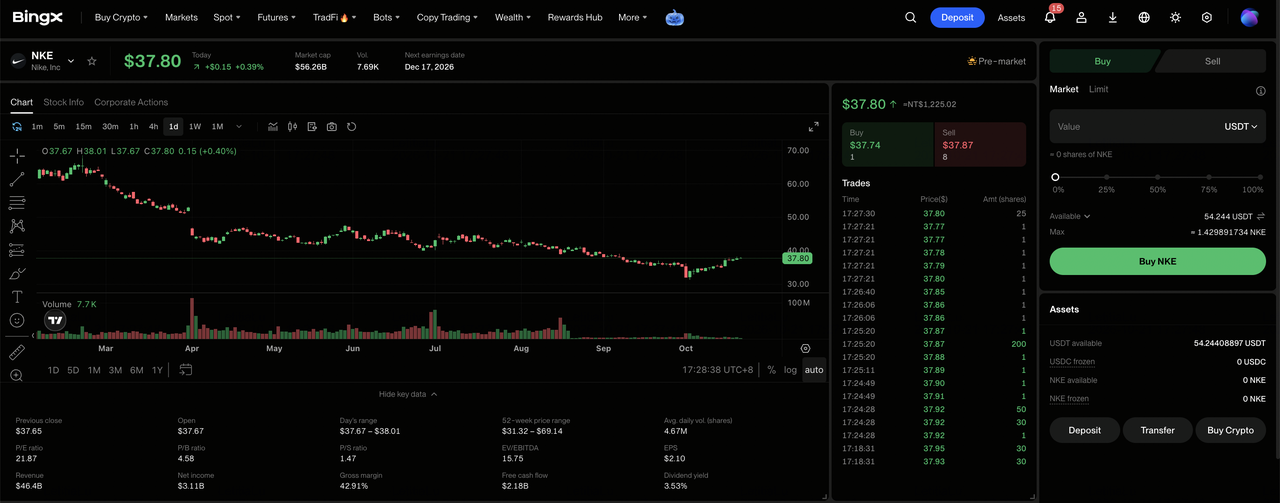
Step 1: Access BingX Stocks Trading. Sign up or log in to BingX, complete the required identity verification, and navigate to "TradFi > Stocks". Accept the Stock Trading Risk Disclosure if accessing the product for the first time.
Step 2: Prepare USDT or USDC. Ensure your Spot Account has sufficient funds for the purchase. Transfer USDT or USDC from your Fund or Wealth Account if needed. Fractional purchases start from 5 USDC or 0.0001 shares.
Step 3: Select Nike (NKE). Open the Stocks market, search for NKE, and select Nike (NKE). Review the current share price, trading session, and available order types.
Step 4: Buy Nike Shares. Select "Buy", enter the investment amount or share quantity, and choose a market or limit order. Market orders execute at available prices during supported trading hours, while limit orders execute at the specified price or better when sufficient liquidity is available.
Step 5: Review and Manage Your Holdings. Open "Stocks > Positions" to monitor your NKE shares and unrealized profit or loss. Use "All Orders" to review transactions or sell shares when needed. T+1 settlement generally affects when sale proceeds become available for withdrawal, rather than when shares can be sold.
Top 5 Risks to Watch for Nike Investors in 2026
Nike's global brand strength, improving performance footwear demand, and ongoing restructuring support its recovery outlook. However, weakness in Greater China, lifestyle product demand, margin pressure, and the timing of cost savings remain important factors determining how quickly sales and profitability can recover.
- Greater China's weakness could delay revenue recovery. Q1 revenue fell 26% currency neutral to $1.180 billion, a $332 million decline. Prolonged adjustments across Tmall, JD, and Douyin could pressure regional sales and profitability as Nike restructures its distribution network.
- Sportswear and Jordan declines could offset performance growth. Sportswear revenue fell low double digits, while Jordan, representing 13% of global sales, declined mid-teens. Reducing retro product supply may strengthen brand positioning but could limit near-term sales and earnings.
- Pace restructuring costs could delay margin improvement. Nike targets $2.5 billion in cumulative savings through FY2031 against approximately $1.0 billion in implementation charges. Delays or additional reinvestment could reduce the expected benefits to margins and cash flow.
- Continued discounting could reverse gross-margin gains. Q1 gross margin improved 60 basis points to 42.8%, partly through logistics savings and favorable currency movements. Weaker full-price demand or further price reductions could offset these improvements and limit profitability.
- Wholesale growth may not reflect stronger consumer demand. North America wholesale rose 9% currency neutral, while Direct declined 6% and global NIKE Brand Digital fell 13%. Shifting sales between channels without stronger overall demand could weaken revenue mix and limit a sustained recovery.
Final Thoughts: Should You Invest in Nike in 2026?
Nike's sport engine is producing growth, with performance up high single digits from a $16 billion fiscal 2026 base and Running and Global Football up double digits. Its first-quarter results also show a company still in transition: revenue fell 4%, China declined 26% currency neutral, and Direct contracted 9%. The 42.8% gross margin and $8.4 billion of cash and short-term investments provide time to repair the assortment, not proof that consolidated demand has recovered.
The $55 Bull Case depends on performance products restoring full-price sales and narrowing the China decline; the $25 Bear Case gains weight if margins weaken and fiscal 2027 EPS guidance falls below $1.15. Conservative traders can watch the November investor day, subsequent China and Direct trends, and whether gross margin holds above 42% as Nike works through the high-single-digit sales decline it has guided for the year.
Risk Reminder: Trading and investing in equities like NKE involves a high risk of capital loss. Consumer demand, China execution, competition, inventory, restructuring costs and leveraged perpetual contracts can produce rapid losses. Conduct independent research before allocating capital.
Related Reading
- Walmart (WMT) Price Prediction 2026: Can E-Commerce and Advertising Push WMT Toward $155?
- Costco (COST) Price Prediction 2026: Can Membership Growth Push COST Toward $1,200?
- McDonald's (MCD) Price Prediction 2026: Can Better Value Execution Push MCD Toward $350?
- AMC Stock Price Prediction 2026: Fundamental Turnaround or Massive Dilution Trap?
- Ferrari (RACE) Price Prediction 2026: Can Luxury Demand and Personalization Push RACE Toward $525?
