

Mastercard Incorporated (MA) entered March 2026 riding the momentum of a record-breaking 2025, where net revenues climbed 18% to $8.8 billion in Q4 alone. With the global shift from cash to digital nearing a tipping point, Mastercard is no longer just a card network; it is an AI-driven security and data ecosystem. The company is aggressively targeting the $150 trillion B2B payment market, where digital adoption is finally hitting a super-cycle.
By March 2026, Mastercard’s Value-Added Services (VAS), including cybersecurity and data analytics, have grown to represent nearly 40% of total revenue. While the stock has faced some volatility early in the year, down roughly 9.3% YTD, institutional sentiment remains robust. Tigress Financial recently raised its price target to $735, citing the company’s Research Focus List status, while Raymond James maintains a more conservative $631 target, balancing growth against a $200 million restructuring charge intended to pivot the workforce toward AI and stablecoin infrastructure.
The Mastercard stock forecast for 2026 is defined by two competing narratives:
- The Services Alpha: High-margin services are growing at 22-26% YoY, decoupled from transaction volume, providing a moat against economic slowdowns.
- The Portfolio Flip: Significant headwinds loom as major partners like Capital One (debit) and Lloyds UK (credit) shift portions of their portfolios to Visa, potentially weighing on U.S. volume growth.
For traders, MA stock in 2026 offers a high-growth Quality play with a $16.7 billion remaining buyback authorization. This guide breaks down the MA stock price prediction for 2026 using data from Zacks, Tigress Financial, and Nasdaq, and how to trade Mastercard (MA) stock on BingX.
Top 5 Things for Mastercard Investors to Know in March 2026
- The $150 Trillion B2B Opportunity: Digital adoption in B2B is accelerating, with Mastercard's virtual card volume projected to grow 19.3% this year.
- Agentic Commerce: Mastercard is leading the guardrail development for AI agents that can authorize and execute payments autonomously on behalf of users.
- Cross-Border Resilience: Despite global fragmentation, cross-border assessments grew 18.1% in late 2025, fueled by a permanent shift toward experience-based travel.
- Stablecoin Integration: Increased regulatory clarity in the US/EU has allowed Mastercard to scale Crypto-to-Fiat gateways for real-time merchant settlement.
- Restructuring for Efficiency: A Q1 2026 restructuring charge of $200 million is being viewed by bulls as a necessary trimming of the sails to fund next-gen AI investments.
What Is Mastercard (MA)?
Mastercard is a global technology company in the payments industry. Unlike banks, Mastercard does not issue cards or extend credit; instead, it operates the world’s fastest payments processing network, connecting consumers, financial institutions, and merchants in more than 210 countries.
In 2026, Mastercard has rebranded itself as a Logistics Engine for Value. Through its partnership with global cloud providers, it uses AI to predict fraud before it happens and provides Tokenization-as-a-Service, replacing sensitive card data with secure digital tokens. This makes the network virtually impenetrable compared to legacy cash-heavy systems.
Mastercard (MA) Stock Performance in 2025: A Recap
Reflecting on its recent history, Mastercard’s 2025 performance was a masterclass in operating leverage and ecosystem diversification. While the broader fintech sector grappled with higher-for-longer interest rates and a slowdown in discretionary retail, Mastercard gained 16% for the year, significantly outpacing the Business Services sector’s average.
The core of this outperformance wasn't just transaction volume; it was the decoupling of revenue from swipes. By pivoting toward a Services-First model, Mastercard converted macro volatility into a competitive moat, maintaining a net margin of 45.65%, a figure nearly unparalleled in the S&P 500.
Mastercard Stock 2025 Key Performance Benchmarks and Highlights
- Gross Dollar Volume (GDV) Milestone: The network processed a record $10.6 trillion in GDV, an 8.7% year-over-year increase, proving that the secular shift to digital still has a long runway in emerging markets.
- The Services Alpha: Value-Added Services (VAS) grew by 22.9%, significantly faster than core payment processing. This segment, which includes cybersecurity tools and data analytics, provided a high-margin buffer against fluctuating consumer spending.
- Cross-Border Dominance: Cross-border assessments jumped 18.1% in 2025. These transactions are high-yield crown jewels for Mastercard, as they carry significantly higher fees than domestic transactions.
- Shareholder Yield: The company returned $11 billion to investors via $8.2 billion in buybacks and $2.8 billion in dividends. This aggressive buyback program effectively reduced the share count, boosting EPS even when top-line growth faced regional headwinds.
- Operational Efficiency: Despite a 14.3% increase in operating expenses driven by AI scaling, the company achieved an operating margin of 58.4% on an adjusted basis, showcasing extreme efficiency in its toll-booth business model.
By December 2025, Mastercard had generated $17.6 billion in operating cash flow, up from $14.8 billion in 2024. This massive liquidity cushion allowed the company to absorb the strategic exit of the Capital One debit portfolio, a volume loss that would have crippled a less diversified firm, without a significant de-rating of its stock. This financial bulletproofing in 2025 provided the necessary R&D capital for the 2026 pivot into Agentic Commerce and Commercial B2B dominance.
Mastercard vs. Visa vs. PayPal: Which Fintech Stock to Trade in 2026?
|
Feature |
Mastercard (MA) |
Visa (V) |
PayPal (PYPL) |
|
Business Model |
Services-Led / B2B Growth |
Scale-Dominant / Infrastructure |
Consumer-First Digital Wallet |
|
2026 Context |
$100T B2B Commercial Pivot |
Beneficiary of Portfolio Flips |
Agentic Commerce Turnaround |
|
Primary Catalyst |
VAS Growth (26% YoY) |
Cross-Border Volume Yields |
Venmo Scaling & Stablecoin (PYUSD) |
|
Forward P/E Ratio |
31.1x |
29.8x |
8.3x |
|
Projected EPS Growth |
15.8% (CAGR) |
12.5% (CAGR) |
0.56% (Near-term) |
|
Net Margin |
45.60% |
50% |
15-18% |
In 2026, the divergence between these three giants is driven by margin quality vs. pure volume. Mastercard is the alpha choice for growth-oriented traders, sporting a superior 15.8% EPS CAGR projection through 2028, fueled by its aggressive capture of the $100 trillion B2B plumbing. While Visa remains the defensive volume king, set to benefit from the migration of massive portfolios like Capital One and Lloyds UK, it lacks Mastercard’s high-margin Value-Added Services (VAS) density, which now commands 40% of MA's revenue. For traders, MA offers higher volatility but a more potent Services-First catalyst, whereas Visa acts as a lower-beta stabilizer with a slightly cheaper 29.8x P/E.
PayPal, meanwhile, represents a high-risk, high-reward Value Recovery play. Trading at a deep-discount 8.3x Forward P/E, it is priced for a Sell, yet its $5.34 EPS floor and 100 million active Venmo accounts offer a massive springboard for a 2026 Agentic Commerce turnaround. While MA and Visa duke it out over infrastructure and institutional cross-border flows, PayPal is the speculative bet on the front-end consumer experience and its PYUSD stablecoin adoption. The practical move: Trade MA for secular growth, Visa for defensive stability, and PayPal for a low-cost volatility play on retail sentiment.
Practical Tip: In 2026, MA is the superior instrument for trading the Institutional Digitization narrative. Visa is the go-to for low-risk exposure to global transaction growth, while PayPal is strictly for contrarian traders betting that the global fintech market has over-discounted its 2026 recovery potential.
Mastercard (MA) 2026 Investment Outlook: The B2B Ramp vs. U.S. Headwinds
The 2026 forecast is a high-stakes battle between a multi-trillion-dollar technical pivot and near-term regional market share shifts. While the core consumer network remains a cash cow, Mastercard is aggressively re-engineering its DNA to capture non-carded flows.
The Bull Case: The $100 Trillion Commercial Pivot to $958
Mastercard is successfully consumerizing the notoriously clunky B2B sector. By March 2026, nearly 70% of global B2B invoices have shifted to electronic formats, and Mastercard’s Virtual Card engine is the primary beneficiary. With Mastercard Move now reaching 17 billion endpoints, the company is capturing a massive slice of the $77 trillion uncarded B2B market. By embedding payment data directly into SAP and Coupa procurement platforms, MA is driving a 35% surge in transaction volume within its commercial segment, justifying its premium 31.1x P/E through superior margin expansion.
Given this B2B inflection point and the compounding effect of its high-margin services, some aggressive analyst models, such as the TIKR Advanced Model, suggest a technical price target as high as $958 by the end of 2026. This represents a staggering 83% upside from current levels, predicated on B2B revenue growth outpacing volume growth by a factor of 2x as lucrative value-added services are layered onto every commercial transaction.
The Bear Case: The Volume Gap and Regulatory Drag to $480 Support
Near-term headwinds are concentrated in the U.S. and U.K. retail sectors. The high-profile migration of Capital One’s debit portfolio and Lloyds UK’s credit accounts to Visa has created a temporary volume vacuum. Analysts at Jefferies project Mastercard’s U.S. domestic growth could cool to 4% in H1 2026, a significant deceleration from double-digit historical norms. Furthermore, with operating expenses rising 14.3% and a $200 million restructuring charge hitting the books, any delay in B2B revenue realization could lead to a short-term valuation de-rating toward the $480 support zone.
The Base Case: The Services-First Stabilizer to $662
In a neutral macro environment, Mastercard’s VAS act as a high-margin floor. Even if transaction volumes face friction, the 26% growth in cybersecurity and data consulting, which now accounts for 40% of total revenue, insulates the bottom line. With a Zacks Consensus EPS of $19.39 and a steady 13.99% growth forecast, the stock is likely to gravitate toward the $662 mid-point, supported by an aggressive $16.7 billion buyback program that provides a persistent tailwind for earnings per share.
Mastercard Stock Price Forecasts for 2026: Bull vs. Bear Outlook
|
Source/Institution |
2026 Price Target |
Market Outlook |
|
Tigress Financial |
$735.00 |
Super-Bullish: Cites shift to digital and VAS growth. |
|
BofA Securities |
$700.00 |
Bullish: Strong execution in diversified global model. |
|
Zacks Consensus |
$662.78 |
Neutral/Buy: Implies ~26% upside from current dip. |
|
Raymond James |
$631.00 |
Cautious: Outperformance due to tax/grant benefits. |
|
Technical Support |
$520.00 |
Baseline: Key support level tested in Jan 2026. |
|
Bear Case Target |
$480.00 |
Bearish: If regulatory caps on swipe fees intensify. |
How to Trade Mastercard (MA) Stock on BingX
Leverage BingX AI’s real-time sentiment analysis to track institutional whale movements in the payments sector during the 2026 earnings season.
Buy, Sell, or HODL Mastercard Tokenized Stock (MAON) on BingX Spot
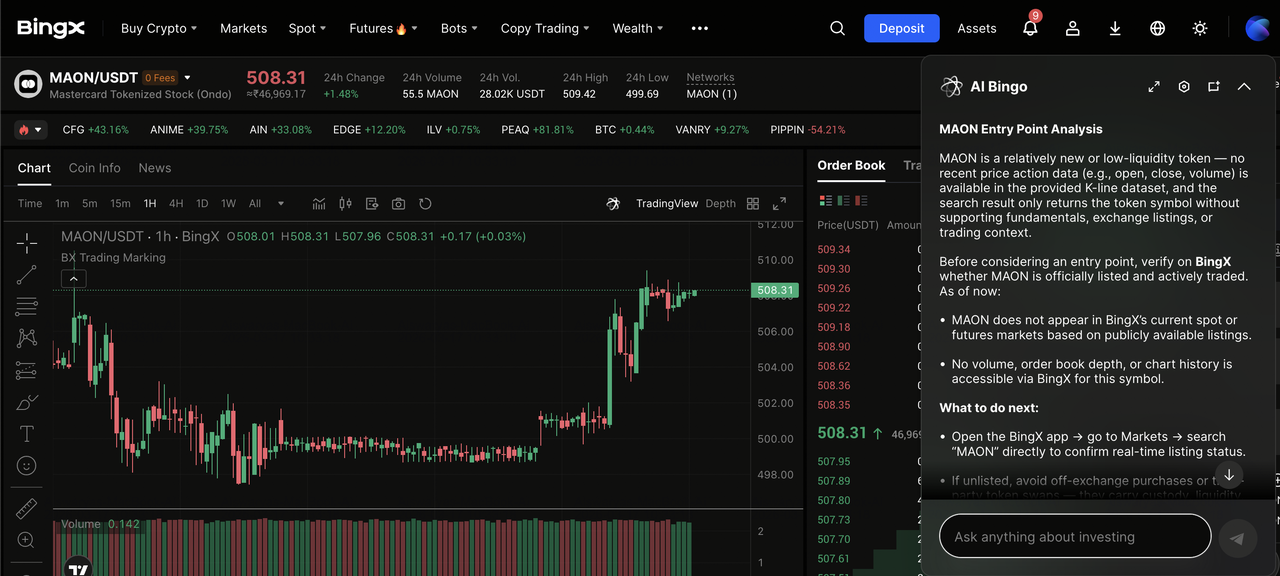
MAON/USDT trading pair on the spot market with BingX AI insights
React to 24/7 global news before the NYSE opens by trading Ondo's tokenized Mastercard stock MAON.
- Locate Pair: Navigate to Spot Market and search for MAON/USDT.
- Select Order Type: Use a Limit Order for precise entry at technical support levels.
- Execute: Enter USDT amount and click Buy MAON.
5 Key Risks for Mastercard Traders to Monitor in 2026
While Mastercard’s B2B pivot offers explosive upside, traders must navigate a complex landscape of regulatory headwinds and structural shifts that could trigger sudden liquidity exits.
- The Interchange Ceiling: Watch for updates on the Credit Card Competition Act and the U.K. Payment Systems Regulator’s fee caps. If multilateral interchange fees are slashed by legislation, Mastercard’s primary revenue engine, the swipe fee, could face a structural de-rating, potentially shaving 2-3% off net margins in key regions.
- Portfolio Attrition Aftershocks: The transition of Capital One’s debit and Lloyds UK’s credit portfolios to Visa is not just a volume loss; it is a test of Mastercard’s resilience. Monitor the Q3 2026 earnings report for incentives and rebates as a percentage of revenue; if Mastercard is forced to spend more to retain existing bank partners, expect a compression in operating income.
- Restructuring ROI: The $200 million restructuring charge taken in early 2026 is a bet on an AI-first workforce. Traders should look for operating expense (OpEx) stabilization by Q4; if expenses continue to rise at a double-digit clip like +14.3% in 2025 without a corresponding bump in Services' revenue, the market may lose faith in management’s efficiency narrative.
- The Tokenization Single Point of Failure: As Mastercard moves toward a 100% tokenized network, its security reputation is its greatest asset. Any high-profile breach of the Tokenization engine or the Crypto-to-Fiat gateway would not just be a legal hurdle but would also trigger a massive institutional sell-off as the Safety Premium baked into the 31x P/E multiple evaporates.
- Alternative Rail Disintermediation: The scaling of real-time payment (RTP) rails like FedNow (USA), PIX (Brazil), and UPI (India) represents a long-term leak in the network. If these government-backed systems capture significant market share in low-value peer-to-peer or merchant transfers, Mastercard’s Gross Dollar Volume (GDV) growth could stall, forcing a shift in the stock’s valuation from a Growth to a Value play.
Conclusion: Should You Invest in Mastercard (MA) in 2026?
Mastercard’s 2026 trajectory represents a strategic pivot toward becoming the indispensable infrastructure for the $100 trillion corporate economy. While the stock carries a premium 31.1x P/E, this valuation is increasingly supported by high-margin VAS rather than just consumer transaction volume. For long-term investors, the target return of up to 83.4%, as suggested by aggressive B2B scaling models, makes MA a premier buy-and-hold asset. The company’s ability to generate $17.6 billion in operating cash flow provides a significant safety net, allowing it to fund AI innovation while maintaining a robust $16.7 billion share buyback program.
However, the near-term path for active traders will likely be defined by technical support and regulatory newsflow. Success in 2026 requires monitoring the $520 support level and the efficiency of the $200 million restructuring effort. If Mastercard can successfully card the massive B2B whitespace while sustaining its 45.6% net margins, it will likely decouple from the broader fintech sector's volatility. Traders should weigh the potential for a $958 bull case against the reality of portfolio attrition to Visa, maintaining a disciplined approach to entry points as the Services-First narrative matures.
Risk Reminder: All investments involve risk. Despite its dominant market position, Mastercard is subject to intense regulatory scrutiny, commodity-driven spending shifts, and competition from real-time payment rails. Use stop-losses and stay updated on quarterly earnings reports, as the rebates and incentives metrics often trigger significant sentiment shifts in the payments sector.
Related Reading
- Coinbase (COIN) Stock Forecast for 2026: Can the Everything Exchange Take COIN Back to $300?
- Circle (CRCL) Stock Outlook for 2026: Can USDC Growth and Dominance Drive CRCL Stock to $250+?
- Robinhood Stock Forecast 2026: $130 Hyper-Growth or Valuation Correction?
- Alphabet (GOOGL) Stock Outlook 2026: Can Gemini and Google Cloud AI Drive GOOGL Cross $420?
- Top x402 Payment Protocol Projects for Blockchain-Based AI Agents
