

Johnson & Johnson (JNJ) entered mid-July 2026 on track for the biggest milestone in its 140-year history. On July 15, the company reported second-quarter sales of $25.31 billion and adjusted EPS of $2.90, both ahead of consensus, then raised full-year guidance to sales of $100.8 billion to $101.4 billion and adjusted EPS of $11.60 to $11.75. JNJ shares traded near $255 after the print, up roughly 25% year to date and close to a 52-week high of $269.43.
The quarter was carried by one segment. Innovative Medicine grew 7.8% to $16.38 billion with oncology up 17.3% to $7.41 billion, enough to absorb a Stelara decline that alone cost the segment roughly 760 basis points of growth. MedTech was the soft spot, up 4.5% to $8.93 billion, held back by cardiovascular where electrophysiology and Abiomed weighed on results. The stock dipped on the day despite the beat, which tells you the bar was already high.
The JNJ stock forecast for 2026 now centers on two competing views:
- The innovation case: Bulls expect oncology momentum, Tremfya's first $2 billion quarter and a deep launch pipeline to drive J&J past $100 billion in annual revenue and toward double-digit growth by decade's end, with analyst targets ranging as high as $300.
- The overhang case: Bears see 68,435 unresolved talc claims with no settlement on the table, continued Stelara erosion, and a MedTech segment growing at less than half the pace of pharma.
This guide breaks down the JNJ stock forecast, 2026 price scenarios, and key risks using the July 15 earnings release, the Q2 investor call, and research from TD Cowen, Citi, RBC Capital, Morgan Stanley, BofA and Stifel, along with how to trade JNJ stock futures on BingX TradFi with USDT collateral.
Top 5 Things for JNJ Investors to Know in July 2026
- Q2 sales of $25.31 billion and adjusted EPS of $2.90 beat consensus: Reported sales grew 6.6% with operational growth of 5.6%, against estimates near $25.05 billion and $2.85. GAAP EPS was $2.27, down slightly from $2.29 a year earlier.
- Full-year guidance was raised twice over: J&J lifted 2026 sales guidance to $100.8 billion to $101.4 billion and adjusted EPS to $11.60 to $11.75, putting the company on course to become the first healthcare company to deliver $100 billion in annual revenue.
- Oncology grew 17.3% and Tremfya hit its first $2 billion quarter: Cancer drug sales reached $7.41 billion led by Darzalex, Carvykti, Tecvayli and Rybrevant, while Duato noted that excluding Stelara, J&J grew double digits in the quarter.
- MedTech was the weak link at 4.5% growth: The segment delivered $8.93 billion with only 3.6% operational growth, dragged by cardiovascular as electrophysiology and Abiomed underperformed, though surgery, vision and orthopedics accelerated.
- Talc litigation stands at 68,435 MDL claims with no settlement pending: After a third failed bankruptcy attempt, J&J withdrew its roughly $7 billion settlement offer and is now defending claims in court, with the first federal bellwether trial approaching.
What Is Johnson & Johnson (JNJ)?
Johnson & Johnson is the world's largest healthcare company, headquartered in New Brunswick, New Jersey, with roughly 140,000 employees. Following the 2023 spinoff of Kenvue, the consumer health business, J&J operates two segments: Innovative Medicine, which covers pharmaceuticals across oncology, immunology and neuroscience, and MedTech, which covers medical devices across surgery, orthopedics, vision and cardiovascular.
The scale of the portfolio is the defence. J&J has 28 products and platforms each generating more than $1 billion in annual sales, which is what allowed a Stelara collapse worth 760 basis points of segment growth to be absorbed inside a quarter that still beat and raised. Under CEO Joaquin Duato, capital has moved toward high-science therapeutic areas, with oncology now the clear engine at $7.41 billion in quarterly sales growing 17.3%. The company remains on track for roughly $21 billion in full-year free cash flow, and is a Dividend King with 64 consecutive years of increases yielding around 2%. A strategic separation of the Orthopaedics business is underway, continuing the simplification that began with Kenvue.
Johnson & Johnson (JNJ) Q2 2026 Earnings: What Drove the Beat and the Guidance Raise
- Oncology did the heavy lifting. Cancer drug sales rose 17.3% to $7.41 billion, or 16.1% operationally, led by Darzalex, Carvykti, Tecvayli and Rybrevant with Lazcluze.
- Tremfya crossed $2 billion in a quarter for the first time. The immunology asset also won approval to inhibit the progression of structural joint damage in active psoriatic arthritis, extending its label.
- Stelara erosion was severe but contained. Biosimilar competition cut roughly 760 basis points from Innovative Medicine growth, yet the segment still grew 7.8% to $16.38 billion. Excluding Stelara, Duato said the company grew double digits.
- New launches began contributing. Icotyde and Inlexzo added incremental revenue, with Inlexzo benefiting from the permanent reimbursement code secured in April.
- MedTech split three ways. Surgery, vision and orthopedics all accelerated while cardiovascular dragged, with electrophysiology and Abiomed the specific weak points inside a segment that grew 4.5% to $8.93 billion.
Johnson & Johnson Q2 2026 Financial and Consensus Profile: Sales, EPS and Segments
J&J's Q2 print showed a company beating on both lines while raising guidance twice in two quarters, yet the stock fell on the day. The reason sits in the mix rather than the totals: pharma is outrunning expectations and MedTech is not.
|
Financial Metric |
Consensus Estimate |
Reported / Actual |
Surprise |
|
Q2 2026 Sales |
~$25.05 billion |
$25.31 billion |
Beat; reported growth of 6.6%, operational growth of 5.6% |
|
Q2 2026 Adjusted EPS |
~$2.85 |
$2.90 |
Beat; up 4.7% year over year |
|
Q2 2026 GAAP EPS |
— |
$2.27 |
Down from $2.29 a year earlier; net earnings of $5.5 billion |
|
Q2 2026 Innovative Medicine |
— |
$16.38 billion |
Up 7.8%; 6.8% operational despite Stelara drag |
|
Q2 2026 Oncology |
— |
$7.41 billion |
Up 17.3%; the primary growth engine |
|
Q2 2026 MedTech |
~$8.96 billion |
$8.93 billion |
Roughly in line; up 4.5%, only 3.6% operational |
|
Q2 2026 Immunology |
— |
$3.84 billion |
Down 3.7%; Stelara erosion outweighed Tremfya strength |
|
FY2026 Sales Guidance |
~$101.02 billion |
$100.8 to $101.4 billion |
Raised from $100.3 to $101.3 billion |
|
FY2026 Adjusted EPS Guidance |
~$11.59 |
$11.60 to $11.75 |
Raised from $11.45 to $11.65; above consensus |
For context, Q1 2026 delivered revenue of $24.06 billion, up 9.9%, with adjusted EPS of $2.70 against a $2.68 consensus, and also prompted a guidance raise. Full-year 2025 sales were $94.2 billion, up 6%, with diluted EPS of $11.03. U.S. sales grew 7.3% in Q2 while sales outside the U.S. grew 3.4%. The stock trades at a forward P/E near 21, above the sector average near 18.5 and well above its own five-year mean near 15.7.
Johnson & Johnson (JNJ) 2026 Investment Outlook: $300 Bull Case vs. $190 Bear Case
JNJ’s outlook for the rest of 2026 depends on one question: whether stronger growth beyond Stelara and raised guidance justify a premium valuation, or whether unresolved talc litigation continues to cap the stock.
The Bull Case: Oncology Momentum and Pipeline Growth Push JNJ Toward $300
The bull case rests on the resilience of the underlying portfolio. J&J absorbed a 760-basis-point drag from Stelara and still beat revenue and earnings expectations while raising guidance. Oncology revenue reached $7.41 billion, up 17.3%, Tremfya surpassed $2 billion, and management said the company delivered double-digit growth excluding Stelara. That suggests the most difficult part of the patent cliff may already be passing.
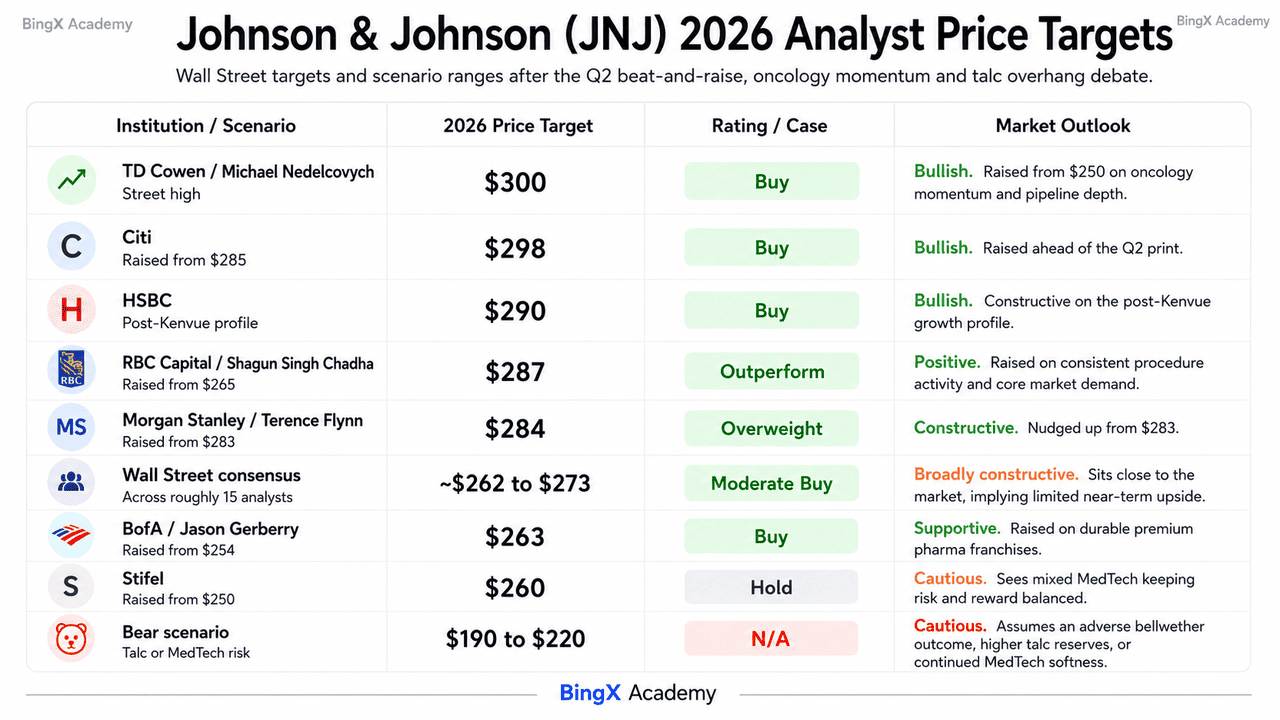
This scenario also requires MedTech growth to improve. TD Cowen raised its target to $300, Citi moved to $298, RBC reached $287, and Morgan Stanley sits at $284. Tremfya, Caplyta, THERMOCOOL, Rybrevant Faspro, Talvey, Darzalex Faspro, and Ottava provide additional second-half catalysts. Annual revenue above $100 billion, roughly $21 billion in free cash flow, and a 64-year dividend growth record would strengthen the case for a higher multiple.
The Base Case: JNJ Consolidates Between $246 and $270
In the base case, J&J delivers its raised guidance without a major valuation expansion. Full-year sales finish near $101.1 billion, adjusted EPS lands within the $11.60 to $11.75 range, and the talc litigation continues without a decisive resolution.
The stock then trades mainly on its dividend, cash flow, and defensive profile. Analyst targets cluster around $246 to $273, close to the current price. A yield near 2%, beta near 0.34, and 28 billion-dollar platforms provide support, while a forward P/E near 21 versus a five-year average near 15.7 limits upside. That points to a range between the lower consensus targets and the $269.43 high.
The Bear Case: Talc Litigation and MedTech Weakness Pull JNJ Toward $190
The bear case depends more on the courts than on drug performance. J&J’s third bankruptcy attempt failed, the company withdrew its roughly $7 billion settlement proposal, and more than 68,000 MDL claims remain unresolved. Recent trial losses and estimates that the eventual cost could reach $11 billion keep the legal overhang firmly in place.
The first federal bellwether trial is the key risk. A favorable ruling could narrow the docket, while an adverse outcome could weaken J&J’s procedural defense and force higher reserves. Combined with slower MedTech growth, Medicare pricing pressure, and Morningstar’s $190 fair value estimate, the stock could de-rate toward the low $200s before testing the $190 area.
JNJ Stock Price Forecasts for 2026 By Wall Street Analysts
Wall Street is constructive but clustered close to the current price, which is unusual after a beat-and-raise. Ratings run roughly 11 Buy to 4 Hold with a Moderate Buy consensus, and the dispersion reflects disagreement about the talc discount rather than the business.
|
Institution |
2026 Price Target |
Rating |
Market Outlook |
|
TD Cowen / Michael Nedelcovych |
$300 |
Buy |
Street high. Raised from $250 on oncology momentum and pipeline depth. |
|
Citi |
$298 |
Buy |
Bullish. Raised from $285 ahead of the Q2 print. |
|
HSBC |
$290 |
Buy |
Bullish. Constructive on the post-Kenvue growth profile. |
|
RBC Capital / Shagun Singh Chadha |
$287 |
Outperform |
Positive. Raised from $265 on consistent procedure activity and core market demand. |
|
Morgan Stanley / Terence Flynn |
$284 |
Overweight |
Constructive. Nudged up from $283. |
|
Wall Street consensus |
~$262 to $273 |
Moderate Buy |
Broadly constructive. Sits close to the market, implying limited near-term upside. |
|
BofA / Jason Gerberry |
$263 |
Buy |
Supportive. Raised from $254 on durable premium pharma franchises. |
|
Stifel |
$260 |
Hold |
Cautious. Raised from $250, but sees mixed MedTech keeping risk and reward balanced. |
|
Bear scenario |
$190 to $220 |
N/A |
Cautious. Assumes an adverse bellwether outcome, higher talc reserves, or continued MedTech softness. |
How to Trade Johnson & Johnson (JNJ) Stock on BingX
Navigate the volatility of Johnson & Johnson's earnings cycle using BingX TradFi and BingX AI tools. By leveraging AI-driven predictive analytics, you can better anticipate market sentiment shifts and price action around quarterly releases.
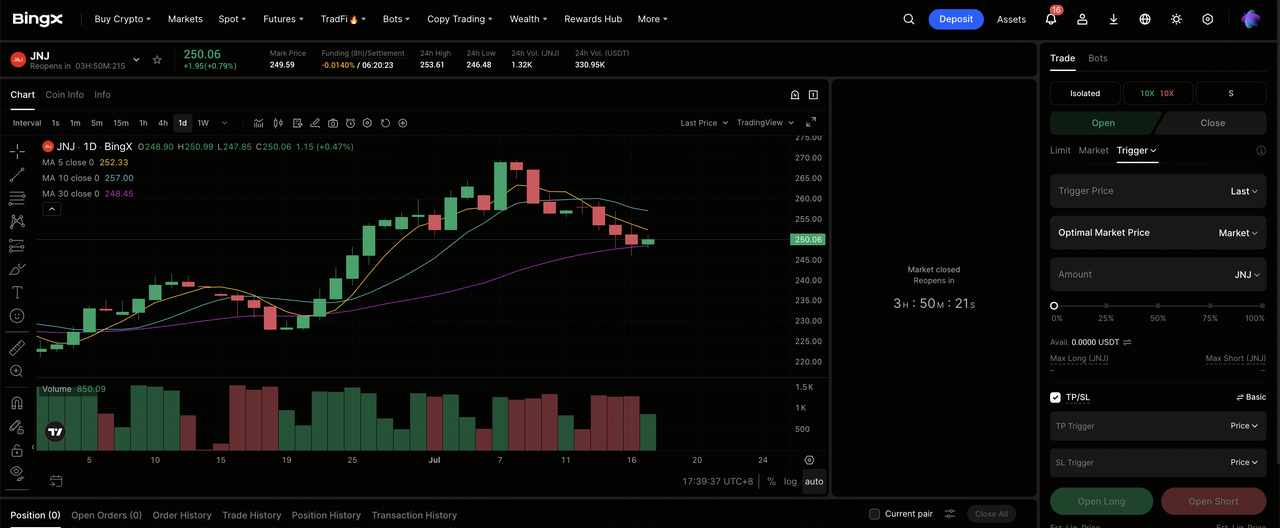
Step 1: Access BingX TradFi. Sign up and navigate to the specialized TradFi section on the main BingX exchange dashboard.
Step 2: Select Johnson & Johnson (JNJ). Search for and select the JNJ-USDT perpetual futures contract.
Step 3: Choose your direction. Select Open Long if you expect oncology momentum to carry J&J past $100 billion in sales, MedTech to reaccelerate as cardiovascular stabilizes, and the talc docket to narrow on the causation motion. Select Open Short if you expect an adverse bellwether outcome to force higher reserves, Stelara erosion to outrun new launches, or a forward P/E near 21 to compress toward its five-year mean.
Step 4: Select leverage and margin mode. Choose Isolated or Cross-Margin based on your risk tolerance. Because JNJ carries a beta near 0.34 but reacts sharply to single court rulings, conservative leverage and clear position sizing are important.
Step 5: Execute strict risk protocols. Set Take-Profit and Stop-Loss (TP/SL) levels before or immediately after entering the trade. JNJ can react quickly to quarterly earnings, talc verdicts and bellwether rulings, FDA approvals and clinical data, Medicare price negotiation headlines, and the Orthopaedics separation timeline.
Top 5 Risks to Watch for JNJ Investors in 2026
To navigate the second half of 2026, investors must weigh J&J's oncology velocity and raised guidance against these five structural and legal headwinds.
- The talc docket has no settlement path: With 68,435 MDL claims pending, a third bankruptcy attempt denied and the roughly $7 billion offer withdrawn, J&J now defends claims individually. It has lost the first two ovarian cancer trials since the pause lifted, and Bloomberg Intelligence has suggested the eventual cost could reach $11 billion.
- MedTech is growing at less than half the pace of pharma: The segment managed 3.6% operational growth against 6.8% for Innovative Medicine, with cardiovascular, electrophysiology and Abiomed the drags. A one-engine company is a more fragile company.
- Stelara erosion has not finished: Biosimilars removed roughly 760 basis points from Innovative Medicine growth this quarter alone, and immunology fell 3.7% overall despite Tremfya's record. Opsumit and Simponi represent the next patent considerations.
- The valuation sits well above its own history: A forward P/E near 21 compares with a five-year mean near 15.7 and a sector average near 18.5. Morningstar has flagged the stock as trading at a large premium to its $190 fair value estimate.
- Medicare price negotiation is now a live margin headwind: Negotiated prices on top sellers including Stelara and Xarelto compress margins that J&J must offset through volume growth in newer therapies rather than pricing.
Final Thoughts: Should You Invest in Johnson & Johnson in 2026?
Johnson & Johnson after the July 15 report is a story of a portfolio that proved its resilience and a stock the market has already priced for it. Sales of $25.31 billion, adjusted EPS of $2.90, oncology up 17.3%, Tremfya's first $2 billion quarter, a guidance raise on both lines, and a path to the first $100 billion year in company history are not in dispute. What is in dispute is what an investor should pay for a business carrying 68,435 unresolved claims with no settlement mechanism and a second engine growing at 3.6%.
The bull case is that the Stelara cliff is now behind J&J rather than ahead, that the oncology and immunology pipeline supports the double-digit growth management is targeting by decade's end, and that roughly $21 billion of free cash flow and a 64-year dividend streak pay investors to wait. The bear case, reflected in a consensus that sits close to the market after a beat-and-raise, is that a forward P/E near 21 against a five-year mean near 15.7 already assumes the talc overhang resolves favourably. Investors who believe the litigation caps out near current reserves may find the franchise the highest-quality defensive holding in healthcare. More conservative traders might wait for the first federal bellwether outcome before adding, using the $246 consensus floor and the $269.43 high as the levels that define the range.
Risk Reminder: Trading and investing in equities like JNJ involves a high risk of capital loss. The company's performance is sensitive to unpredictable legal rulings, FDA clinical outcomes and federal drug pricing regulation, any of which can move the stock independently of its earnings. Conduct independent research before allocating capital.
Related Reading
- IBM (IBM) Price Prediction 2026: Can IBM Recover From the 25% Drop After a Q2 Revenue Miss?
- ASML (ASML) Price Prediction 2026: Can a Third Guidance Raise Push ASML Past $2,000?
- UnitedHealth (UNH) Stock Price Prediction 2026: AI-Driven Recovery or Regulatory Trap at $306?
- Abbott Laboratories (ABT) Price Prediction 2026: MedTech Recovery or $70M Legal Anchor?
- JPMorgan Chase (JPM) Price Prediction 2026: Fortress Defense or AI-Driven Alpha at $341?
- Goldman Sachs (GS) Price Prediction 2026: Record Quarter Momentum or Valuation Ceiling at $1,140?
