

By mid-March 2026, Hyperliquid has redefined the DeFi landscape. While established altcoins struggled with low volatility, HYPE surged 25% year-to-date, driven by a 97% fee-buyback mechanism that effectively turns protocol revenue into token scarcity. Following the launch of HIP-4 for Outcome Trading and record Crude Oil volume exceeding $1.1 billion in a single session, HYPE is currently trading above $38 with a market cap approaching $10 billion as of mid-March 2026.
The HYPE price prediction for 2026 is currently divided into two camps: the Revenue-Driven Bulls who see the Layer-1 (L1) blockchain as a Binance Killer and the Technical Bears who warn of ongoing token unlocks and validator centralization. For traders, this creates a high-yield environment supported by organic trading volume and a buy wall generated by the protocol’s own fees.
This guide explores HYPE forecasts from CoinCodex, Arthur Hayes, and other analysts, alongside real-time on-chain metrics. You will also learn how to trade these moves in HYPE token on BingX.
Top 5 Things to Know About Hyperliquid (HYPE) in March 2026
- Revenue Dominance: Hyperliquid is currently the top-earning protocol (excluding stablecoins), generating over $54 million in fees from mid-February to mid-March in 2026.
- The Hayes Target: BitMEX co-founder Arthur Hayes predicts HYPE will hit $150 by August 2026, citing a potential $1.4 billion in annualized revenue.
- HIP-3 Surge: Open Interest (OI) for permissionless Real-World Assets (RWA) like Crude Oil and Gold hit an All-Time High of $1.33 billion in March 2026.
- Portfolio Margin: The rollout of the Alpha phase for portfolio margin allows professional traders to support larger positions with less collateral, increasing capital efficiency.
- 97% Buyback: Unlike most L1s, 97% of protocol revenue is funneled into HYPE buybacks via the Assistance Fund, creating a deflationary pressure during high-volume periods.
What Is Hyperliquid (HYPE)?
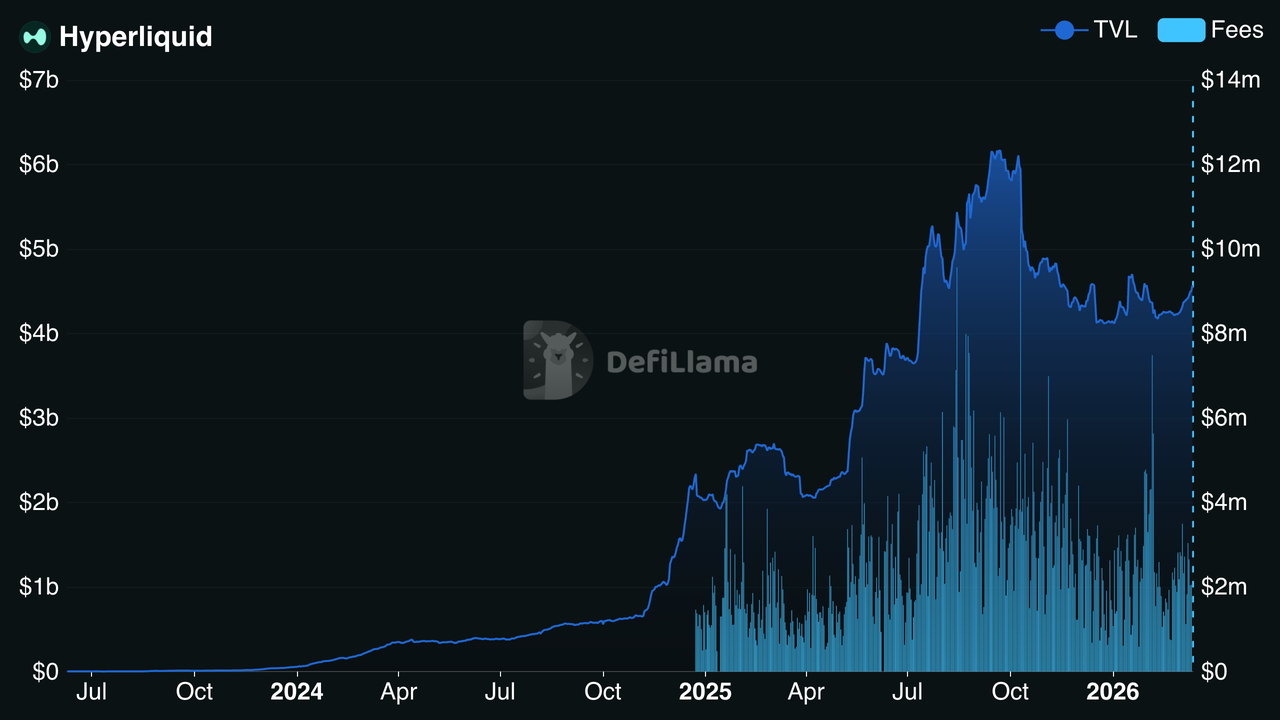
Hyperliquid is a purpose-built Layer-1 blockchain engineered specifically to handle the high-throughput demands of professional-grade financial services. While general-purpose blockchains like Ethereum struggle with the latency required for high-frequency trading, Hyperliquid utilizes a custom consensus mechanism known as HyperCore. This architecture allows for sub-second block times and a fully on-chain, decentralized limit order book (CLOB) that rivals the performance of centralized exchanges (CEXs) while maintaining the transparency and self-custody of DeFi. As of mid-March 2026, Hyperliquid has a total valued locked (TVL) of over $4.5 billion.
The project reached a pivotal milestone in early 2026 with the full integration of USDH, the ecosystem's native, Hyperliquid-aligned stablecoin. Unlike generic stablecoins, USDH acts as the primary settlement layer for the platform's new HIP-4 Outcome Markets (prediction markets). By March 10, 2026, the protocol officially increased the USDH supply cap to $500 million, signaling a massive expansion in on-chain liquidity.() This integration ensures that even as traders pivot between crypto, commodities, and event-based betting, all value remains captured within the Hyperliquid economy.
Read more: What Is Hyperliquid (HYPE) Decentralized Perpetual Exchange: A Complete Guide
An Overview of HYPE Token Utility and Tokenomics
The HYPE token is the native engine of the ecosystem, designed to align the interests of validators, builders, and traders through a revenue-first model.
- Network Security and Governance: HYPE is used for Proof-of-Stake (PoS) to secure the HyperCore consensus. Holders also use the token to vote on Hyperliquid Improvement Proposals (HIPs), steering the modular evolution of the chain.
- Permissionless Infrastructure: To prevent spam and ensure skin in the game, builders are required to stake significant amounts of HYPE, typically 500,000 to 1 million tokens, to bootstrap new perpetual markets or launch native assets via the HIP-6 IPO mechanism.
- The Assistance Fund Buyback: Perhaps the most unique aspect of HYPE tokenomics is the protocol's fee-distribution model. 97% of all trading fees generated on the platform are funneled into an Assistance Fund, which is programmatically used to buy back and burn HYPE or provide protocol-owned liquidity. This creates a direct correlation between exchange volume and token scarcity, often referred to by analysts as the HYPE Revenue Thesis.
What Makes Hyperliquid Different From Other Traditional DEXs?
Hyperliquid distinguishes itself through its vertical integration, operating as a dedicated Layer-1 blockchain rather than an application on an existing network. In March 2026, data reveals that this architectural choice has allowed Hyperliquid to surpass Coinbase in notional trading volume, recording $2.6 trillion compared to Coinbase’s $1.4 trillion. Unlike traditional DEXs like Uniswap that rely on Automated Market Makers (AMMs) and suffer from price impact on large orders, Hyperliquid employs a fully on-chain Central Limit Order Book (CLOB). This enables sub-100ms execution and a gasless trading experience for end-users, effectively eliminating the DEX tax and slippage issues that typically plague decentralized trading.
From a practical standpoint, Hyperliquid functions as a DeFi Prime Brokerage. While traditional DEXs are often limited to crypto-native tokens, Hyperliquid’s HIP-3 and HIP-4 frameworks have bridged the gap to Traditional Finance (TradFi). As of early 2026, the platform facilitates 24/7 trading of synthetic RWAs, including Gold, Silver, and Crude Oil perpetuals, which alone saw over $20 billion in volume during a single 10-day period in February. This allows traders to manage a diversified portfolio, spanning memecoins and global commodities, under a unified Portfolio Margin system, a level of capital efficiency rarely seen outside of Tier-1 centralized exchanges.
How Hyperliquid Differs From Other Perp DEXs: 3 Key Features
| Feature | Hyperliquid (HYPE) | Typical Perp DEX |
| Infrastructure | Custom L1 (HyperCore) | App on an existing L2 |
| Fee Structure | 97% Revenue to Buybacks | Often shared with LPs/Stakers |
| TradFi Access | 24/7 RWA Perps (Oil, Gold) | Primarily Crypto-only |
| Margin System | Cross-Asset Portfolio Margin | Isolated or simple Cross Margin |
| Max Supply | 1,000,000,000 HYPE | Varies by project |
While rivals like dYdX and GMX paved the way for on-chain leverage, Hyperliquid’s 2026 market dominance, capturing over 70% of DeFi perp market share, stems from three specific technical and economic moats:
- Custom L1 vs. App-Chain: Unlike dYdX, which utilizes the Cosmos SDK, or GMX, which sits on Arbitrum/Avalanche, Hyperliquid’s HyperCore engine is custom-built for 200,000 orders per second. This prevents noisy neighbors on a shared chain from slowing down trade execution during high-volatility events.
- The 97% Buyback Flywheel: Most Perp DEXs distribute fees to Liquidity Providers or stakers as passive income. Hyperliquid’s model is more aggressive: 97% of protocol revenue (exceeding $5.5 million daily in peak sessions) is used to buy back HYPE tokens. In early 2026, this resulted in the removal of over 2.3 million HYPE from circulation in a single month, creating a direct price-link between platform success and token scarcity.
- EVM Composability (HyperEVM): While many Perp DEXs are walled gardens, Hyperliquid integrates an EVM-compatible layer. This allows external protocols like Pendle or Kinetiq to build yield-strategies directly on top of Hyperliquid’s liquidity, creating a secondary Lego layer that platforms like Vertex or Paradex currently lack.
Choosing between Hyperliquid and other perpetual DEXs like dYdX or GMX depends on your preference for L1 vertical integration. On BingX, trading HYPE allows you to play the Chain Narrative.
Read more: Aster vs. Hyperliquid: Which One Will Lead the Perpertual DEX Market in 2026?
HYPE 2026 Outlook: The Revenue Supercycle vs. The Unlock Reality
The 2026 forecast for Hyperliquid (HYPE) has evolved into a high-stakes tug-of-war between a revolutionary Revenue Supercycle and the structural gravity of the Unlock Reality. As of March 2026, the market is no longer pricing HYPE based on mere speculation, but on the protocol's ability to sustain its multi-billion dollar daily volumes.
Traders are currently navigating three distinct price regimes, each defined by a combination of on-chain fundamental milestones and macroeconomic liquidity conditions.
The Bull Case: The Binance Killer Ascent Could Drive $HYPE to $100-$150
The bull case centers on the successful maturation of HIP-4 and the approval of a Spot HYPE ETF. If a HYPE ETF is greenlit by the SEC in late 2026, it would allow TradFi wealth managers to gain exposure to Hyperliquid’s revenue-generating model without navigating on-chain wallets. This institutional wall of money would likely collide with the protocol's 97% fee-to-buyback mechanism; at sustained daily volumes exceeding $20 billion, the resulting supply shock could force HYPE toward Arthur Hayes’ $150 target.
By August 2026, the bull narrative is further fueled by USDH dominance. As USDH becomes the preferred stablecoin for 24/7 RWA settlement like Oil, Gold, and Nasdaq perps, the interest-bearing reserves provide a constant, non-trading source of HYPE buybacks. This shifts the token's valuation from a speculative asset to a digital dividend play, supporting a significant P/E multiple expansion as the market prices in the end of the four-year crypto cycle.
Read more: Arthur Hayes Bets on Hyperliquid HYPE Reaching $150 by August 2026 on Revenue-Driven Buybacks
The Base Case: Structural Maturity Establishes HYPE in $50-$80 Range
The base case assumes a steady, up-only trajectory where Hyperliquid maintains its status as the leading Perp DEX but faces stiff competition from emerging L1 competitors. In this scenario, the platform successfully rolls out Portfolio Margin and HyperEVM write-capabilities, leading to a surge in TVL as third-party developers launch lending protocols and yield vaults. HYPE becomes a Blue Chip DeFi asset, characterized by consistent organic demand that offsets minor sell-side pressure.
Under these conditions, HYPE trades within a healthy ascending channel, finding a structural floor near $50. The HIP-3 RWA markets act as a critical hedge, ensuring that even during crypto-native winter cycles, commodity trading volume keeps the Assistance Fund active. This scenario represents the Middle Way, where the protocol achieves institutional legitimacy without needing a total market mania.
The Bear Case : The Unlock Hangover Drags Hyperliquid Price to $25-$30
The bear case focuses on the structural headwinds of the 2026–2027 token emission schedule. With a significant portion of the supply still entering circulation and a validator set that remains relatively centralized (approx. 16 nodes), any systemic technical exploit or regulatory pivot could trigger a mass deleveraging event. If broader crypto sentiment remains in the Extreme Fear zone, the sell-side pressure from venture capital unlocks and early stakers could overwhelm the protocol’s internal buybacks.
Practically, this would see HYPE fail to sustain its breakout above the $40 psychological barrier, leading to a liquidity hunt toward the $25–$30 support zone. In this risk-off environment, the 97% buyback mechanism serves as a safety net rather than a rocket ship, preventing a total collapse but leaving the token trapped in a sideways range. Traders would likely see HYPE retest its $20 fundamental floor as it waits for the next major protocol upgrade or macro tailwind.
Practical Tip: As of March 2026, HYPE is the leading beta for RWA adoption in crypto. If geopolitical tensions drive oil prices up on weekends, HYPE volume tends to spike, making it a proxy for global volatility.
Read more: Top 10 Blockchains for Real‑World Asset (RWA) Tokenization Projects in 2026
Hyperliquid Price Forecasts for 2026: Institutional and Analyst Outlook
Institutional sentiment has shifted bullish following the HIP-4 mainnet rollout.
| Entity/Analyst | 2026 Price Target | Market Outlook |
| Arthur Hayes | $150 | Super-Bullish: Cites P/E expansion and $1.4B revenue potential. |
| CoinCodex | $96.50 | Bullish: End-of-year target based on historical cycle models. |
| BeInCrypto | $36 - $50 | Conservative: Sees HYPE tracking the broader Altcoin market. |
| Axel Bitblaze | $180+ | Long-term Bull: Compares Hyperliquid to a decentralized Binance. |
| 3Commas/Algorithmic | $34 - $38 | Neutral: Predicts consolidation due to supply unlocks. |
How to Trade Hyperliquid (HYPE) on BingX
Navigate the high-velocity Hyperliquid market with precision by leveraging BingX AI, which provides real-time trend analysis and automated strategy suggestions for both spot and derivatives traders.
1. Trading HYPE on the Spot Market
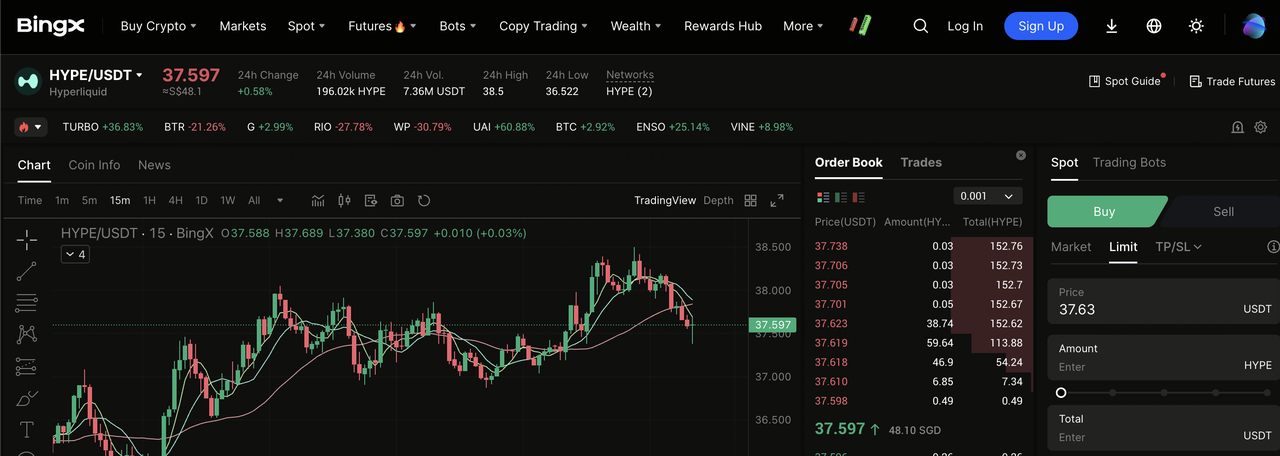
HYPE/USDT trading pair on the spot market
Spot trading is ideal for long-term investors looking to own the HYPE token and benefit from the protocol’s long-term revenue-buyback growth without the risks of liquidation.
- Log in to your BingX account and navigate to the Spot Market.
- Search for HYPE/USDT in the search bar.
- Analyze the order book and choose your order type: Limit Order to set a specific entry price or Market Order to buy instantly at the current price.
- Enter the amount of USDT you wish to spend and click Buy HYPE. Your tokens will be immediately available in your Spot Account.
Learn more about how to buy Hyperliquid (HYPE) on BingX in our beginner's guide.
2. Trading HYPE Perpetuals on the Futures Market
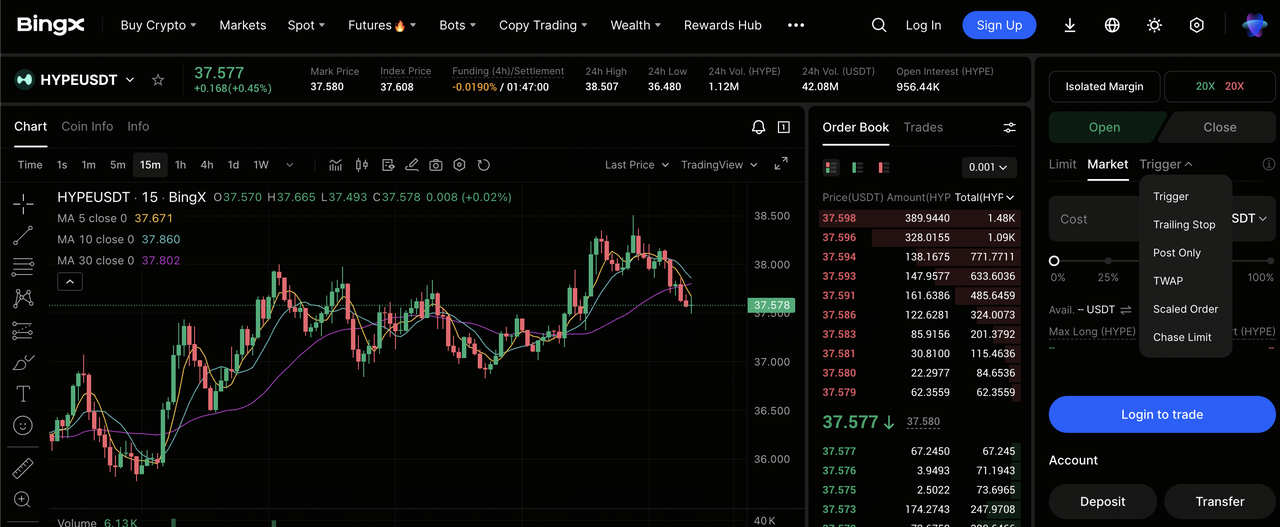
HYPE/USDT perpetuals on the futures market
For active traders looking to capitalize on HYPE’s 2026 volatility or hedge against weekend price gaps, BingX offers USDT-margined perpetual contracts.
- Navigate to Futures and select Perpetual Futures.
- Select the HYPE/USDT perpetual contract.
- Choose your Margin Mode: Use Isolated Margin to limit risk to a single trade, or Cross Margin to utilize your entire account balance as collateral.
- Select your Leverage; professional risk management for HYPE in 2026 typically suggests 2x–5x due to $10+ daily price swings.
- Set your Take-Profit (TP) and Stop-Loss (SL) levels. In the current Extreme Fear macro environment as of early 2026, tight stop-losses are essential to protect your collateral from sudden reversals.
- Click Open Long if you anticipate HYPE hitting bullish targets, or Open Short to profit from potential retracements toward key support levels.
5 Key Risks for HYPE Traders to Watch in 2026
While Hyperliquid's revenue-driven model provides a strong fundamental floor, traders must navigate a unique set of structural and macroeconomic hazards to protect their capital in 2026.
- The Unlock Pressure: Major token unlocks occur periodically through 2027. Watch the Token Unlock Calendar and follow the latest updates on BingX News to avoid being caught in a supply-side dump.
- Validator Centralization: With fewer than 20 validators, any technical exploit or regulatory pressure on these nodes could halt the chain.
- The Hayes Reversal: Arthur Hayes is known for bold calls followed by tactical exits. Treat $150 as a best-case scenario rather than a guaranteed floor.
- CEX Counter-Attacks: If major CEXs like Binance significantly lower fees or launch their own L1 perps, Hyperliquid’s organic volume moat could shrink.
- Macro Correlation: Despite its RWA features, HYPE remains highly correlated to the Fear & Greed Index. In a risk-off environment, HYPE will likely drop with the rest of the market.
Conclusion: Should You Buy Hyperliquid (HYPE) in 2026?
Determining if HYPE is a buy in 2026 requires a distinction between a tactical volatility play and a fundamental value investment. In the immediate term, the asset is a high-conviction momentum trade. The $40 level remains the definitive psychological and technical pivot; a sustained daily close above this resistance, backed by rising HIP-3 volume, would validate the bull case and likely trigger a gap-fill move toward the $50–$60 range. For active traders, the 97% buyback mechanism provides a unique volatility floor; the more the market swings, the more fees are generated to support the token price.
For long-term participants, the 2026 investment thesis rests on Execution over Narrative. HYPE’s valuation is increasingly decoupling from speculative altcoin cycles and aligning with its utility as a high-yield financial infrastructure. If the protocol successfully implements HIP-6 (on-chain IPOs) and continues to absorb RWA market share from centralized giants, the deflationary supply-side pressure will likely establish a baseline value significantly higher than traditional L1 peers. The practical approach for BingX users is one of disciplined risk management: prioritizing entries near structural supports while monitoring on-chain revenue as the primary indicator of long-term price appreciation.
Risk Reminder: Trading HYPE involves an extremely high level of risk. The revenue-driven buy wall is entirely dependent on trading volume; if the platform’s activity stalls, the token is susceptible to the same downward pressures as any other digital asset. Leverage should be used sparingly, and stop-loss orders are essential to protect capital against the sharp, sudden corrections characteristic of the 2026 market.
Related Reading
- Crude Oil Price Forecast 2026: $140 War Premium or $60 Surplus Baseline?
- Aster vs. Hyperliquid: Which One Will Lead the Perpertual DEX Market in 2026?
- What Are the Top Perp DEXs (Perpetual DEXs) to Know in 2026?
- What Is a Spot Hyperliquid (HYPE) ETF and When Will It Launch?
- What Is USDH, Hyperliquid's New Stablecoin Issued by Native Markets?
