
Zcash (ZEC) remains a foundational pillar of the privacy-preserving Proof-of-Work (PoW) ecosystem in 2026. Built on the original Bitcoin codebase, Zcash has established itself as the pioneer of financial confidentiality through zero-knowledge proofs (zk-SNARKs). As global compliance and data surveillance discussions mature across jurisdictions, the network security provided by Zcash miners continues to protect transaction privacy for users worldwide.
For anyone looking to understand how to mine Zcash in 2026, the competitive landscape has undergone a major paradigm shift. General-purpose setups like CPU and GPU mining have been completely phased out by specialized, industrial-grade zcash miner arrays. Driven by recent cryptographic milestones, such as the recent NU6.2 emergency hard fork fixing Orchard circuit bugs and removing long-standing regulatory overhangs, the Zcash network has reached a total hashrate of approximately 10.71 GSol/s. This evolution presents both unique strategic opportunities and technical challenges for infrastructure miners.
What Is Zcash (ZEC) and How Does It Work?
Zcash (ZEC) is a decentralized, open-source cryptocurrency built on the original Bitcoin codebase, designed specifically to enforce absolute financial privacy. While it maintains a fixed total supply cap of 21 million tokens, Zcash distinguishes itself through the implementation of zero-knowledge proofs, specifically advanced zk-SNARKs via its Halo 2 proving system.
This mathematical architecture allows the network to validate transactions without exposing sensitive data like sender identities, receiver addresses, or transaction volumes. Operating on a 75-second block time, the protocol gives users the flexibility to choose between public, transparent transactions (t-addresses) and fully encrypted, shielded transactions (z-addresses) depending on their compliance or privacy requirements.
For infrastructure operators, mining Zcash in 2026 presents a compelling utility-first investment profile. Following its late-2024 halving, the network distributes a fixed block subsidy of 1.5625 ZEC, creating a highly predictable daily supply schedule of 1,800 ZEC.
Mining Zcash is structurally attractive because it yields virgin coins completely devoid of transaction history, eliminating the regulatory compliance risks associated with tainted assets. Furthermore, the 2026 resurgence of institutional interest in zero-knowledge scaling layers, combined with the resolution of core circuit vulnerabilities via the recent NU6.2 network upgrade, has driven deep market liquidity and robust exchange trading volumes. For miners deploying highly efficient Equihash ASICs, this environment offers a transparent ROI baseline anchored to a mature, high-demand privacy asset.
Read more: What Is Zcash (ZEC) Privacy Coin Powered By zk-SNARKs?
Is Zcash Mining Still Profitable?
Mining Zcash can be a lucrative endeavor, but its profitability in 2026 relies on a razor-thin spread between hardware hash-efficiency and local utility rates. Following the block reward halving in late 2024, the baseline emission rate sits at 1.5625 ZEC per block, occurring roughly every 75 seconds. To accurately assess if your operational overhead will yield net positive returns, you must run an equation factoring in your capital expenditure (CapEx) against real-time network parameters.
To perform an exact financial calculation, use dedicated mining aggregators like WhatToMine, Minerstat, or CoinWarz. Your input data points must include:
- Hardware Hashrate: Measured in Solutions per Second (Sols/s) or Kilosolutions per Second (kSol/s).
- Power Draw: The continuous load of your machine measured in Watts (W).
- Electricity Cost: Your local utility contract rate scaled by kilowatt-hour (kWh).
- Pool Fees: Typically ranging between 1% and 3% depending on your chosen distribution infrastructure.
As a general benchmark in 2026, sustainable profitability requires cheap, industrial-scale electricity pricing. If your local electricity rates exceed $0.06 to $0.08 per kWh, the operational costs of running a high-voltage zcash miner will easily outpace the market spot value of the generated ZEC. In high-cost utility regions, purchasing the asset directly via an exchange spot market is often a more viable economic strategy than printing it via raw computing infrastructure.
Read more: What Is a Spot Zcash ETF and When Could It Launch?
Analyzing the ZEC Solo Mining Reward
Solo mining represents an all-or-nothing economic lottery. If you configure a single machine to mine solo, you are competing directly against the entire global network hashrate (~10.71 GSol/s) to find the correct cryptographic block solution.
While the nominal ZEC solo mining reward sits at a full 1.5625 ZEC plus network transaction fees, the probability of a standalone ASIC discovering a block is statistically negligible against current network difficulties. Without hundreds of machines deployed in an industrial warehouse, solo mining will result in zero payouts for months on end while your utility meter runs constantly.
For retail and intermediate miners, mining pools are practically mandatory. Pools allow thousands of individual hardware units to merge their hashrates over a shared server network. When the pool successfully solves a block, the 1.5625 ZEC reward is distributed proportionally among all participants based on the specific computing shares they submitted. This smooths out volatility, turning highly unpredictable lottery rewards into steady, incremental daily payouts.
Zcash Mining Hardware: What Are the Best ASIC Miners for Equihash in 2026?
Zcash runs on the memory-hard Equihash (200,9) hashing algorithm. Because this algorithm requires specialized high-speed memory buffers to process mathematical structures, general-purpose GPUs (even flagship cards like the RTX 4090) are completely obsolete. They simply cannot compete with the sheer efficiency of custom Application-Specific Integrated Circuits (ASICs).
When sourcing hardware in 2026, the primary metric to optimize for is electrical efficiency, expressed as Watts per Kilosolution (W/kSol). Below is a comparative review of top-tier Equihash hardware currently sustaining the network:
|
ASIC Miner Model |
Hashrate (kSol/s) |
Power Consumption (W) |
Efficiency (W/kSol) |
|
Bitmain Antminer Z15 Pro |
840 kSol/s |
2,780 W |
3.3 W / kSol |
|
Bitmain Antminer Z15 |
420 kSol/s |
1,510 W |
3.5 W / kSol |
|
ASICMiner Zeon 180 |
180 kSol/s |
2,200 W |
12.2 W / kSol |
|
Innosilicon A9++ Z-Master |
140 kSol/s |
1,550 W |
11.0 W / kSol |
Warning: Older legacy machines running at efficiencies greater than 10 W/kSol have effectively become e-waste in 2026. Unless you have access to free surplus electricity, operating sub-efficient hardware will result in a net financial loss due to rising network difficulty. Always buy directly from reputable manufacturers or verified secondary distributors to avoid hardware deployment scams.
Read more: Zcash (ZEC) vs. Monero (XMR): Which is the Better Privacy Coin in 2026?
How to Set Up Your Zcash Miner: A Step-by-Step Technical Guide
Once you have acquired a compatible Equihash ASIC and a suitable Power Supply Unit (PSU), you can proceed with the physical and software installation.
Step 1: Establish a Private Zcash Wallet
Before your zcash miner processes a single share, you need a target address to collect incoming payouts.
- For Pool Payouts: Set up a transparent address (t-address). Most commercial mining pools only support direct reward settlement to public t-addresses. Recommended options include native software interfaces like YWallet, ZecWallet Lite, or cold storage hardware wallets like Ledger and Trezor.
- Privacy Optimization: Once pool funds arrive safely in your transparent wallet, you can manually broadcast a shielded transaction to move your balances into a private z-address using Zcash’s zero-knowledge layout.
Step 2: Power and Network Connection
Place your ASIC in a well-ventilated, isolated area as these machines produce massive heat and high-decibel fan noise. Plug the heavy-duty power cables into your designated circuit breaker line, then plug an Ethernet cable directly from your internet router into the ASIC’s network interface card. Avoid Wi-Fi extenders to prevent packet drops and stale share rejections.
Step 3: Discover the Miner’s Local IP Address
Turn on the machine and wait a few minutes for the hardware to boot up. Open a computer connected to the same local network and use a desktop network diagnostic tool, such as Advanced IP Scanner, or check your router’s internal DHCP client list to find the localized IP address assigned to the ASIC.
Step 4: Access the Web GUI and Configure Pool Settings
Type the miner’s local IP address directly into any standard web browser address bar. Log in using the default administrative credentials (typically admin / admin or found on the physical machine sticker). Navigate over to the Miner Configuration or Pool Settings tab.
You will need to input the details of your chosen mining pool. Select a reliable pool infrastructure with low latency and favorable payout terms:
- ViaBTC: Commands roughly 44% of network hashrate; utilizes PPS+ structures.
- F2Pool: Reliable distribution structure with solid regional infrastructure.
- 2Miners / Flypool: Highly popular alternative frameworks offering low 1% pool fees.
Fill out the configuration fields exactly as follows:
- URL / Stratum Address: Paste the regional gateway server provided by your pool.
- Worker / Username: Input your public t-address followed by a worker suffix to track performance metrics.
- Password: Enter x or leave it empty as dictated by the pool documentation.
Click Save & Apply. The miner will automatically restart its cooling fans, run internal diagnostic chips, and begin submitting valid cryptographic shares to the pool network. Monitor your dashboard closely to ensure operating chip temperatures stay well below 70∘C for sustained system longevity.
Green Mining: How to Use Renewable Energy to Mine ZEC Coins
As decentralized protocols face growing global scrutiny regarding environmental impact, the concept of Green Mining has moved from a niche philosophical choice to a structural economic requirement. Mining Zcash with clean power allows operators to satisfy environmental, social, and governance compliance models while optimizing long-term balance sheets.
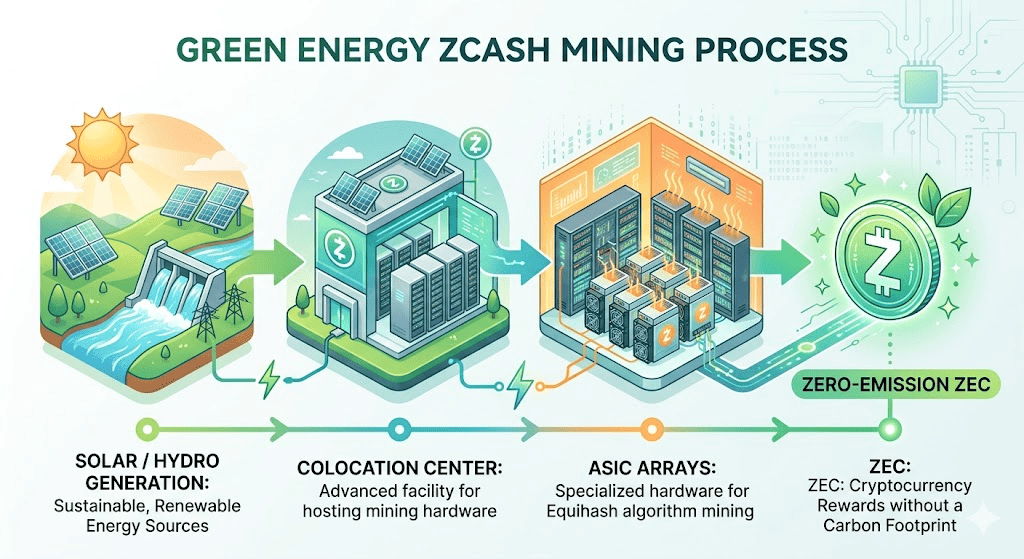
The most successful industrial deployments in 2026 leverage stranded or off-grid renewable infrastructure:
- Hydroelectric Power: Running ASIC infrastructure adjacent to run-of-river dams offers ultra-low, predictable baseline costs and steady, non-intermittent power delivery.
- Co-located Solar Arrays: Implementing solar-plus-storage frameworks allows miners to monetize overproduced mid-day power that would otherwise face curtailment by regional grid operators.
- Stranded Methane Capture: Advanced operators deploy modular mining containers to remote oil fields, combusting vented methane emissions to drive field generators. This turns a highly harmful environmental waste gas into raw computing power for the Zcash blockchain.
By anchoring your hardware investments to sustainable energy zones, you eliminate reliance on fossil-fuel grids and shield your mining business from carbon taxation or sudden regulatory utility price spikes.
How to Trade Zcash (ZEC) on BingX
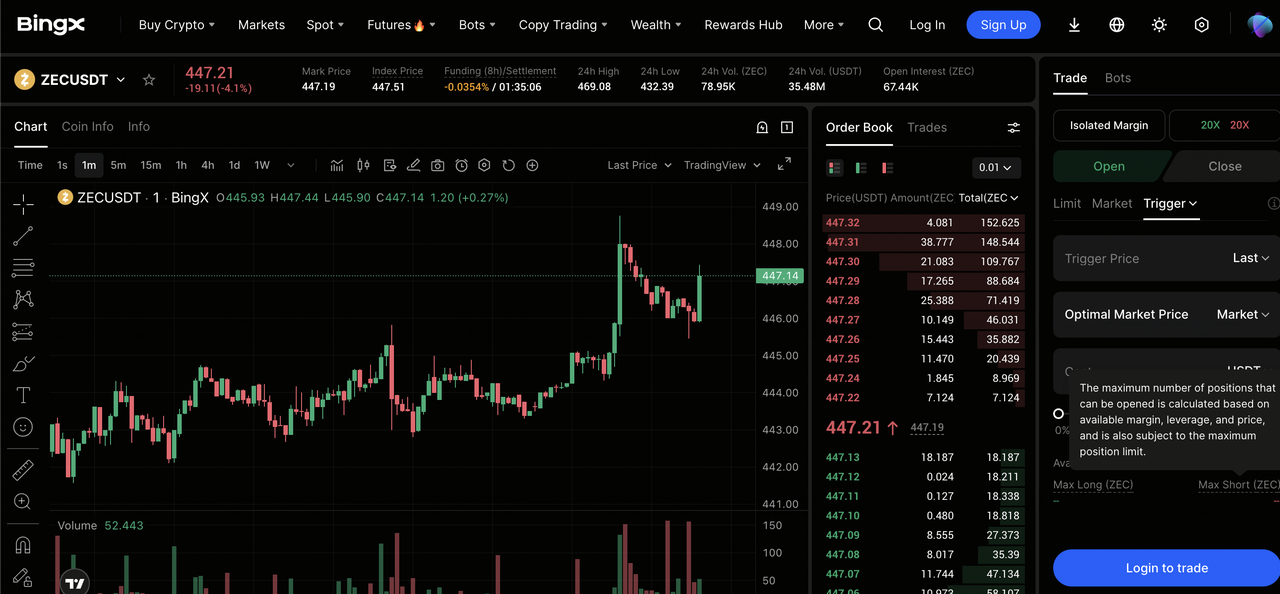
ZEC/USDT perpetual contract on BingX futures market
By utilizing the institutional-grade predictive analytics of the BingX AI ecosystem, trading Zcash Perpetual Futures offers a significantly faster, lower-overhead alternative to maximize market returns without the expensive hardware depreciation, cooling issues, or massive electricity costs of physical ASIC mining.
If you prefer to capture profits from ZEC price movements using capital-efficient derivatives rather than building physical infrastructure, follow this concise step-by-step trading guide:
- Fund Your Futures Wallet: Navigate to your account panel, select Transfer, and move your target capital, USDT or USDC, from your primary Fund Account directly into your Perpetual Futures Account.
- Select the ZEC Market: Hover over the Futures tab on the top primary menu, select Perpetual Futures, and use the search dashboard on the left panel to open the ZEC/USDT perpetual contract.
- Establish Margin Mode and Leverage: On the right-hand execution console, set your margin mode to Isolated Margin to insulate your account balance from localized volatility, then adjust your slider to a safe leverage level, e.g., 2x to 5x.
- Configure the Order Parameters: Choose your structural order mechanism - Market for immediate fill at the global spot average, or Limit to secure an exact entry price floor. Input your desired position margin sizing.
- Activate Risk Firewalls: Check the TP/SL (Take-Profit/Stop-Loss) safety module to establish pre-defined exit targets, and select the Guaranteed Price feature to protect your stop-loss from slippage during erratic market updates.
- Execute the Position: Click Open Long if your technical indicators and AI signals point to an upward breakout, or click Open Short if you want to profit from a downward market rejection. Monitor your active trade metrics, live funding adjustments, and real-time PnL metrics inside the Positions dock at the bottom of the workspace.
Top Risks to Consider When Mining Zcash
While Equihash mining offers a structured path to earning virgin block rewards, operators must navigate severe operational, financial, and network-level hazards to maintain long-term viability.
- Severe Electricity and Margin Arbitrage: Because Zcash's network difficulty sits at historic highs as of June 2026, profitability hinges entirely on your local utility rates; if your energy costs rise above $0.06 to $0.08 per kWh, the massive power consumption of your ASIC will outweigh the market value of the ZEC produced, turning your operation into a net financial loss.
- Rapid Hardware Obsolescence and CapEx Depreciation: The Equihash ASIC market moves incredibly fast, meaning legacy hardware can quickly lose competitiveness; deploying sub-efficient machines or failing to match the efficiency curve of newer models like the Antminer Z15 Pro risks turning expensive hardware into unprofitable e-waste.
- Extreme Operational Overhead (Noise, Heat, and Failures): Commercial ASIC miners are industrial-grade machines that generate deafening decibel levels and intense thermal output. Operating them requires dedicated ventilation systems, robust circuit setups, and constant chip temperature monitoring to avoid heat damage and hardware degradation.
- Systemic Market Volatility and Regulatory Shifts: As a privacy-focused coin, Zcash is uniquely exposed to shifting global compliance frameworks and regulatory scrutiny surrounding private transaction shielding. Sudden exchange delistings or structural shifts in privacy regulations can severely choke liquidity and crash the market spot price of your rewards.
- Network Structure and Potential Protocol Transitions: Mining economics are strictly bound to proof-of-work block rewards, which programmatically halve every four years. Additionally, ongoing developer discussions regarding a potential long-term migration to Proof-of-Stake (PoS) present a foundational risk of rendering specialized physical mining hardware completely obsolete in the future.
Final Word: Is Zcash Mining Right for You in 2026?
Mining Zcash in 2026 provides an active path to secure an essential privacy preservation layer while capturing un-spent, virgin ZEC directly from block rewards. For enterprise operators who can access high-efficiency Equihash ASICs like the Antminer Z15 Pro and lock down low electricity rates below 0.06/\text{kWh}$, the network offers a structured revenue pipeline.
However, retail hobbyists must proceed with extreme operational caution. The high initial CapEx for specialized hardware, severe noise footprints, and intense heat dissipation requirements mean that home-based operations are rarely practical. Furthermore, the inherent volatility of privacy assets and shifting network difficulties add significant downside financial risk. If you lack industrial colocation space or competitive energy arbitrage options, accumulation via exchange spot trading pairs or locking liquidity inside interest-bearing vehicles remains the safest approach to gain exposure to the Zcash ecosystem.
Risk Reminder: Cryptocurrency mining involves high operational overhead, hardware depreciation risk, and systemic market volatility. Always run a comprehensive local cost-benefit audit before allocating capital to hardware components.
Related Reading
- What Is Zcash (ZEC) Privacy Coin Powered By zk-SNARKs?
- What Are the Top Proof-of-Work (PoW) Coins to Mine in 2026?
- How to Mine Bitcoin (BTC) in 2025: A Beginner's Guide
- How to Mine Dogecoin in 2026: A Complete Guide
- How to Mine Litecoin (LTC) in 2026: A Beginner’s Guide
FAQs on Zcash Mining
1. Can I mine Zcash on my gaming laptop or home PC?
No. Zcash mining requires immense memory-hard processing power that can only be generated by Equihash-specific ASICs. Attempting to mine ZEC using standard desktop CPUs or consumer-grade GPUs will consume more money in electricity than you can ever recover in block rewards.
2. What is the difference between a T-Address and a Z-Address for Zcash?
A T-address is transparent, meaning all transaction flows and associated balances are visible on the public block explorer, identical to Bitcoin. A Z-address uses zero-knowledge proofs to completely shield transaction details, ensuring absolute sender, receiver, and balance privacy.
3. Why do most Zcash mining pools require a T-Address for ZEC payouts?
Most public mining pools run automated distribution software that requires transparent address state structures to verify, audit, and batch-process mass payout distributions to thousands of independent miners simultaneously without computing excessive cryptographic proofs on every block cycle.
4. When is the next Zcash block halving event?
The third official Zcash block halving is projected to occur around November 23, 2028, at block height 4,406,400. This event will programmatically slice the block emission reward in half from 1.5625 ZEC down to 0.78125 ZEC.
