Entering 2026, the cryptocurrency market is no longer an experimental playground for a select few, but has evolved into a mature market encompassing investment, trading, hedging, and cross-border asset allocation. As the boundaries between digital assets and traditional financial systems become increasingly clear, the crypto market not only carries native assets like Bitcoin and Ethereum, but also extends to RWA (Real World Asset tokenization) domains. Tokenized stocks, gold, and commodities have successively gone on-chain, making the connection between TradFi and crypto finance even tighter. Crypto assets are gradually becoming part of cross-market allocation rather than merely a single speculative market.
Meanwhile, global regulatory frameworks are gradually taking shape. In early 2026, the US crypto regulatory bill GENIUS Act came into effect, with markets becoming increasingly clear on asset custody and risk management standards for exchanges. Exchanges are no longer just matching platforms, but must serve as infrastructure that balances liquidity management, risk control, and information transparency. Against the backdrop of ETF launches, RWA on-chain adoption, and accelerating cross-market capital flows, exchanges have become important nodes connecting TradFi and crypto assets.
For Taiwanese users, these changes are reflected in practical choices. When investment needs extend from simple buying and selling of cryptocurrencies to tokenized stocks, gold, and other cross-market assets, platform integration capabilities and liquidity depth become even more critical. Most investors weigh between "local exchanges that support TWD deposits" and "international exchanges with more comprehensive features." Achieving balance between funding convenience and functional completeness has become part of investment strategy. This article will compare local and international exchanges against the backdrop of Taiwan's market, and through BingX's actual use cases, explain key considerations when making choices.
How to Choose a Crypto Exchange in Taiwan? 6 Key Evaluation Factors
As Real World Asset tokenization (RWA) and the convergence of TradFi with crypto markets accelerate, the role of exchanges has evolved from simple matching platforms to important infrastructure connecting multi-market assets. When investment scope is no longer limited to Bitcoin or Ethereum, but extends to tokenized stocks, gold, silver, and commodities, the exchange's integration capabilities and risk management standards directly impact asset allocation efficiency.
Before comparing Taiwanese and international exchanges, several core evaluation criteria deserve priority clarification. Different investors have significantly different needs - for example, local investors who primarily use TWD deposits and withdrawals versus advanced users who prefer multi-currency allocation, low costs, or cross-market operations often have completely different platform expectations. The following six dimensions are key considerations that most Taiwanese investors should prioritize when choosing exchanges.
1. Deposit and Withdrawal Channels
Whether the platform supports direct TWD deposits is one of the primary considerations for Taiwanese investors. Whether the platform has trust mechanisms in place through partnerships with local banks also affects fiat fund security and institutional transparency. As asset allocation increasingly spans cryptocurrencies and tokenized assets, fund management efficiency becomes even more important, making withdrawal process smoothness and timing stability factors that cannot be ignored in practical operations.
2. Trading Fee Structure
Maker and Taker fee rates for spot trading are important sources of long-term costs. Some platforms have tiered systems that adjust based on trading volume or position size, which can be significant for high-frequency or large-volume traders. When investment scope includes tokenized stocks or commodity assets, the transparency and reasonableness of fee structures should be included in overall evaluation.
3. Trading Pairs and Market Depth
The number of tradeable cryptocurrencies and market depth are core indicators for measuring platform integration capabilities. Whether mainstream trading pairs like BTC/USDT and ETH/USDT have sufficient liquidity, and whether large orders easily produce slippage directly affects execution efficiency. If platforms also support RWA-type assets such as tokenized stocks or gold products, their overall liquidity management capabilities need to be observed for stability.
4. Security and Asset Protection Mechanisms
Against the backdrop of gradually clarifying global regulations, whether platforms adopt cold-hot wallet separation mechanisms, whether they publish Proof of Reserves, and whether they have insurance funds or risk reserves have become basic requirements. If platforms simultaneously support multi-asset trading, whether asset segregation and risk control mechanisms are clear and transparent should also be included in priority evaluation items.
5. Platform Functionality Completeness
As TradFi and crypto market convergence accelerates, exchange functions are no longer limited to spot trading. Whether platforms provide futures markets, dollar-cost averaging (DCA), copy trading, or other strategy tools affects investors' operational flexibility in different market environments. For advanced investors, whether platforms have the capability to support multi-asset allocation and risk management is an important long-term consideration.
6. Language and Customer Support
For Taiwanese users, the completeness of Chinese interface and customer support often directly affects daily operational experience. When trading involves cross-market assets or complex tools, whether platforms provide clear information disclosure and real-time assistance also affects overall trust in usage.
After understanding the above evaluation framework, the following will introduce international exchanges and local exchanges commonly used by Taiwanese investors, explaining each platform's positioning, features, and suitable scenarios to help investors with different needs make clearer platform choices.
International Exchanges: Deeper Liquidity, Advanced Features, and Global Resources
Compared to local platforms, international cryptocurrency exchanges generally offer higher market liquidity, richer cryptocurrency selections, and more diverse trading tools. As TradFi and crypto market convergence accelerates, some platforms also integrate tokenized stocks, gold, and commodities, making exchanges important nodes for cross-market asset allocation. For investors whose primary need is not TWD direct deposits and withdrawals, and who hope to complete trading and strategy management on the same platform, international exchanges usually provide more comprehensive operational environments.
Meanwhile, most international platforms have continuously optimized operational interfaces and educational resources in recent years, from Chinese support, operational guidance to demo trading and strategy tool demonstrations, gradually lowering barriers for beginners. For Taiwanese users, such trading environments that combine market depth with learning support are not only suitable for advanced allocation but also suitable as primary long-term platforms.
1. BingX Exchange
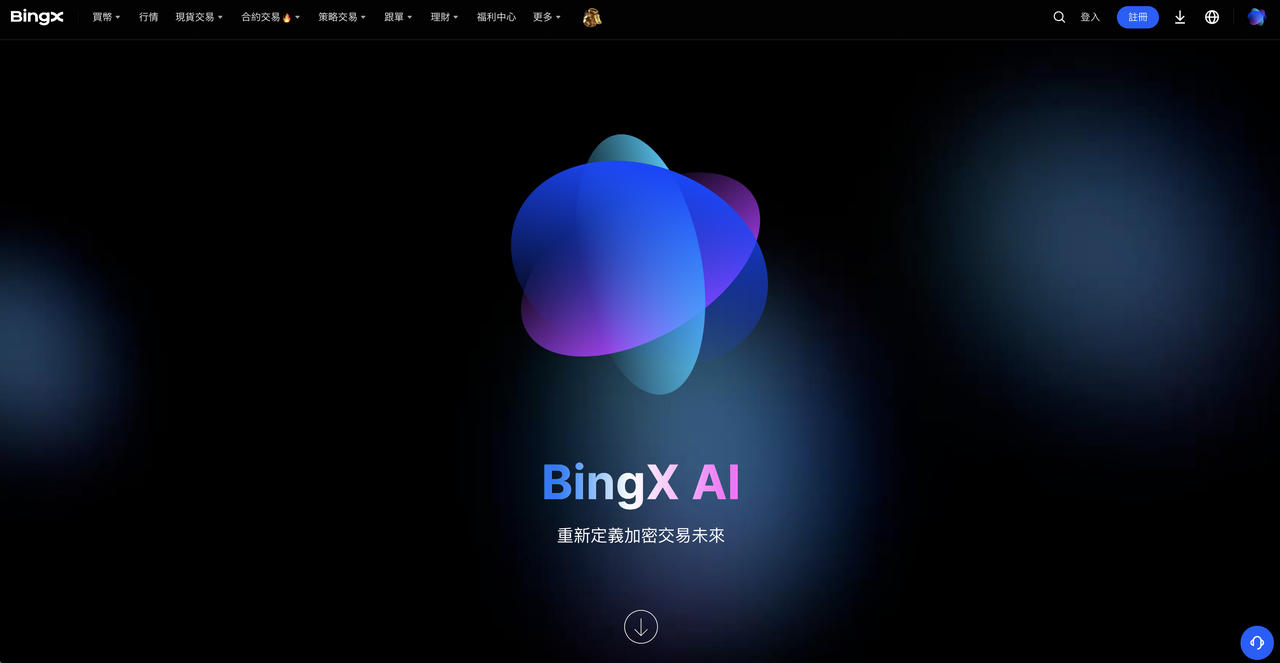
Positioning: Comprehensive international trading platform integrating crypto assets and TradFi products.
BingX was established in 2018, and by 2026, BingX's global user base has exceeded 40 million, serving multiple major markets and gradually becoming one of the important options for Taiwanese users when conducting spot trading, derivatives, and strategy operations. Its positioning is not as a platform with single trading functions, but emphasizes providing complete trading tool combinations as an international exchange. As user demographics diversify, the platform continues to optimize Chinese interfaces and rich educational resources, from basic operational guidance to strategy demonstrations and demo trading tools, lowering barriers for beginners while retaining advanced operational flexibility.
In terms of product structure, BingX not only covers spot trading and perpetual futures for mainstream cryptocurrencies, but also integrates TradFi-type products, including tokenized US stocks, gold, metals, and commodities, allowing users to observe and operate both crypto markets and traditional financial markets on the same platform. This multi-asset integration architecture provides certain convenience for investors hoping to conduct cross-market allocation or hedging operations. The platform also provides dollar-cost averaging (DCA), grid trading, and copy trading strategy tools, combined with consistent and transparent fee structures, particularly suitable for use cases requiring batch entry, frequent position adjustments, or simultaneous execution of multiple strategies.
In terms of actual trading experience, BingX's mainstream trading pairs have relatively stable market depth and execution efficiency, maintaining reasonable slippage levels even during market volatility. The platform also integrates BingX AI as a market assistance tool, incorporating both cryptocurrency and TradFi market data into analysis frameworks, providing technical indicators and trend interpretation assistance. In terms of security mechanisms, BingX publishes 100% Merkle Tree Proof of Reserves, and has established a user protection fund, combined with cold-hot wallet separation and multi-factor authentication architecture, strengthening asset transparency and system stability, giving it the qualifications to serve as a long-term primary trading platform.
2. Kraken Exchange
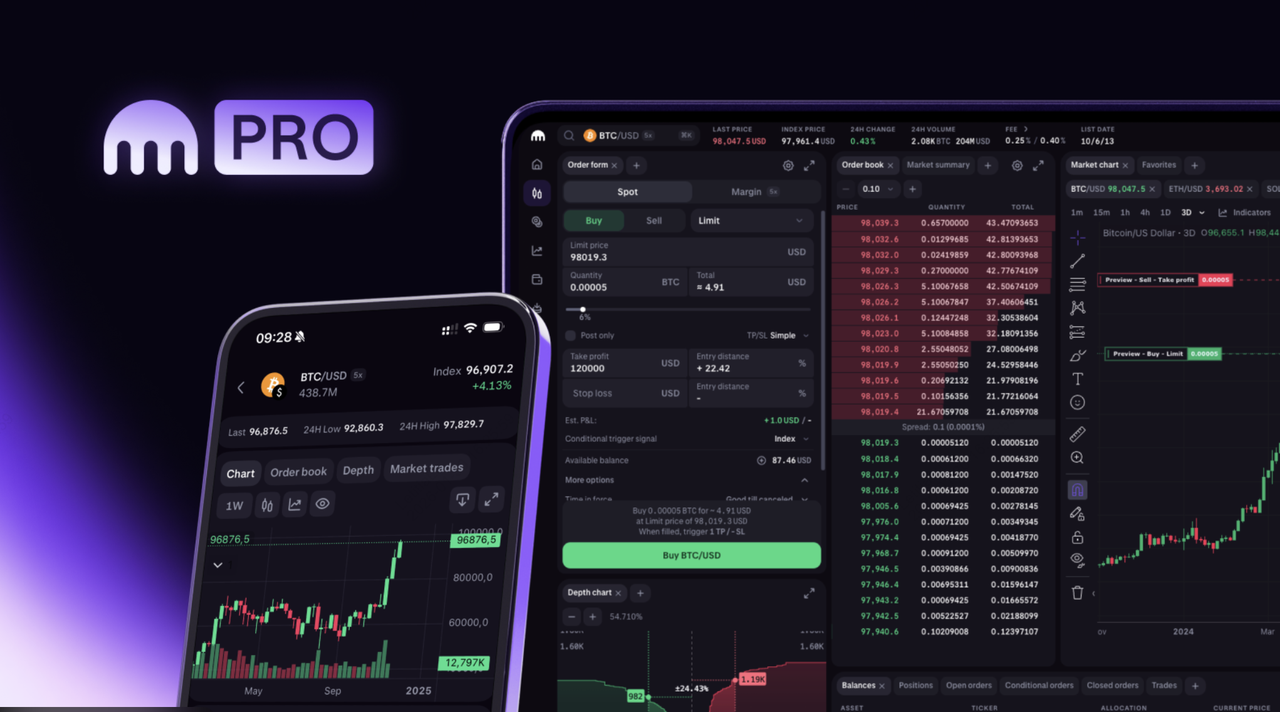
Positioning: Established international trading platform renowned for compliance and security track record.
Kraken was established in 2011 and is one of the earliest established mainstream cryptocurrency exchanges globally, long-standing in the industry with its security standards and regulatory compliance image. After entering 2026, Kraken announced plans for an IPO with a target valuation of approximately $15 billion, showing its intention to further strengthen institutional transparency and capital market positioning.
In terms of trading functions, Kraken provides spot trading, margin trading, and some staking services. Its advanced interface Kraken Pro supports complete order types and technical analysis tools, more suitable for users with trading experience. The platform's market depth and mainstream cryptocurrency liquidity are relatively stable, but the overall interface design leans toward professional orientation. For Taiwanese investors, Kraken's Chinese support is relatively limited, with overall positioning more suitable for advanced investors who have English operational capabilities and value compliance background and security records.
3. Crypto.com Exchange
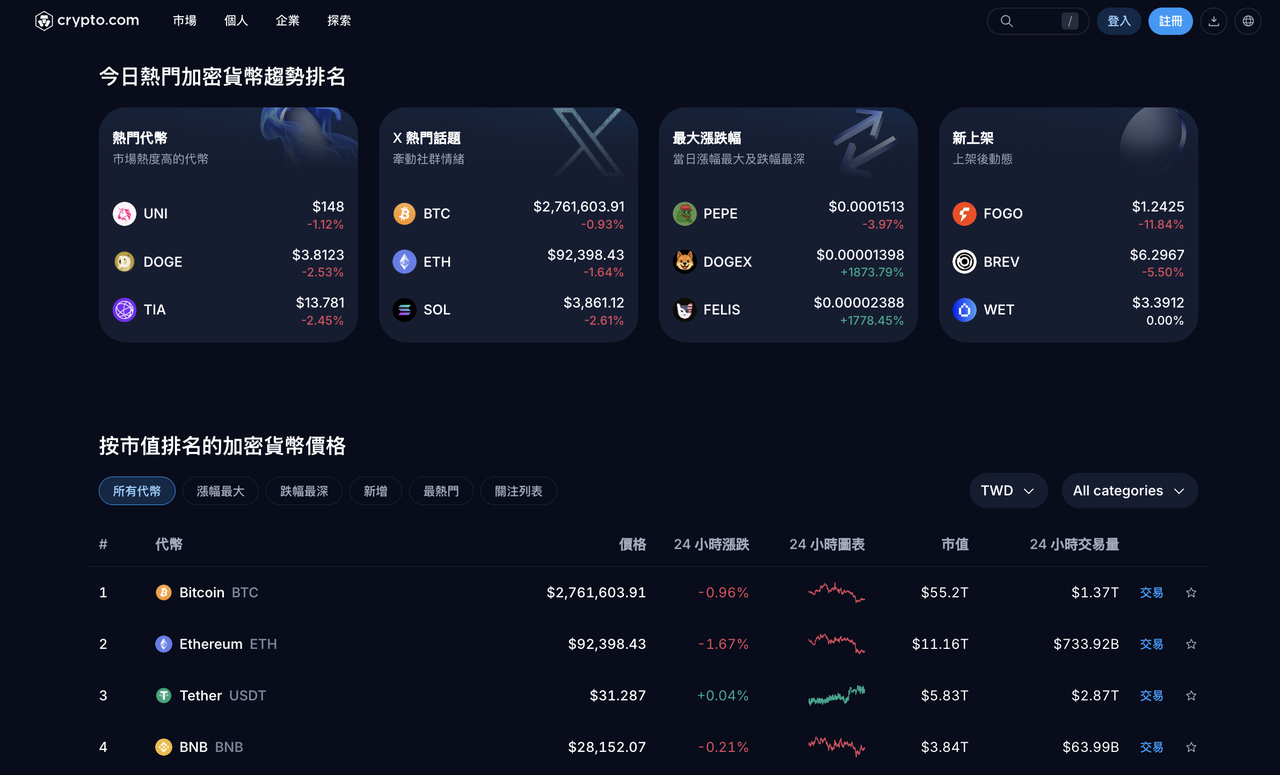
Positioning: Ecosystem-type crypto asset platform combining mobile applications, trading, and payment scenarios.
Crypto.com centers around mobile applications, integrating spot trading, asset management, and payment functions within the same ecosystem, emphasizing incorporating crypto assets into daily financial use scenarios. Besides spot trading, the platform also develops payment cards and yield products, making crypto asset application scenarios more diverse.
In terms of fee structure, spot basic trading fees reach up to about 0.4% and are highly tied to the native token CRO. Users who stake CRO and reach specified levels can gradually reduce trading fee rates, but must simultaneously bear CRO price volatility risks. For Taiwanese users, the platform does not provide direct TWD deposit channels, requiring credit card or stablecoin operations, with attention to credit card fees and exchange rate costs. Overall, Crypto.com is more suitable for investors who value mobile experience and ecosystem integration and are willing to participate in platform token mechanisms.
4. Bitfinex Exchange
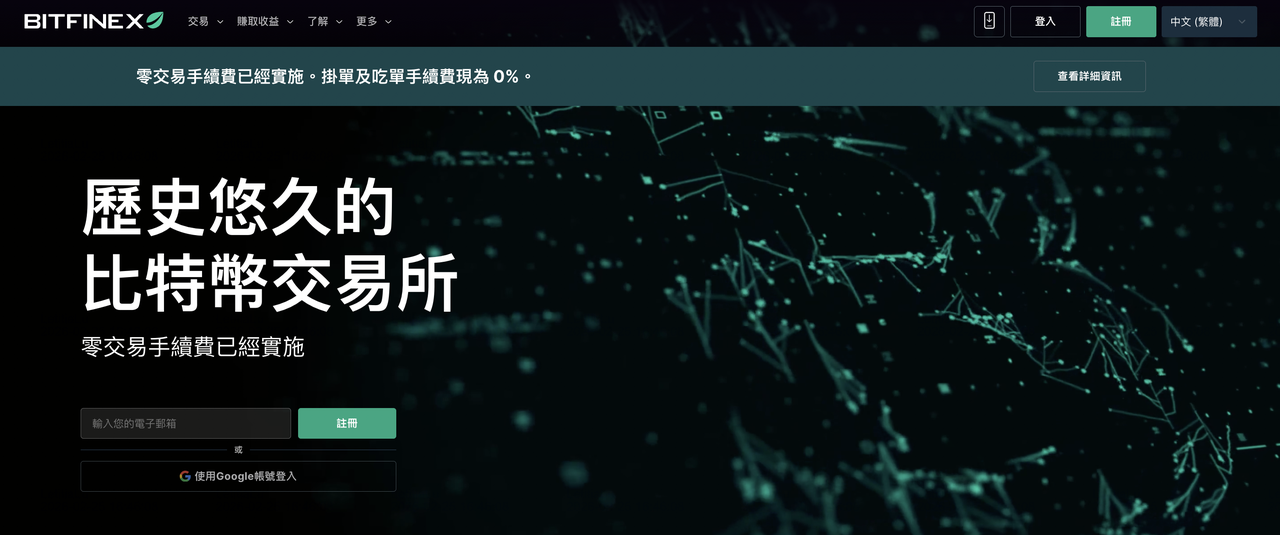
Positioning: International trading platform renowned for professional trading tools, high market depth, and stablecoin liquidity.
Bitfinex was established in 2012 and is one of the important exchanges in the early global cryptocurrency market, with certain influence among professional traders and institutional users. The platform has long been known for high market depth and complete trading tools, particularly outstanding in liquidity for mainstream trading pairs and stablecoin markets. Bitfinex has close historical and capital structure relationships with the world's largest stablecoin issuer Tether (USDT), and USDT is also the platform's core liquidity foundation, giving it certain advantages in stablecoin trading pairs and cross-market fund transfers.
In terms of product functionality, Bitfinex provides spot trading, margin trading, and various derivative tools, supporting higher leverage ratios and advanced order types, and provides complete API interfaces convenient for quantitative trading and strategy development. Its interface design and functional structure lean toward professional users, with relatively high barriers to entry, more suitable for users with trading experience.
Regarding fund deposits and withdrawals, Bitfinex does not support TWD deposits, with Taiwanese users mostly needing to transfer funds through USDT or other crypto assets. Overall, Bitfinex is more suitable for investors who value market depth, stablecoin liquidity, and advanced strategy operations, rather than users who prioritize fiat deposit convenience or simple operations.
Taiwan Local Exchanges: Easier TWD Deposits and Entry-Level Accessibility
Compared to international platforms, the biggest advantage of Taiwanese local exchanges is supporting direct TWD deposits and withdrawals, eliminating foreign exchange conversion and cross-border transfer processes. For investors whose primary funding source is TWD, local exchanges can significantly reduce operational barriers and fund conversion costs, particularly suitable as starting points for first-time entry or small-amount batch allocation.
1. MAX Exchange
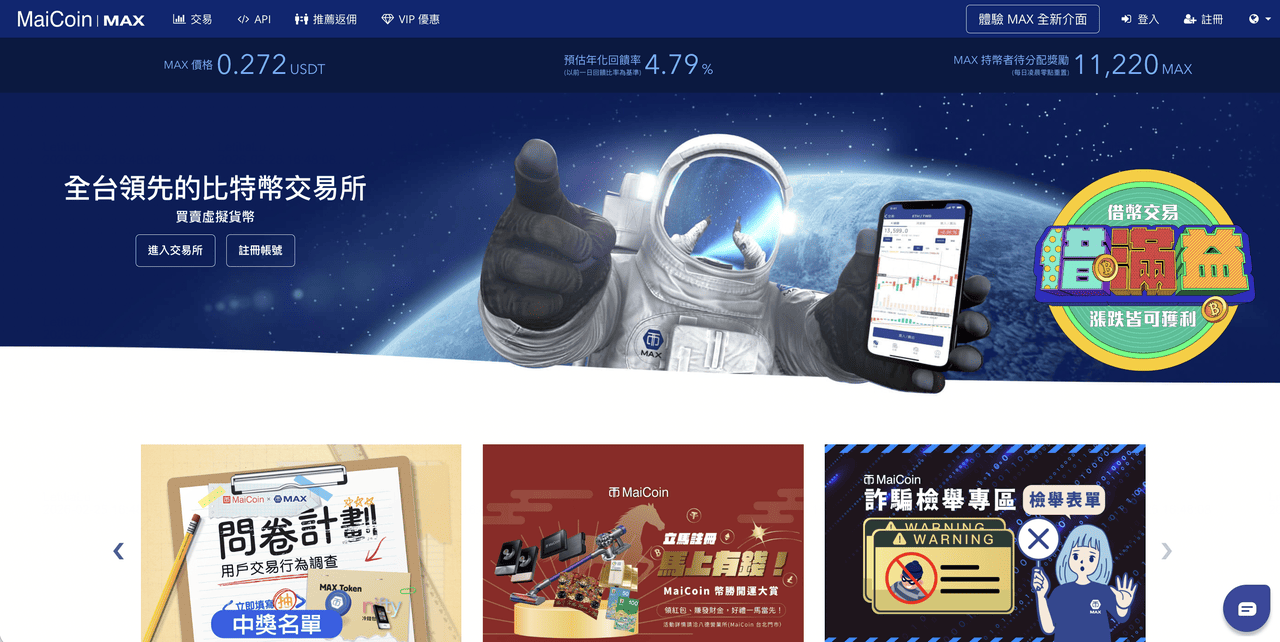
Positioning: Established local cryptocurrency platform with TWD deposits as core advantage.
MAX Exchange is operated by MaiCoin Group, long positioned as providing direct TWD purchases of crypto assets. The platform has TWD trust custody mechanisms through bank partnerships, separating users' TWD funds from operational funds, providing a certain trust foundation for investors who value fiat fund security and operational simplicity. MAX provides TWD trading pairs for mainstream cryptocurrencies like BTC/TWD and ETH/TWD, with spot trading fees around 0.15%, typical levels in the local market.
Due to overall market depth being limited compared to major international exchanges, attention should be paid to slippage and batch order strategies for large transactions. Overall, MAX is most suitable as "the first stop for TWD funds entering the crypto market," particularly suitable for investors new to cryptocurrencies who hope to complete deposits through familiar bank transfer processes.
2. BitoPro Exchange
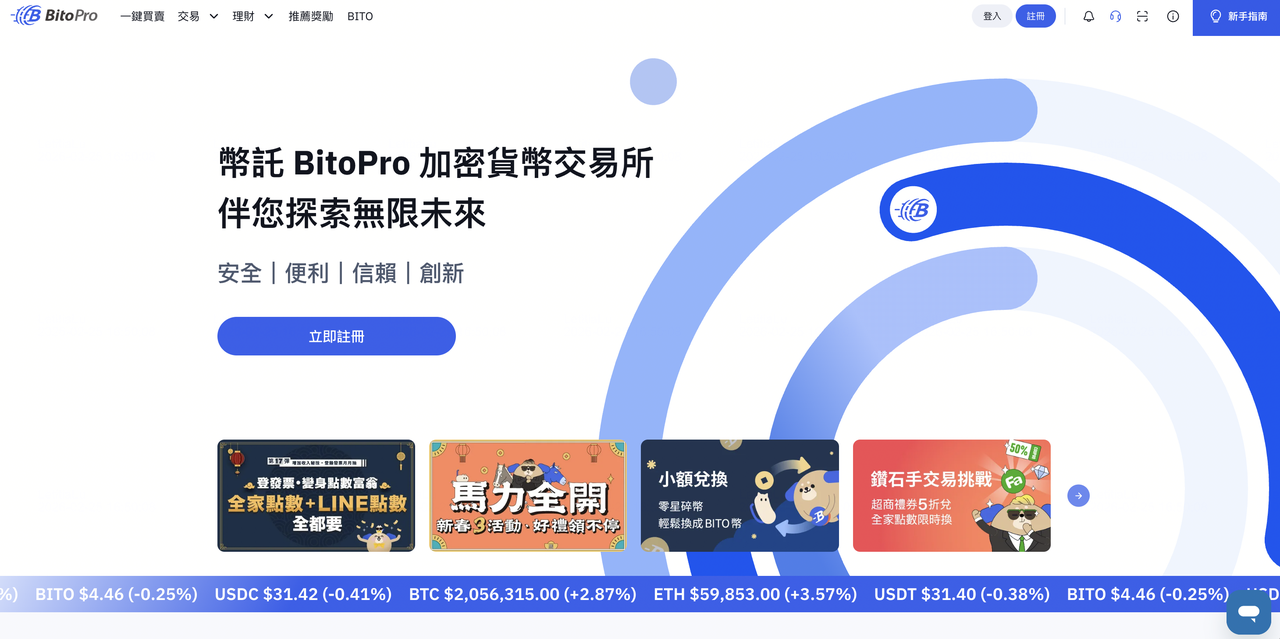
Positioning: Taiwanese local platform combining TWD deposits with diverse trading channels.
BitoPro also supports direct TWD purchases of crypto assets, providing spot trading pairs like BTC/TWD and ETH/TWD, with spot trading fees in the 0.1%-0.2% range, varying slightly by user level. The platform's operational process is relatively intuitive, providing certain convenience for users who primarily use TWD for regular purchases.
Additionally, BitoPro also provides over-the-counter (OTC) services, featuring dedicated personnel assistance for large-volume transactions to reduce impact on public market prices. However, it should be noted that OTC-type transactions in Taiwan's market generally carry higher risks. Even through platforms, caution should be maintained in process confirmation and fund settlement. Overall, BitoPro and MAX both belong to local TWD entry options and can be chosen individually or used in combination based on actual usage habits and trading needs.
Taiwan vs. International Crypto Exchanges: Which Platform Is Right for You?
As crypto markets gradually mature, exchanges have become important infrastructure for asset allocation and market participation. For Taiwanese investors, the common choice is balancing between local platforms that support TWD deposits and international exchanges with more complete functions. Both have different positioning in funding processes, trading costs, and market depth, with different applicable scenarios. The following provides practical comparisons.
| Evaluation Aspect | Taiwanese Local Exchanges (MAX, BitoPro) | International Exchanges (e.g., BingX) |
| Deposit and Withdrawal Channels | Support direct TWD deposits and withdrawals, simple and intuitive process | Most do not support direct TWD deposits, can transfer via stablecoins or credit cards |
| Trading Fee Structure | Spot fees around 0.1%-0.2%, relatively simple structure | Spot fees around 0.1%-0.4%, mostly have tiered systems |
| Trading Pairs and Market Depth | More concentrated cryptocurrency selection, mainstream coin liquidity meets general needs | Broad cryptocurrency coverage, higher liquidity for mainstream trading pairs |
| Multi-Asset Integration Capability | Mainly crypto spot trading, relatively single asset type | Support crypto assets and some tokenized stocks, commodities, etc. |
| Security and Asset Mechanisms | Have TWD trust custody mechanisms | Mostly adopt cold-hot wallet separation and proof of reserves mechanisms |
| Functionality Completeness | Mainly spot trading and basic asset management | Provide spot trading, futures, DCA, and strategy tools |
| Language and Customer Support | Complete Chinese interface and customer support | Chinese support level varies by platform |
| Suitable Use Scenarios | TWD entry and simple allocation | Multi-asset allocation and advanced strategy operations |
Scenarios suitable for choosing Taiwanese exchanges: If the primary need is direct TWD deposits and withdrawals with simple processes and lower operational barriers, Taiwanese exchanges are usually more intuitive. Supporting TWD-denominated trading pairs and bank transfer deposits can reduce the complexity of foreign exchange conversion and cross-border transfers, particularly suitable as starting points for first-time crypto market entry or small-amount, regular allocation.
Scenarios suitable for choosing international exchanges: If already having certain trading experience and beginning to value market depth, fee structures, and diverse strategy tools, such as futures trading, dollar-cost averaging, or cross-market asset operations, international exchanges usually provide more complete functional combinations. For investors hoping to simultaneously allocate crypto assets and tokenized stocks, gold, or other assets, integration and liquidity become key considerations.
Combined use of Taiwanese and international exchanges: In practice, many investors first complete TWD entry through Taiwanese exchanges, then transfer assets to international exchanges for advanced allocation and strategy operations. This division-of-labor usage method helps balance funding convenience with trading tool completeness, maintaining greater flexibility in different market environments.
How to Register on BingX and Get Started: Step-by-Step Guide
For investors who have confirmed using BingX as their primary trading platform, the overall setup process is quite intuitive, with operational logic consistent with mainstream international exchanges. The following explains core steps from account creation to officially starting to use platform functions.
Step 1: Register Account and Complete Identity Verification (KYC)
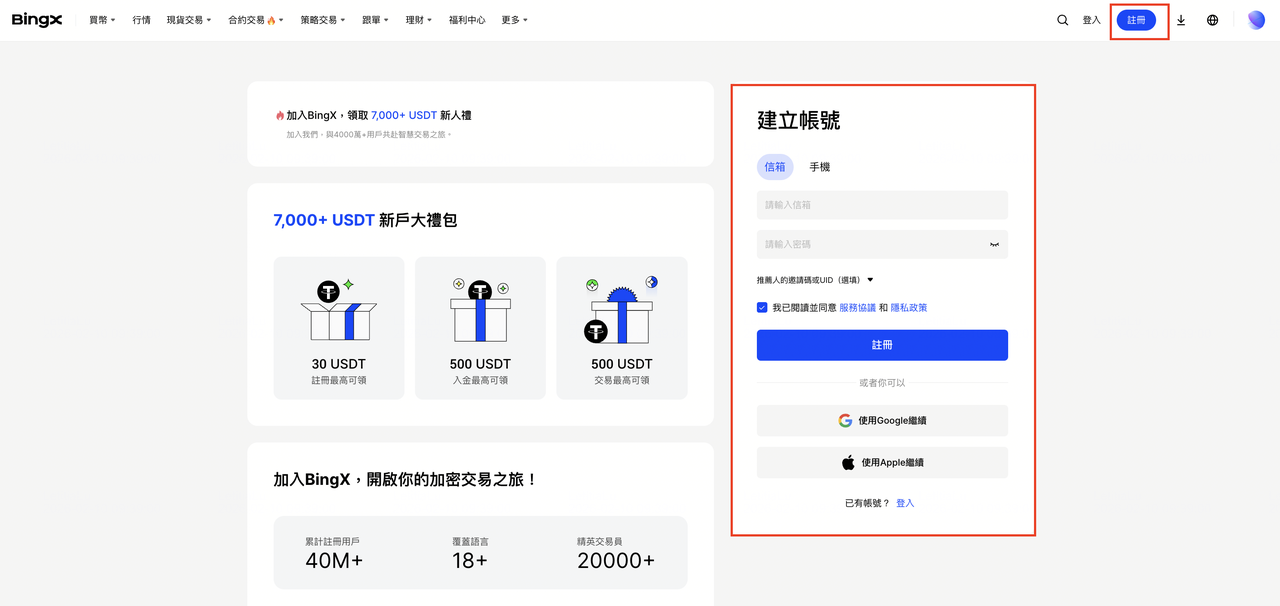
Visit the BingX website or download the mobile application, complete account registration with email or phone number, and complete KYC identity verification according to instructions. The current verification process is highly automated and can be completed quickly in most cases.
After completing registration, it's recommended to immediately enable Google Two-Factor Authentication (2FA) as basic account security settings. For users who use trading platforms long-term, this is an indispensable protective measure.
Step 2: Choose Deposit Method and Obtain Trading Funds
BingX provides multiple fund deposit methods, allowing users to flexibly choose based on trading amount, arrival speed, and fee requirements.
Method 1: Quick Purchase of Stablecoins (USDT)
After logging into BingX, go to the "Quick Buy" page, select USDT as the cryptocurrency, enter the desired purchase amount, choose "Credit/Debit Card" or "Third-party Payment" in payment methods. The system will display corresponding limits, exchange rates, and fees for each option, allowing users to compare and choose. After completing card payment, USDT usually arrives within minutes.
Credit card stablecoin purchases have simple operational processes and fast arrival times, suitable for users who want to quickly complete setup and start trading.
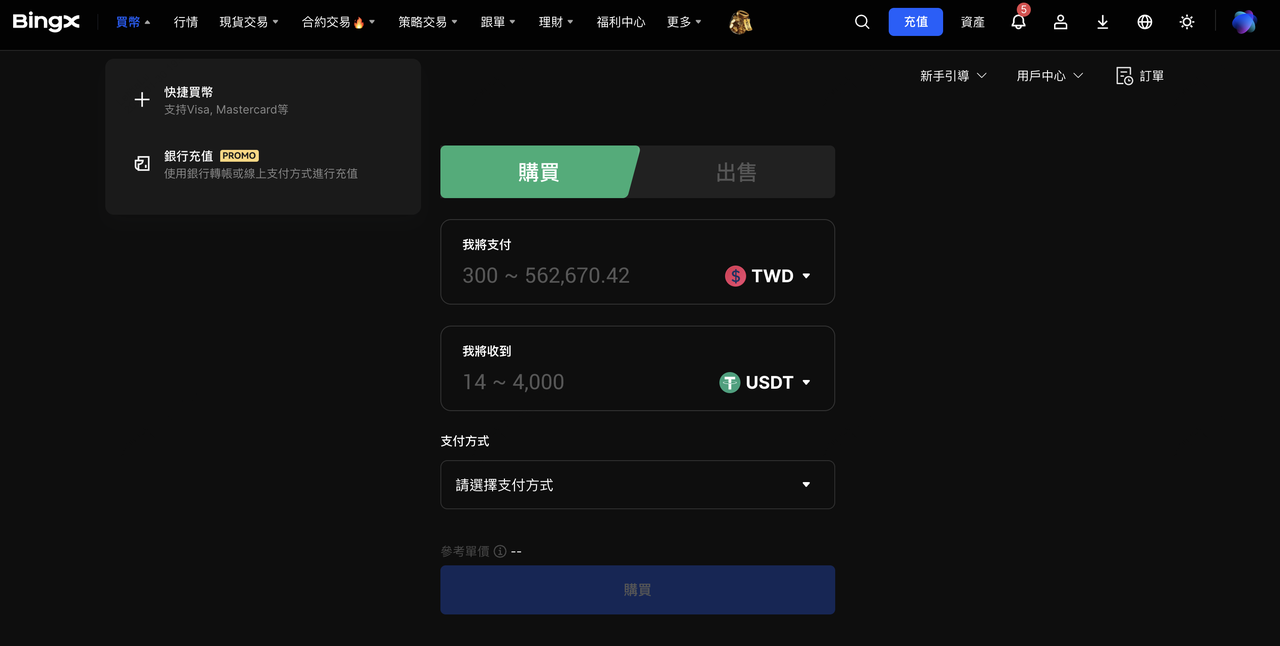
Method 2: Transfer Existing Stablecoin Assets
If you already hold USDT on other platforms or wallets, you can deposit to BingX via blockchain transfers. This method usually has lower fees, suitable for larger amounts or users with operational experience. Please ensure correct network and address when transferring.
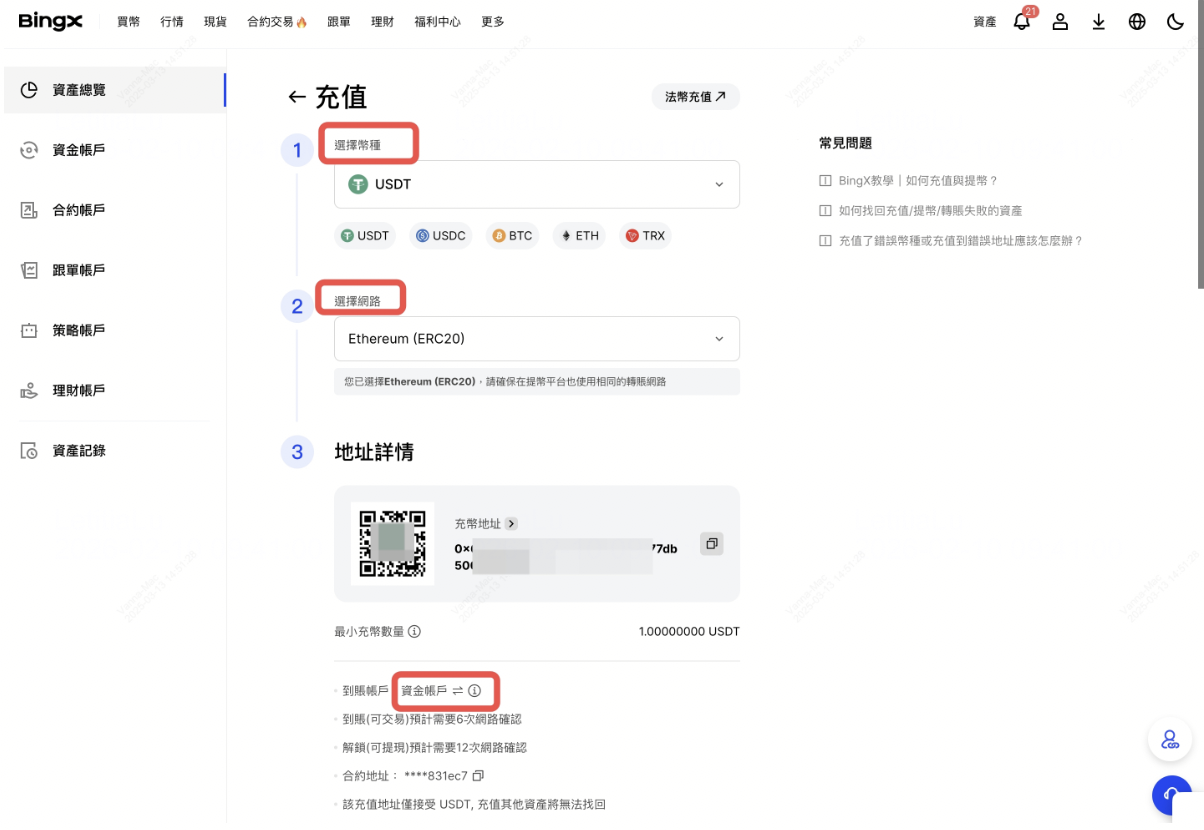
Extended Reading: How to Buy USDT in Taiwan? 2026 Cryptocurrency Exchange Recommendations and Complete Purchase Guide
Step 3: Start Using Trading and Strategy Functions
After completing deposits, you can start using BingX's various trading and strategy tools. The platform not only provides basic trading functions but also integrates multiple strategy modules, allowing users to choose suitable methods based on market conditions and risk preferences:
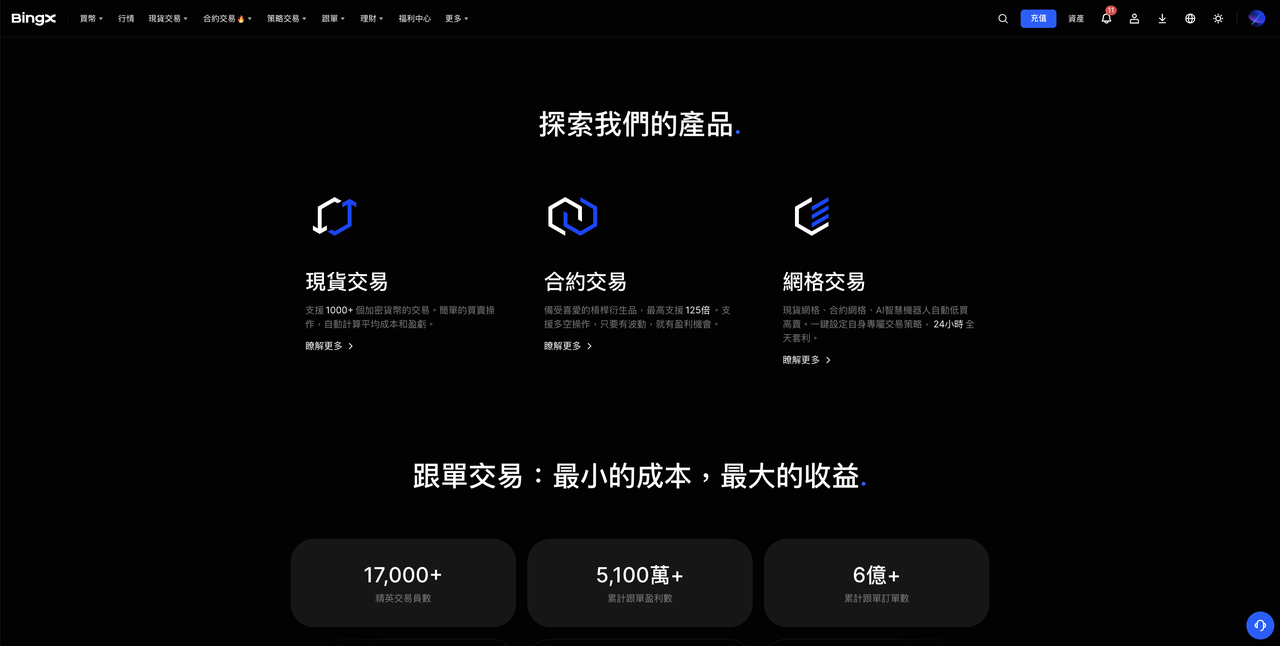
• Spot Trading: Directly buy and sell crypto assets at market prices or set prices, the most basic and common operation method, suitable for long-term holding and general asset allocation.
• Dollar-Cost Averaging (DCA): Set fixed amounts and frequencies to automatically make batch purchases, suitable for long-term investment without frequent market monitoring.
• Copy Trading: Choose traders with public performance records for copy trading, with the system automatically replicating their position operations.
• Grid Trading: Automatically buy low and sell high within set price ranges, suitable for automated strategies in volatile markets.
• Perpetual Futures: Support long-short bidirectional and leveraged operations, belonging to higher-risk derivative tools, recommended to fully understand mechanisms before use.
• BingX TradFi: Can trade tokenized US stocks, gold, crude oil, and other traditional financial assets, supporting cross-market asset allocation.
For investors just starting to use the platform, they can first familiarize themselves with operations through spot trading or dollar-cost averaging, then gradually explore other advanced functions.
Conclusion: BingX Offers a More Integrated Trading Infrastructure
Entering 2026, the crypto market is no longer just a single trading venue for Bitcoin and Ethereum, but is gradually becoming a cross-market system connecting crypto-native assets with RWA (Real World Assets). Against the backdrop of accelerating convergence between TradFi and crypto finance, the role of exchanges has also transformed. Integrated international trading platforms represented by BingX not only provide spot and derivative trading, but also extend to tokenized stocks, gold, and commodities, gradually becoming important infrastructure for cross-market asset allocation.
For Taiwanese investors, the convenience of TWD deposits remains important, with local exchanges serving as entry points for fiat currency into the market. However, when investment needs extend to multi-currency allocation, strategy tool operations, and cross-market asset deployment, platform integration capabilities, liquidity depth, and fee structures become more critical factors. BingX's performance in functional coverage and market depth enables it to simultaneously handle crypto trading and TradFi-type asset operation needs.
Market volatility may be unavoidable, but platform choice can be actively decided. In today's world where crypto assets are gradually becoming part of long-term asset allocation, choosing a trading platform with complete functions and cross-market integration capabilities is essentially planning for the future. Under 2026 market conditions, if seeking balance between convenience, tool completeness, and asset integration capabilities, BingX remains the choice with the most integration advantages for Taiwanese investors.
BingX FAQ: Common Questions Answered
1. Is BingX Suitable for Crypto Beginners?
Yes. BingX has an intuitive interface design with clear spot trading processes and provides complete Traditional Chinese educational materials. The platform also provides 100,000 USDT in demo trading funds, allowing practice operations without actual financial risk. If using futures or leveraged products, it's still recommended to fully understand risk mechanisms first.
2. Can I Trade Spot Only on BingX Without Using Futures?
Yes. BingX adopts modular design, allowing users to use only spot trading functions without activating futures or other advanced tools. Each function is independent with high operational flexibility.
3. What Are the Trading Fees on BingX?
Spot trading fees are 0.1% (same for Maker and Taker); perpetual futures Maker as low as 0.02%, Taker around 0.05%. Overall fees are competitive among mainstream international exchanges.
4. Is BingX Safe? How Are User Assets Protected?
BingX publishes 100% Merkle Tree Proof of Reserves, allowing users to independently verify asset coverage. The platform has a user protection fund and adopts cold-hot wallet separation with multi-factor authentication mechanisms. At the account level, it's recommended to enable Google 2FA for enhanced security.
5. What Deposit Methods Are Available on BingX?
Currently supports credit/debit card stablecoin purchases, third-party payments, and on-chain transfers from other wallets or exchanges. The platform does not provide direct TWD deposits, requiring USDT acquisition first before trading.
6. Can I Trade Both Crypto and TradFi Assets on BingX?
Yes. BingX provides tokenized US stocks, gold, crude oil, and some indices and other TradFi-type products, allowing users to conduct cross-market operations and allocation within the same platform.
7. Do Taiwan Users Need to Pay Taxes When Buying Crypto on BingX?
Taiwan's taxation regulations for cryptocurrencies are still developing and have not yet formed complete unified standards. It's recommended to keep complete trading records and continue monitoring regulatory policy updates.
