



Constellation Energy (CEG) generates and sells electricity from nuclear, natural-gas, and renewable plants to businesses and households across the United States. Its operating nuclear fleet and retail supply platform remain important, while long-duration power agreements with large technology customers expand the opportunity. The conversion of those agreements into earnings depends on plant availability, expensive capacity upgrades, grid approvals, and disciplined integration of the acquired Calpine fleet.
The latest quarter showed stronger adjusted earnings alongside a weaker nuclear operating comparison. Constellation Energy Q2 2026 revenue reached $7.504 billion, up 23.0% from a year earlier, and adjusted operating EPS rose to $2.55 from $1.91, helped by Calpine and favorable market conditions. Yet nuclear output fell to 44,160 gigawatt-hours and the capacity factor to 93.0%. Restoring availability while delivering the raised $11.50 to $12.50 full-year adjusted EPS outlook remains the test.
The CEG stock forecast for 2026 now centers on two competing views:
- The contracted-nuclear expansion case: Google and Amazon agreements turn existing plant upgrades into predictable, long-duration power sales while Calpine adds dispatchable capacity and customer reach.
- The fleet-conversion case: Outages, capital needs, and delayed uprates absorb cash before contracted capacity makes a meaningful earnings contribution.
This guide breaks down the CEG stock forecast, 2026 price scenarios, key risks and analyst outlooks, drawing on Constellation's August 6 Q2 release, company agreements and market data through October 20, plus how to buy CEG stocks on BingX TradFi with USDT.
Top 5 Things for Constellation Energy Investors to Know in October 2026
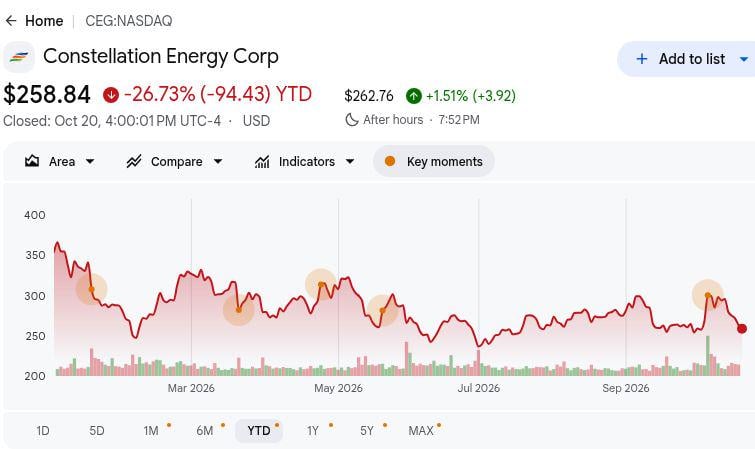
- CEG closed at $258.84 on October 20, down 26.73% YTD. Shares traded within a $228.65 to $406.04 52-week range, reflecting sensitivity to nuclear power contracts and valuation expectations. Raymond James' raised $341 target suggests recovery potential, although future earnings must support that outlook.
- Q2 revenue grew 23.0% to $7.504 billion but missed estimates. Sales increased from $6.101 billion a year earlier, partly supported by the Calpine acquisition, but fell approximately $440 million below the $7.94 billion consensus. Stronger consolidated revenue did not translate into a broad sales beat.
- Adjusted operating EPS rose 33.5% to $2.55. Earnings increased from $1.91 and exceeded the $2.41 estimate by $0.14, while GAAP EPS declined to $1.42 from $2.67. Calpine and favorable market conditions supported adjusted results, although additional nuclear outage days affected operating performance.
- Management raised its 2026 adjusted EPS guidance to 11.50–12.50. The midpoint increased by $0.50 from the previous 11.00–12.00 range, reflecting Calpine integration and stronger commercial execution. Nuclear refueling outage days rose to 86 from 41, making plant availability an important earnings factor.
- Google's nuclear agreements support 890 MW of planned capacity expansion. The 20-year agreements cover upgrades across 11 nuclear units and over $4.3 billion in investment, alongside a separate 2,700 MW supply arrangement. Amazon's 690 MW Calvert Cliffs agreement includes a 190 MW uprate planned for 2030–2032, strengthening long-term contracted demand rather than immediate 2026 generation.
What Is Constellation Energy (CEG)?
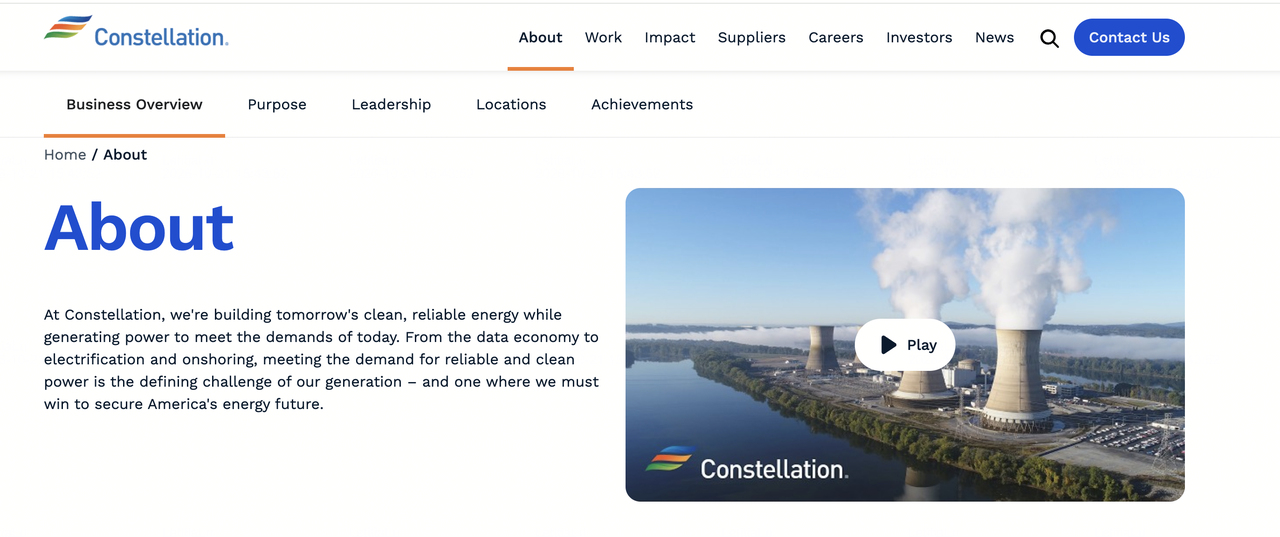
Constellation Energy is one of the largest electricity producers in the United States, operating approximately 55 gigawatts of generation capacity across nuclear, natural gas, hydro, geothermal, wind, and solar facilities. Its nuclear fleet provides a major source of reliable, low-carbon electricity, while the January 2026 acquisition of Calpine expanded its natural gas generation business. Constellation supplies power and energy services to approximately 2.5 million customer accounts, including businesses representing 80% of the Fortune 100. Revenue comes from electricity sales, capacity payments, and commercial contracts, with profitability influenced by power prices, plant availability, and customer demand.
Constellation is expanding its role in AI and data center infrastructure through long-term nuclear power agreements with major technology companies. Google signed a 20-year agreement supporting 890 MW of planned nuclear upgrades, alongside a separate 2,700 MW supply arrangement. Amazon's Calvert Cliffs agreement covers 690 MW, including 190 MW of planned expansion, while Walmart is among the customers supporting additional long-term nuclear contracts. These agreements strengthen Constellation's contracted electricity demand, with future growth depending on nuclear upgrades, regulatory approvals, and the timely delivery of additional generating capacity.
Read More: Top AI Energy Stocks to Buy in 2026: Nuclear, Gas, Fuel Cells, and the AI Power Buildout
Constellation Energy (CEG) Q2 2026 Earnings Overview: EPS Beat and Higher Guidance Offset Revenue Miss
Constellation Energy reported Q2 2026 revenue of $7.504 billion, up 23.0% year over year but approximately $440 million below consensus. Adjusted operating EPS increased to $2.55, beating estimates by $0.14, supported by the Calpine acquisition and stronger commercial performance. However, nuclear output declined to 44,160 GWh as refueling outages increased. Management raised its full-year adjusted EPS guidance to $11.50 to $12.50, with nuclear fleet reliability and Calpine integration remaining central to earnings growth.
|
Financial Metric |
Guidance / Consensus |
Reported / Actual |
Surprise |
|
Q2 operating revenue |
$7.94B consensus |
$7.504B |
Missed. $0.44B below consensus; up 23.0% YoY. |
|
Q2 adjusted operating EPS |
$2.41 consensus |
$2.55 |
Beat. $0.14 above consensus. |
|
Q2 GAAP EPS |
$2.67 a year earlier |
$1.42 |
Lower. Down $1.25 year over year. |
|
Q2 adjusted earnings |
$599M a year earlier |
$920M |
Higher. Up $321M year over year. |
|
Q2 nuclear output |
45,170 GWh a year earlier |
44,160 GWh |
Lower. Down 1,010 GWh year over year. |
|
Q2 nuclear capacity factor |
94.8% a year earlier |
93.00% |
Lower. Down 1.8 percentage points. |
|
New long-term nuclear PPAs |
— |
920 MW |
Added. Contract terms span 15–20 years. |
|
2026 adjusted EPS guide |
11.00–12.00 prior |
11.50–12.50 |
Raised. Midpoint increased $0.50. |
- Revenue grew 23.0% to $7.504 billion despite missing consensus. Sales increased $1.403 billion from $6.101 billion a year earlier, partly supported by the Calpine acquisition. The $440 million consensus miss highlights how power-market conditions and portfolio mix can affect quarterly revenue despite greater generation capacity.
- Adjusted operating EPS rose 33.5% to $2.55. Earnings increased from $1.91 and exceeded the $2.41 estimate by $0.14, while adjusted operating income reached $920 million from $599 million. Calpine and favorable market conditions supported growth, although nuclear outages limited part of the improvement.
- GAAP EPS declined to $1.42 despite stronger adjusted earnings. Net income attributable to shareholders fell to $513 million from $839 million, reflecting fair-value effects, decommissioning items, acquisition-related amortization, and merger costs. Separating these adjustments from recurring operations provides a clearer view of profitability.
- Nuclear generation declined 1,010 GWh to 44,160 GWh. The capacity factor fell to 93.0% from 94.8%, while planned refueling outage days increased to 86 from 41. Maintaining plant availability remains essential to controlling replacement power costs and improving nuclear earnings.
- Constellation raised its 2026 adjusted EPS guidance to 11.50–12.50. The $12.00 midpoint increased by $0.50, reflecting stronger commercial execution and Calpine contributions. Newly signed 920 MW nuclear power agreements beginning in 2029–2032 add longer-term visibility, while near-term results depend on existing fleet performance and integration.
Constellation Energy (CEG) 2026 Investment Outlook: $420 Bull Case vs. $190 Bear Case
Constellation Energy's 2026 outlook depends on whether stronger nuclear generation, Calpine integration, and long-term AI power contracts can support sustained earnings growth. Agreements with Google and Amazon strengthen future demand visibility, while plant availability, operating costs, and the timing of nuclear capacity upgrades remain important to valuation.
The Bull Case: Strong Nuclear Demand Pushes CEG Toward $420
The Bull Case assumes Constellation's nuclear fleet and Calpine's natural gas operations deliver stronger earnings as electricity demand from AI data centers expands. Google's 890 MW nuclear upgrade program and Amazon's 690 MW Calvert Cliffs agreement strengthen long-term contracted demand, while improving nuclear availability beyond Q2's 93.0% capacity factor could support higher generation margins.
A move toward $420 would require 2026 adjusted EPS near or above the $12.50 guidance ceiling, Q3 earnings above the $3.62 consensus, and stronger nuclear output. Clear progress on Google's 11-unit upgrades and the Crane restart would further support the upside case.
The Base Case: Steady Earnings Growth Keeps CEG Between $275 and $350
The Base Case assumes Constellation's 55 GW generation fleet and expanded retail business support stable earnings, while planned nuclear outages and Calpine integration costs limit near-term growth. Google and Amazon contracts improve longer-term revenue visibility, although most additional nuclear capacity will not enter service until after 2026.
CEG could trade between $275 and $350 if adjusted EPS meets the $11.50 to $12.50 annual guidance and nuclear capacity factor improves from 93.0%. Stronger generation and higher guidance could support the upper end, while additional outages or weaker margins would pressure the range.
The Bear Case: Nuclear Outages and Project Delays Pull CEG Toward $190
The Bear Case assumes nuclear plant availability remains weak, wholesale electricity prices soften, or Calpine integration costs exceed expectations. Q2 nuclear output declined 1,010 GWh year over year, while capacity factor fell 1.8 percentage points. Higher maintenance and replacement power costs could pressure earnings before planned nuclear upgrades begin generating additional revenue.
A move toward $190 would become more likely if Q3 adjusted EPS misses the $3.62 consensus and management reduces its $11.50 to $12.50 annual outlook. Continued nuclear outages, delays to the Crane restart, or slower Google and Amazon upgrade schedules could further weaken future cash-flow expectations.
CEG Stock Price Forecasts for 2026 By Wall Street Analysts
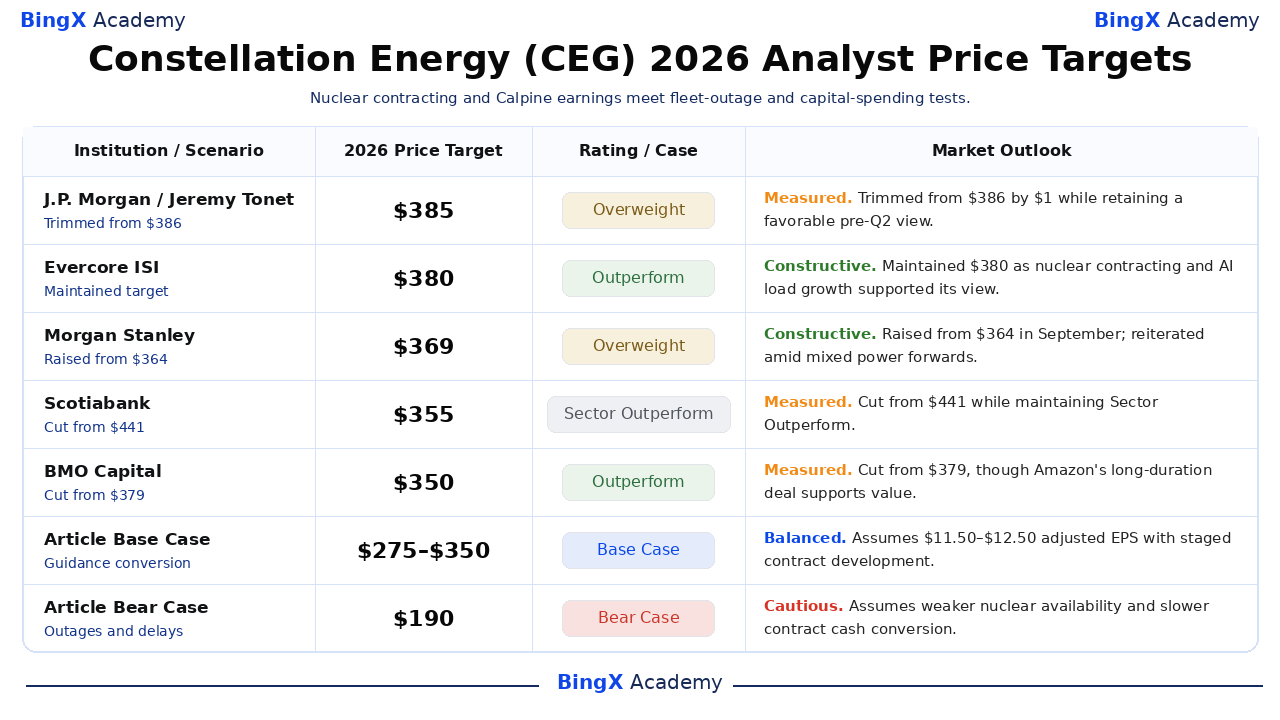
These named, dated analyst actions are third-party 12-month reference points, not promises or a single consensus. Targets differ on nuclear contract value, Calpine earnings, fleet reliability, and valuation. The Article Base and Bear rows are independent editorial scenarios rather than brokerage forecasts; the $420 Bull Case is also an editorial outcome above the named Street targets.
|
Institution / Scenario |
2026 Price Target |
Rating / Case |
Market Outlook |
|
J.P. Morgan / Jeremy Tonet |
$385 |
Overweight |
Measured. July 30: trimmed from $386 by $1 while retaining a favorable pre-Q2 view. |
|
Evercore ISI / Nicholas Amicucci |
$380 |
Outperform |
Constructive. October 1: maintained $380 as nuclear contracting and AI load growth supported its view. |
|
Morgan Stanley / David Arcaro |
$369 |
Overweight |
Constructive. October 7: reiterated the September raise from $364 amid mixed power forwards. |
|
Scotiabank / Andrew Weisel |
$355 |
Sector Outperform |
Measured. October 7: maintained the reduced $355 target, down from $441, while retaining a favorable rating. |
|
BMO Capital / James Thalacker |
$350 |
Outperform |
Measured. October 2: cut from $379 but saw Amazon's long-duration contract supporting value. |
|
Raymond James / J.R. Weston |
$341 |
Outperform |
Constructive. October 20: raised from $336 on nuclear monetization, while trimming its Q3 EPS estimate. |
|
Article Base Case |
275–350 |
Base Case |
Balanced. Assumes 11.50–12.50 annual adjusted EPS and staged contract development. |
|
Article Bear Case |
$190 |
Bear Case |
Cautious. Assumes weaker availability and slower contract cash conversion. |
How to Buy Constellation Energy (CEG) Stock on BingX
Buy and hold Constellation Energy shares through BingX Stocks Trading using USDT or USDC. Constellation offers exposure to growing AI data center electricity demand, long-term nuclear power contracts, and expanding generation capacity. With fractional investing and no leverage or funding fees, eligible users can build positions based on their investment goals and outlook for Constellation's long-term growth.
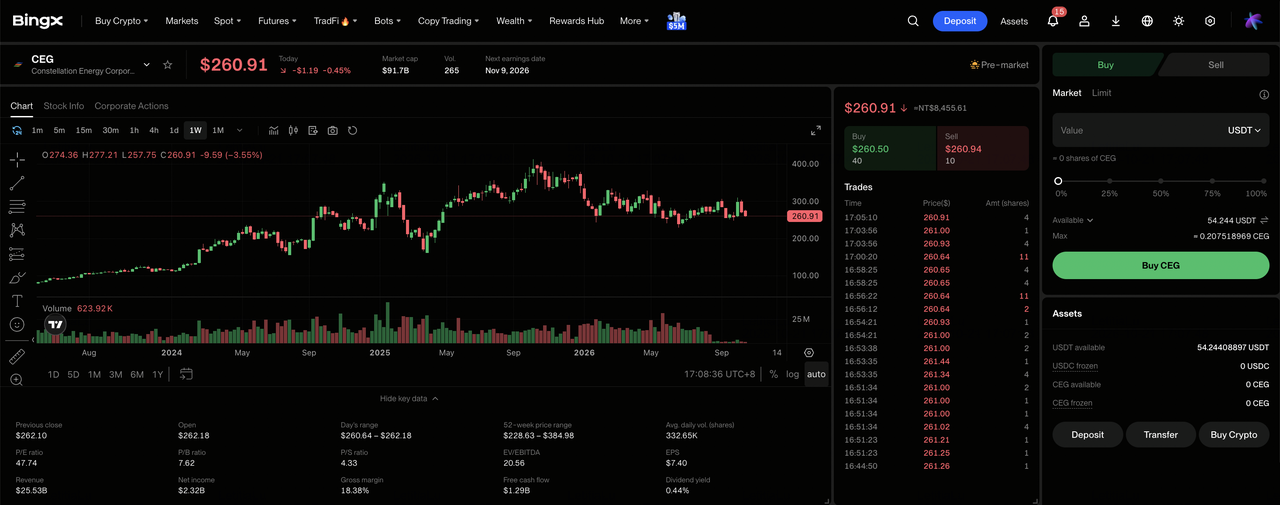
Step 1: Access BingX Stocks Trading. Sign up or log in to BingX, complete the required identity verification, and navigate to "TradFi > Stocks". Accept the Stock Trading Risk Disclosure if accessing the product for the first time.
Step 2: Prepare USDT or USDC. Ensure your Spot Account has sufficient funds for the purchase. Transfer USDT or USDC from your Fund or Wealth Account if needed. Fractional purchases start from 5 USDC or 0.0001 shares.
Step 3: Select Constellation Energy (CEG). Open the Stocks market, search for CEG, and select Constellation Energy (CEG). Review the current share price, trading session, and available order types.
Step 4: Buy Constellation Energy Shares. Select "Buy", enter the investment amount or share quantity, and choose a market or limit order. Market orders execute at available prices during supported trading hours, while limit orders execute at the specified price or better when sufficient liquidity is available.
Step 5: Review and Manage Your Holdings. Open "Stocks > Positions" to monitor your CEG shares and unrealized profit or loss. Use "All Orders" to review transactions or sell shares when needed. T+1 settlement generally affects when sale proceeds become available for withdrawal, rather than when shares can be sold.
Top 5 Risks to Watch for Constellation Energy Investors in 2026
Constellation's large nuclear fleet, expanded generation capacity, and long-term power agreements support its growth outlook. However, plant reliability, project execution, integration costs, and electricity market conditions remain important factors determining how much of that growth translates into earnings, cash flow, and shareholder returns.
- Nuclear outages could weaken earnings growth. Q2 capacity factor declined to 93.0% from 94.8%, while planned refueling days increased to 86 from 41. Lower generation and higher replacement power costs could pressure adjusted EPS despite stronger contracted demand.
- Nuclear expansion delays could postpone contracted revenue. Google's 890 MW program requires upgrades across 11 units, while Amazon's 190 MW expansion is planned for 2030–2032. Construction, permitting, or equipment delays could postpone cash returns on more than $4.3 billion in planned Google-related investment.
- Calpine integration could increase costs. The acquisition expanded Constellation's natural gas generation capacity and supported Q2 adjusted earnings. However, financing expenses, integration costs, and weaker acquired-asset performance could reduce the expected benefits to shareholders.
- Power prices and regulatory changes could affect profitability. Some electricity output remains exposed to wholesale prices, while PJM capacity rules influence generation revenue. Lower realized prices or unfavorable regulatory decisions could weaken cash flow before new long-term contracts begin contributing.
- High growth expectations could pressure valuation. CEG closed at $258.84 on October 20, down 26.73% YTD, despite analyst targets reaching $385. Delayed nuclear projects, weaker contracted returns, or 2026 adjusted EPS below $11.50 could reduce the valuation assigned to future earnings.
Final Thoughts: Should You Invest in Constellation Energy in 2026?
Constellation has a large, operating generation and retail platform. Q2 adjusted operating EPS rose to $2.55 and management raised the annual range to $11.50 to $12.50, while the Google and Amazon agreements extended visibility over future nuclear capacity. Those contracts strengthen the longer-term demand case, but the quarter's 93.0% nuclear capacity factor and lower GAAP EPS show why today's operating results still matter.
The $420 Bull Case requires stronger availability, high-end guidance delivery, and credible upgrade schedules. The $190 Bear Case gains weight if Q3 earnings miss, the annual guide is cut, or costly projects slip while capital is committed. Conservative traders can monitor the next nuclear output and adjusted EPS release before treating contracted megawatts as realized cash flow.
Risk Reminder: Trading and investing in equities like CEG involves a high risk of capital loss. Power prices, nuclear outages, regulatory decisions, project construction, acquisition integration, and leveraged trading can produce sharp losses. Conduct independent research before allocating capital.
Related Reading
- Top AI Energy Stocks to Buy in 2026: Nuclear, Gas, Fuel Cells, and the AI Power Buildout
- Vistra (VST) Price Prediction 2026: Can AI Nuclear Deals Lift VST Toward $250?
- Bloom Energy (BE) Price Prediction 2026: Can AI Data-Center Power Push BE Toward $350?
- Oklo (OKLO) Price Prediction 2026: Can Nuclear Milestones Push OKLO Toward $100?
- NuScale Power (SMR) Price Prediction 2026: Can Project Conversion Push SMR Toward $20?
