

Bitcoin market sentiment may be shifting as signs of renewed U.S. demand begin to appear. One key indicator closely watched by traders is the BTC Premium Index, which tracks the price difference between Coinbase and other major exchanges and often signals institutional activity.
The Coinbase Bitcoin Premium Index is showing clearer signs of strengthening, with readings now sustaining in positive territory over multiple consecutive days as of April 14. After 15 consecutive trading days in negative territory, the index has decisively turned positive, with the latest reading at 0.0421%, indicating that U.S. demand is no longer intermittent but beginning to consistently outweigh global pricing. This marks a shift in order flow, with U.S.-led buying starting to dominate after a prolonged period of sell pressure.
This improvement is supported by spot Bitcoin ETF flows, which recorded two consecutive days of net inflows on April 9 and 10 totaling approximately $599 million, with BlackRock’s IBIT contributing over $400 million. Cumulative historical net inflows have reached $56.5 billion, leaving only around $80 million to fully recover all outflows recorded in 2026. Alongside continued accumulation from institutions such as Strategy, the data suggests that compliant capital is gradually re-entering the market. Notably, this is happening while the Crypto Fear & Greed Index has remained in the “Extreme Fear” zone for 46 consecutive days, highlighting a divergence that may indicate more informed capital positioning ahead of broader sentiment recovery.
What Is the Coinbase Bitcoin Premium Index?
The Coinbase Bitcoin Premium Index measures the percentage difference between Bitcoin’s price on Coinbase, a major regulated U.S. exchange, and the global average BTC price across leading international platforms.
Because Coinbase primarily serves U.S. retail investors, institutions, and compliance-focused capital, movements in this index act as a real-time indicator of U.S. market sentiment and institutional flows.
- Positive premium (Coinbase price above global average): Indicates stronger U.S. buying pressure and potential institutional inflows.
- Negative premium (Coinbase price below global average): Suggests stronger selling pressure from U.S. markets and weaker risk appetite.
This makes the Coinbase Premium Index one of the clearest market indicators for tracking whether institutional capital may be entering or exiting the Bitcoin market.
Coinbase Bitcoin Premium Index Turns Positive After 15-Day Discount, Signaling U.S. Demand Recovery
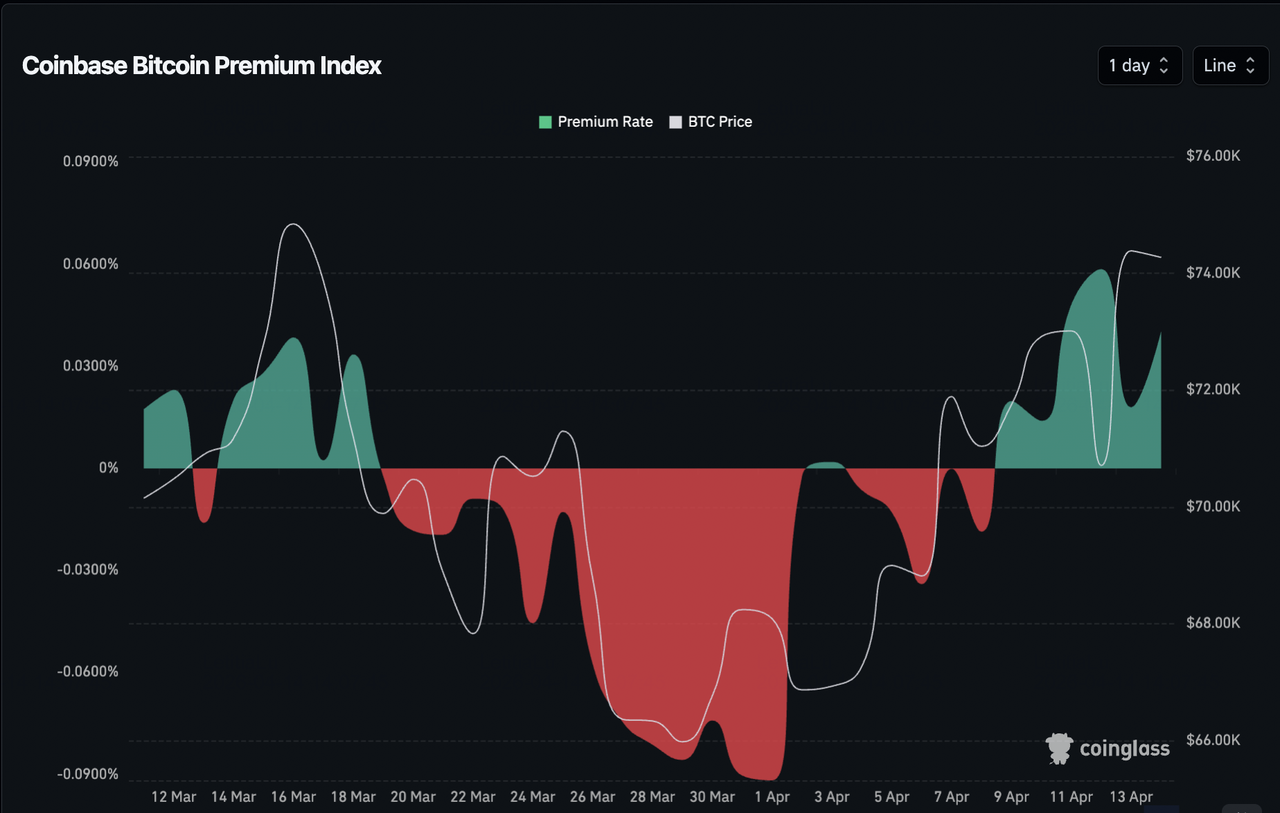
The Coinbase Bitcoin Premium Index has shifted into a more definitive recovery phase, with readings sustaining in positive territory over multiple consecutive days as of April 14. Prior to this, the index had remained in negative territory for 15 consecutive trading days, during which Bitcoin traded at a discount on Coinbase relative to global exchanges, reflecting weaker U.S. demand and cautious positioning from American market participants. The latest reading stands at 0.0421%, indicating that Bitcoin is now trading at a premium on Coinbase, a sign that U.S. demand has begun to consistently exceed global averages.
The emergence of sustained positive premiums suggests that U.S. buying pressure is no longer intermittent but is becoming more persistent. This shift indicates that demand on Coinbase has moved from stabilization into early expansion, with order flow increasingly driven by U.S.-based buyers. Given Coinbase’s role as a primary venue for institutional and regulated investors, the return to consistent premiums may reflect a more active re-entry of compliant capital.
Historically, transitions from extended negative premiums to sustained positive conditions have often coincided with improving Bitcoin price momentum. While the current signal remains in its early stages, traders are closely monitoring whether this trend can hold, as it may indicate that institutional demand is rebuilding with greater conviction beneath the surface.
What the Coinbase Bitcoin Premium Index Reversal Means for Bitcoin
A shift from sustained negative readings to sustained positive premiums reflects a more definitive change in market structure. Historically, a confirmed move into positive territory has often preceded 4–8 weeks of upward price momentum. In the current context, the signal is strengthening beyond a transition phase, suggesting early signs of a more durable demand recovery led by U.S. participants.
|
Signal |
What It Means |
|
Sustained positive premium (0.0421%) |
U.S. demand consistently exceeding global markets |
|
15-day negative premium streak prior |
Prolonged U.S. selling pressure and weak sentiment |
|
ETF net inflows (~$599M over 2 days) |
Institutional capital actively re-entering |
|
Extreme Fear (46 days) vs inflows |
Smart money positioning ahead of sentiment shift |
- 15 Days of Negative Premium Before Reversal: For 15 consecutive trading days, the Coinbase Bitcoin Premium Index remained negative, reflecting weak U.S. demand and reduced institutional participation. During this period, Bitcoin consistently traded at a discount on Coinbase relative to global exchanges. Extended negative stretches typically signal persistent sell pressure, but also set the stage for a reversal once demand returns.
- Shift to Sustained Positive Premium Signals Stronger Demand: The index has now moved beyond intraday signals into sustained positive territory, with the latest reading at 0.0421% as of April 14. Unlike earlier short-lived intraday premiums, this reflects more consistent buy-side pressure across sessions. It suggests that U.S. participants are no longer stepping in selectively, but are beginning to drive price action more steadily.
- Institutional Capital Re-Entering with Early Conviction: Coinbase remains a key venue for institutional and regulated investors. This shift is reinforced by spot Bitcoin ETF flows, which recorded approximately $599 million in net inflows across April 9–10, with BlackRock’s IBIT contributing over $400 million. Cumulative historical net inflows have reached $56.5 billion, leaving only around $80 million to fully recover all outflows recorded in 2026. Notably, this capital return is happening while the Fear & Greed Index remains in “Extreme Fear” for 46 consecutive days, indicating that institutional participants may be positioning ahead of broader market sentiment recovery.
How Traders Are Interpreting the Positive Coinbase Bitcoin Premium Signal
- Short-term outlook: With the index now sustaining in positive territory on a daily basis (latest at 0.0421%), the near-term setup has shifted from early stabilization into initial recovery. This suggests that U.S. buying pressure is no longer just intermittent, but is becoming more consistent. Rather than a fragile transition phase, the current structure points to demand beginning to take a more active role in price formation, though still in the early stages of a broader trend shift.
- What to watch: The key confirmation signal is whether the Coinbase Bitcoin Premium Index can maintain and expand above zero over time. Continued positive readings, especially if supported by ETF inflows (e.g. ~$599M across April 9–10), improving funding rates, and favorable exchange netflow trends, would strengthen the case for sustained recovery. Conversely, a quick reversion back into negative territory would suggest that current buy-side strength is not yet fully established and may still be vulnerable to renewed sell pressure.
How to Trade Bitcoin Perpetual Futures on BingX
Bitcoin can be traded on BingX through the BTC/USDT perpetual futures market, allowing traders to take both long and short positions depending on market conditions. Unlike traditional futures, perpetual contracts do not have an expiration date, making them suitable for traders who want to actively trade Bitcoin price movements.
BingX AI also provides real-time market analysis and trend indicators to help traders evaluate momentum and manage volatility.
Steps to Trade BTC Perpetual Futures
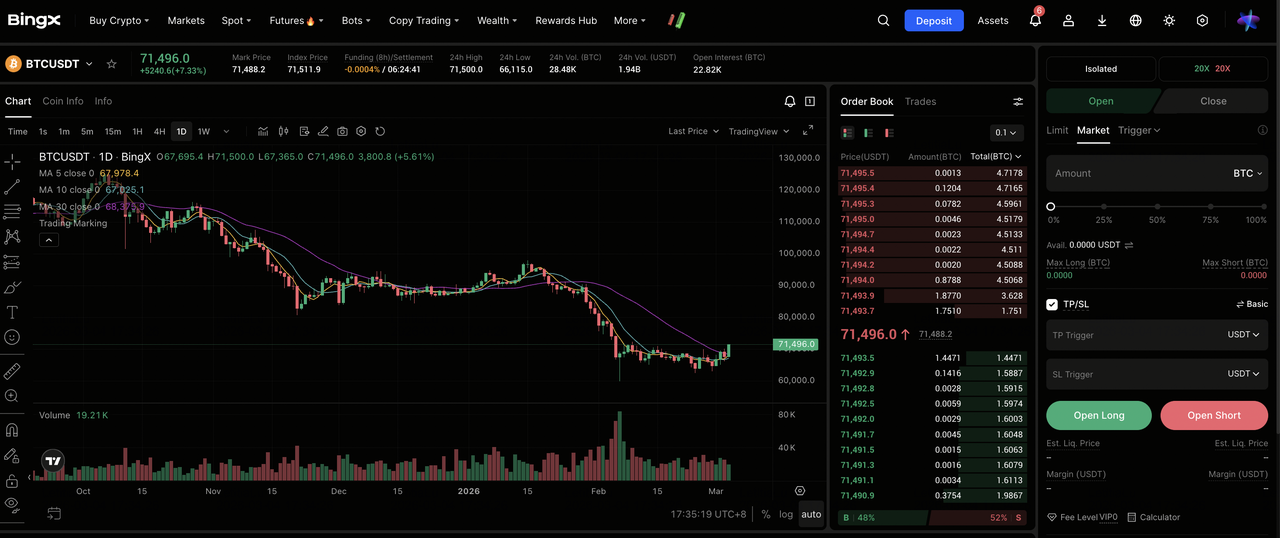
- Open the BTC/USDT Perpetual Futures market: Log in to your BingX account and navigate to the BTC/USDT Perpetual Futures trading page.
- Choose your position direction: Select Long if you expect Bitcoin’s price to rise, or Short if you expect the price to decline.
- Set order type and position size: Choose a market order for immediate execution or a limit order to enter at a specific price. Then specify the position size and leverage level.
- Manage risk before opening the trade: Set stop-loss and take-profit levels to control downside risk and lock in gains if the market moves in your favor.
- Monitor the position using BingX AI insights: Track market momentum, RSI divergence, and volatility signals with BingX AI tools to adjust your position if conditions change.
Leverage can amplify potential returns but also increases risk, so careful position sizing and risk management are essential when trading Bitcoin perpetual futures.
Final Thoughts
The recent shift in the Coinbase Bitcoin Premium Index, now sustaining in positive territory, suggests that buying sentiment in the U.S. market is beginning to recover. Following a prolonged period of negative premiums, the move back above zero indicates that prior selling pressure is easing. This shift is further supported by consecutive days of ETF net inflows and cumulative flows approaching a full recovery of this year’s outflows, pointing to a gradual return of compliant capital into the market.
That said, this does not yet confirm a sustained rally. The Crypto Fear & Greed Index remains in the “Extreme Fear” zone, highlighting a divergence between improving capital flows and still-fragile sentiment. In this context, the return to positive premium is better viewed as an early signal of seller exhaustion. Whether this trend can extend and hold will be key to determining if market conditions are undergoing a more structural shift.
