

Bitcoin Cash (BCH) finds itself at a defining operational crossroads in June 2026. Long recognized as a highly optimized peer-to-peer (P2P) payment network born out of Bitcoin’s historic scalability debate, the protocol is attempting an aggressive transition toward programmable Layer-1 utility. However, asset value remains heavily locked in a structural tug-of-war: can the network’s newly activated smart contract architecture generate sufficient organic developer demand to absorb severe macro headwind distributions?
This guide breaks down the macro liquidity dynamics, recent core protocol upgrades, and quantitative baseline targets shaping the comprehensive Bitcoin Cash price prediction layout for the remainder of 2026.
By mid-June 2026, the spot price action for BCH highlights a steep disconnect between institutional infrastructure onboarding and immediate market gravity. While the core ecosystem has successfully forced a massive protocol evolution, headlined by the successful activation of the Layla upgrade, the BCH token has experienced severe short-term distribution, hitting local lows near the $193–208 range amid an aggregate crypto market pullback led by Bitcoin (BTC) slipping below $65,000.
Plagued by an extreme risk-off backdrop tied to global geopolitical tensions, BCH has surrendered its mid-May local peaks above $465, sliding over 55% within a multi-month corrective window. It is currently trading around $207.82 with an estimated market cap stabilizing near $4.16 billion as of mid-June 2026. This guide evaluates the real-world utility frameworks, institutional ETF plumbing, and moving average consensus models to project structural realities and price ranges.
Top 3 Things to Know About Bitcoin Cash (BCH) in June 2026
- The Layla Hard Fork Success: Activated smoothly on May 15, 2026, this major mainnet upgrade introduces bounded loops, reusable functions, and native bitwise capabilities directly into the Cash Virtual Machine (CashVM), giving BCH advanced smart contract programmability.
- Active Crypto ETF Access: In June 2026, the SEC approved T. Rowe Price’s Active Crypto ETF for listing on NYSE Arca. The fund dynamically manages a basket of crypto assets and explicitly includes BCH alongside legacy majors like BTC and ETH.
- The Layer-1 Competitive Battle: While BCH boasts sub-penny network fees, it faces persistent adoption pressure from highly scalable Layer-1 chains like Solana and Sui, as well as Bitcoin’s own Lightning Network integrations.
What Is Bitcoin Cash (BCH)?
Bitcoin Cash is a high-throughput, utility-focused cryptocurrency originally engineered in August 2017 via a hard fork of the original Bitcoin blockchain. The historic split emerged from a fierce philosophical debate regarding transaction scalability: one community segment favored keeping block sizes small to protect decentralized node execution, while the BCH founders championed a large-block framework to achieve low fees and fast transaction speeds, honoring Satoshi Nakamoto's foundational thesis of a true "peer-to-peer electronic cash system."
The project has entered a massive operational expansion phase. Beyond its legacy footprint as a fast, low-cost medium of exchange with an Adaptive Block Limit Algorithm (ABLA) handling transaction spikes, BCH has transformed its baseline engine. With the implementation of its native CashTokens framework and highly responsive smart contract scripts (CashScript), developers can mint fungible and non-fungible assets natively on the base chain. This allows the network to process complex financial tasks and tokenized dApps without relying on bulky, high-cost layer abstractions.
Read more: What Is Bitcoin Cash (BCH) Payments Blockchain and How Does It Work?
BCH's Architectural Shift in 2026: The Impact of the Layla Upgrade
The bedrock of Bitcoin Cash's 2026 operational transformation rests on its recent core infrastructure overhauls, most notably the successful activation of the Layla upgrade (Node Version 29.0.0) on May 15, 2026.
Rather than acting as a simple marketing patch, Layla represents a major consensus-level evolution that implements four critical Cash Improvement Proposals (CHIPs):
- CHIP-2021-05 Loops: Introduces bounded looping architectures inside the virtual execution environment, allowing smart contracts to perform repetitive data processing without overwhelming network consensus.
- CHIP-2025-05 Functions: Enables developers to code reusable definitions, reducing block space footprint and maximizing efficiency.
- CHIP-2025-05 Bitwise: Restores efficient low-level computer data operations, crucial for advanced cryptographic math and decentralized application logic.
- CHIP-2024-12 Pay-to-Script (P2S): Standardizes automated smart contract outputs across the mainnet landscape.
By upgrading the software environment to C++20 and eliminating old dependencies, the network has drastically expanded its programmability. This structural shift repositions BCH to aggressively capture decentralized finance (DeFi) use cases, ensuring that transactions remain stable at fractions of a penny while supporting scalable automated payment routing.
Traditional Finance Integration: The Multi-Asset Crypto ETF Waves
Evaluating any long-term Bitcoin Cash price prediction model requires tracking the asset’s recent breakthrough into traditional regulated financial plumbing. On June 13, 2026, T. Rowe Price's Active Crypto ETF received official regulatory approval to trade on NYSE Arca. Unlike basic spot products that are limited to holding a single asset, this active fund manages a dynamic allocation across a small group of digital assets, explicitly introducing retail and institutional investors to BCH.
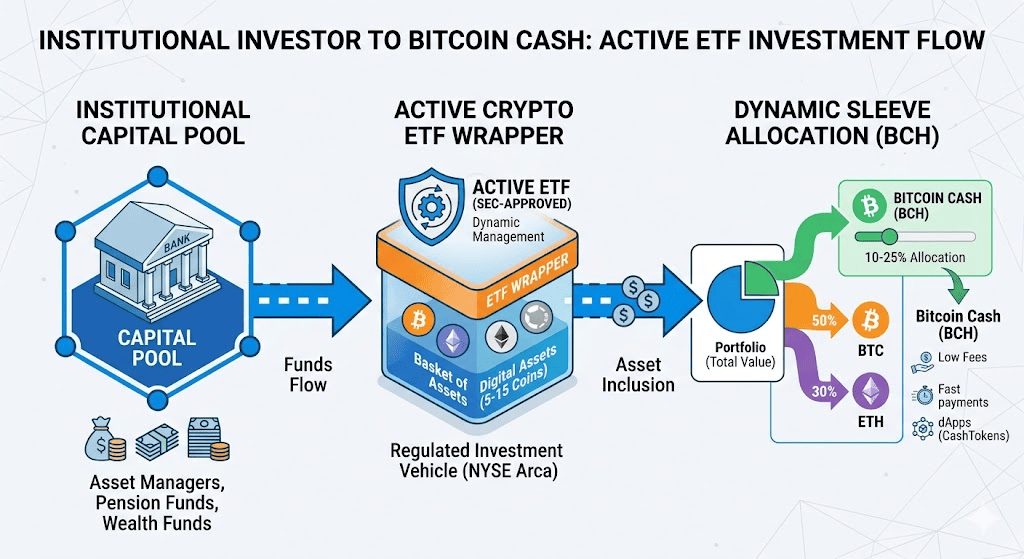
Furthermore, institutional liquidity tools expanded globally via the launch of cash-settled Nasdaq CME Crypto Index Futures on June 8, 2026, alongside Kalshi’s CFTC-regulated BCH perpetual contracts.
However, market participants must approach this milestone with practical caution. Real-world precedents, such as the early spot Litecoin ETF (LTCC), demonstrate that regulatory packaging does not instantly generate massive trading volume. The immediate impact on BCH will depend entirely on whether active fund managers choose to heavily weight the BCH sleeve relative to BTC and ETH, or treat it as a marginal portfolio addition.
What Makes Bitcoin Cash Different From Bitcoin and Other L1 Blockchains?
|
Structural Vector |
Bitcoin Cash (BCH) |
Original Bitcoin (BTC) |
High-Speed L1s (Solana/Sui) |
|
Scalability Core |
Native 32MB Blocks + ABLA |
1MB Base Block + SegWit |
PoS Parallel Consensus |
|
Average Fee Profile |
Sub-Penny (Fractions of a Cent) |
Volatile ($2.00–$20.00+) |
Sub-Penny (Fractions of a Cent) |
|
Smart Contract Engine |
CashVM (Loops & Reusable Functions) |
Restrictive Scripting Architecture |
Parallel Sealevel / Move VM |
|
Liquidity On-Ramp |
Multi-Asset ETFs & CME Index Futures |
Spot ETFs & Deep Liquid Options |
Spot Options Pipelines |
|
Token Design Moat |
Native CashTokens (UTXO Based) |
Layer-2 Taproot / Ordinals |
Account-Based Tokens |
Unlike traditional alternative blockchains that rely on account-based logic prone to state congestion, BCH preserves the clean, security-hardened Unspent Transaction Output (UTXO) framework while building out advanced smart contract compatibility. This ensures that massive transaction batches run concurrently without facing the gas fee spikes common on networks like Ethereum.
Read more: What Is the Difference Between Bitcoin (BTC) and Bitcoin Cash (BCH)?
Bitcoin Cash 2026 Price Prediction: How High Could BCH Go?
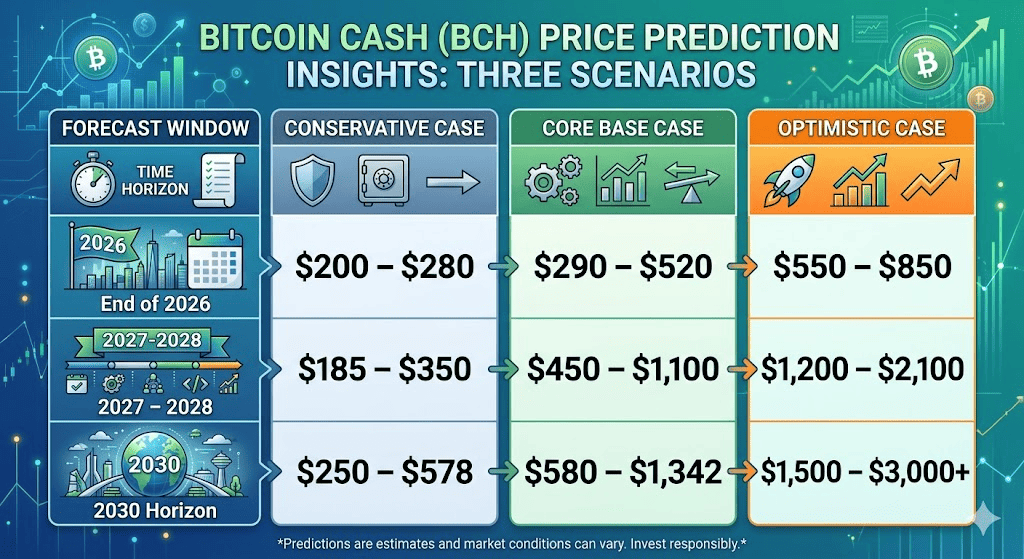
The multi-year trajectory for Bitcoin Cash depends entirely on whether utility consumption via CashVM dApps can eventually outpace macro technical gravity and broader crypto asset pullbacks.
BCH/USDT Technical Analysis Outlook: Multi-Year Support Horizons
From a pure chart perspective, the short-term trend is firmly bearish, with BCH printing multiple red weekly candles beneath its declining 50-day and 200-day simple moving averages. However, the asset has entered a historically significant horizontal support zone between $185 and $230. This macro floor served as the definitive structural launchpad for explosive rallies in both early 2020 and mid-2023.
The Bull Case Scenario
If the deeply oversold RSI levels trigger a violent short squeeze and the Layla upgrade drives an immediate wave of functional dApp deployments, the asset could rapidly clear short-term moving average resistances. Reclaiming the critical $440–$450 zone with sustained trading volume would shift the macro market structure completely. This bullish pivot would open a clean technical path toward the $550–$850 target range by late 2026, fueled by active fund managers heavily weighting BCH within their newly approved multi-asset portfolios.
The Core Base Case Scenario
In the neutral base case scenario, Bitcoin Cash is projected to maintain its steady range-bound consolidation between the $290 and $520 parameters by the end of 2026. This model assumes that broader crypto market sentiment remains cautiously steady, allowing BCH to gradually absorb its oversold technical indicators. Under these conditions, newly launched institutional frameworks, such as the T. Rowe Price Active Crypto ETF and CME index futures, provide a reliable liquidity floor, while early-stage dApp projects begin experimenting with the newly introduced Layla smart contract features.
The Bear Case Scenario
If Bitcoin continues to struggle below the $65,000 threshold and broader market fear breaks the current support baseline, BCH could breach its hard floor at $193.45. In this downside scenario, low active ETF fund inflows and stagnant developer adoption of the CashVM engine would fail to absorb sell-side pressures. This would likely trigger a deeper flush toward the multi-year macro horizontal support baseline around $138.70 before stabilizing into 2027.
Consensus Reference Target Scenarios for Bitcoin Cash Price: 2026–2030
|
Forecast Window |
Conservative Case |
Core Base Case |
Optimistic Case |
|
End of 2026 |
$200 – $280 |
$290 – $520 |
$550 – $850 |
|
2027 – 2028 |
$185 – $350 |
$450 – $1,100 |
$1,200 – $2,100 |
|
2030 Horizon |
$250 – $578 |
$580 – $1,342 |
$1,500 – $3,000+ |
How to Buy Bitcoin Cash (BCH) on BingX Spot
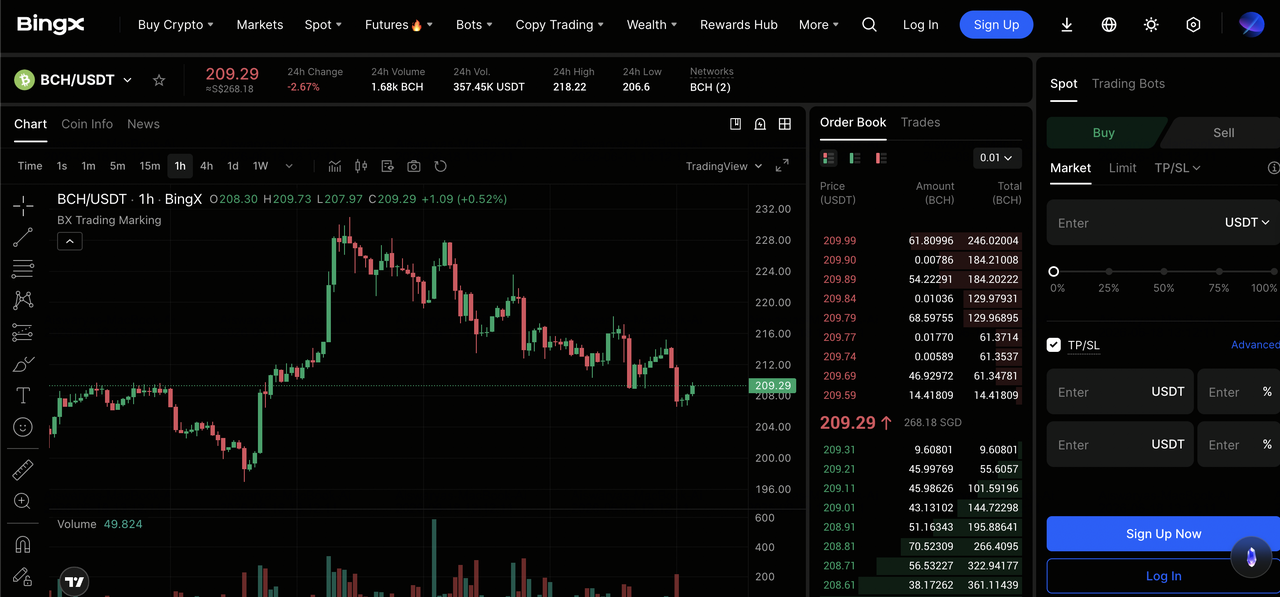
BCH/USDT trading pair on BingX spot market
Navigating the spot market allows you to acquire physical BCH tokens for immediate delivery and long-term holding. Follow this structured layout to execute your spot purchase on the BingX platform:
- Access the Spot Platform: Log in to your verified BingX account, hover over the Spot tab on the main navigation bar, and select Spot Market to pull up the primary exchange terminal.
- Locate the Trading Pair: Use the localized search terminal on the left-hand panel of the trading interface and input the BCH ticker. Select the BCH/USDT trading pair to load the live spot order book and real-time market depth charts.
- Choose Your Order Type: Select your execution parameters on the trading panel located on the right side of the screen. Choose a Limit Order if you wish to specify a precise entry price below the current rate, or choose a Market Order to instantly fill your buy request at the prevailing global spot price.
- Input Order Details: Enter the exact amount of USDT you wish to deploy or specify the total number of BCH tokens you intend to purchase. If using a Limit Order, verify that your target price matches your technical support boundaries.
- Execute the Purchase: Review your transaction metrics and click the green Buy BCH button. Once the order is filled, your newly acquired Bitcoin Cash tokens will instantly clear into your secure BingX Spot Account, ready for ecosystem deployment or holding.
How to Trade Bitcoin Cash (BCH) Futures on BingX
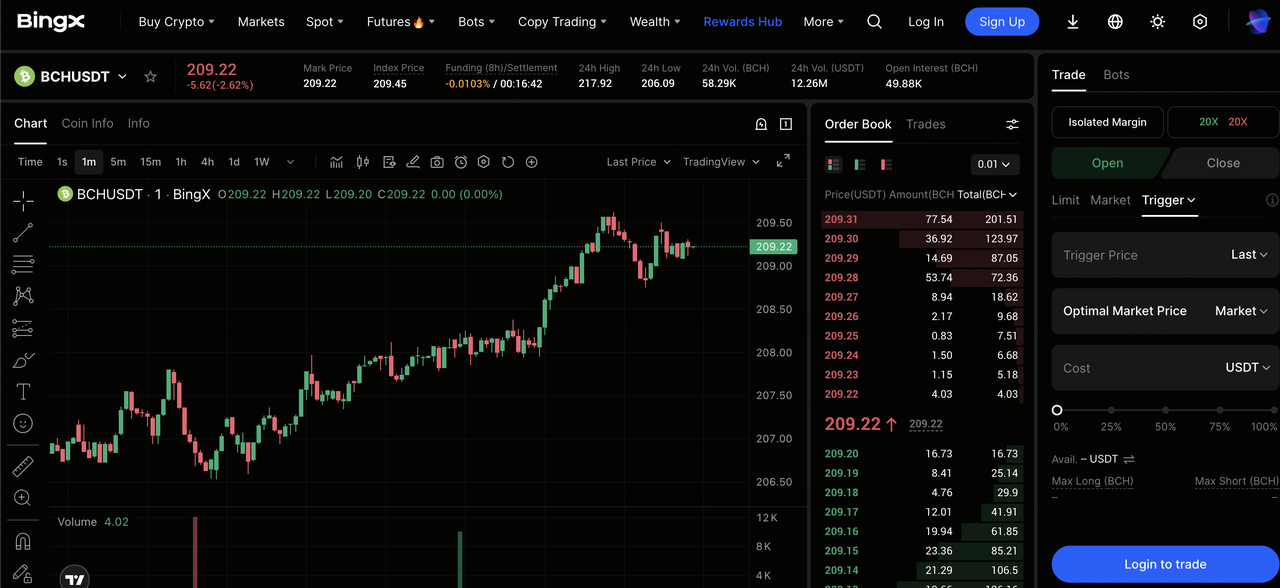
BCH/USDT perpetual contract on BingX futures market
BCH/USDT derivatives can be traded with precision using BingX's comprehensive order management tools. Follow this layout to configure and execute your trading parameters:
- Access the Trading Terminal: Securely log in to your BingX dashboard, hover across the Futures tab on the header navigation bar, and select Perpetual Futures.
- Select the Asset Pair: Enter the BCH/USDT perpetual contract or BCH/USDC perpetuals inside the market search bar to view live order book depth, automated indicators, and real-time canvas metrics.
- Set Your Margin Boundary: Choose Isolated Margin to lock risk liabilities directly to the collateral assigned to that single trade, or use Cross Margin to utilize your broader account balance to defend against unexpected liquidations.
- Configure Leverage Ratios: Adjust the risk multiplier toggle. Given current elevated volatility conditions, conservative leverage, such as 2x–5x, is recommended to manage risk effectively.
- Select Order Parameters: Input execution preferences. Choose a Limit Order to specify an exact entry target, or select a Market Order to fill instantly at the best available index rate.
- Activate Safety Braking: Toggle the Take-Profit (TP) and Stop-Loss (SL) fields to define your precise exit parameters and shield your trading capital automatically.
- Open the Position: Click Open Long if your research supports a technical bounce from the current oversold macro support, or click Open Short to profit from any continuation of the broader downtrend toward deeper levels.
5 Key Risks for Bitcoin Cash Traders to Watch
While the integration of the Layla upgrade and expanding institutional wrappers provide a structural foundation for growth, market participants must carefully navigate a unique matrix of network and macro vulnerabilities to protect their trading capital.
- Bitcoin Correlation Sensitivity: BCH preserves a deep statistical lock with BTC's price movements. If the broader market benchmark breaks into an extended bear phase, individual BCH network fundamentals will be severely capped.
- Developer Adoption Velocity: The technical success of the Layla hard fork is distinct from actual commercial utility. If dApp and stablecoin deployments fail to materialise on the CashVM engine over the coming months, the asset's investment case will soften.
- Derivative Short Imbalances: Current market data highlights negative funding rates and elevated futures positioning. While this leaves the token vulnerable to sharp downward wicks, it also increases the possibility of sudden upward short squeezes.
- Competitive Liquidity Fragmentation: The payment blockchain niche is crowded. BCH must continuously defend its market share against massive stablecoin velocity on chains like Tron and Solana, alongside Bitcoin's native scaling networks.
- Regulatory Framework Shifts: The digital asset space remains under intense scrutiny across major economies. Unfavorable macro updates regarding multi-asset investment funds could impact liquidity and institutional access.
Conclusion: Can Bitcoin Cash Balance Innovation Against Market Inertia in 2026?
Determining whether Bitcoin Cash warrants an active allocation in your trading playbook requires separating near-term technical trends from long-term fundamental progress. In the immediate trading window, the asset faces an overwhelmingly defensive technical setup, pinned beneath long-term moving averages while absorbing broad market fear. Disciplined risk management requires keeping a close eye on the $193.45 support level and looking to a clean break above $304 as an early indicator of a potential trend reversal.
However, from an structural perspective, BCH's smooth upgrade to the Layla CashVM infrastructure establishes a modern, scalable foundation for decentralized utility. If the ecosystem successfully translates these advanced smart contract capabilities into real-world developer traction and growing transaction volumes, the asset will build an on-chain utility baseline capable of supporting a solid market recovery as macro conditions stabilize.
Related Reading
- What Is Bitcoin Cash (BCH) Payments Blockchain and How Does It Work?
- What Is the Difference Between Bitcoin (BTC) and Bitcoin Cash (BCH)?
- What Are the Best Bitcoin Cash (BCH) Wallets to Use in 2026?
- Hyperliquid (HYPE) Price Prediction 2026: The $150 Revenue Thesis vs. The $40 Baseline
- Pi Network (PI) Price Prediction 2026: The AI Human-Infrastructure Thesis vs. The 163M Token Unlock
