
BingX gives users more than one way to bring stock-market exposure into a crypto portfolio. Spot Stock Trading follows a traditional securities model, where eligible users can buy and hold U.S. stocks and ETFs with USDT or USDC through a brokerage and custody arrangement. Tokenized stocks package stock-linked exposure into blockchain-based instruments that trade through the crypto Spot market, creating a more familiar experience for users who already trade digital assets.
The difference is less about the company being tracked and more about how the exposure is structured and held. Spot Stock Trading focuses on securities ownership, eligible dividends or ETF distributions, and conventional settlement. Tokenized stocks focus on token-based access, crypto-market trading, and supported on-chain functionality. This guide breaks down those differences across ownership, custody, income, trading access, fees, and risk so each product can be matched to the type of exposure an investor actually wants.
Key Takeaways
BingX Spot Stock Trading and tokenized stocks both provide access to U.S. stock market exposure, but they differ in ownership structure, custody, income treatment, and how each product can be used.
- Spot Stock Trading provides brokerage-held stock and ETF exposure: Orders are executed through Alpaca Securities LLC, with securities held under its regulated custody arrangement. Eligible holdings may also receive dividends or ETF distributions.
- Tokenized stocks provide stock-linked exposure through blockchain tokens: Products such as xStocks are backed by underlying securities held through the issuer’s custody structure. Token holders receive the economic rights defined by the token terms rather than direct ownership of the referenced company’s shares.
- Both can be bought without leverage: Spot shares and tokenized stocks purchased on the Spot market do not involve perpetual funding or margin-based liquidation. Tokenized stocks, however, add issuer, custody, and blockchain-related risks on top of normal market risk.
- Dividends, fees, and settlement work differently: Eligible spot shares may receive cash dividends or ETF distributions, while some tokenized-stock issuers reflect dividends through token-specific mechanisms. Trading costs, redemption rules, and withdrawal timing also vary by product.
- The better choice depends on how the exposure will be used: Spot Stock Trading is better suited to traditional ownership and longer-term portfolio building. Tokenized stocks offer a more crypto-native route, including blockchain transfers and compatible on-chain use where supported.
What Is BingX Stock Trading?
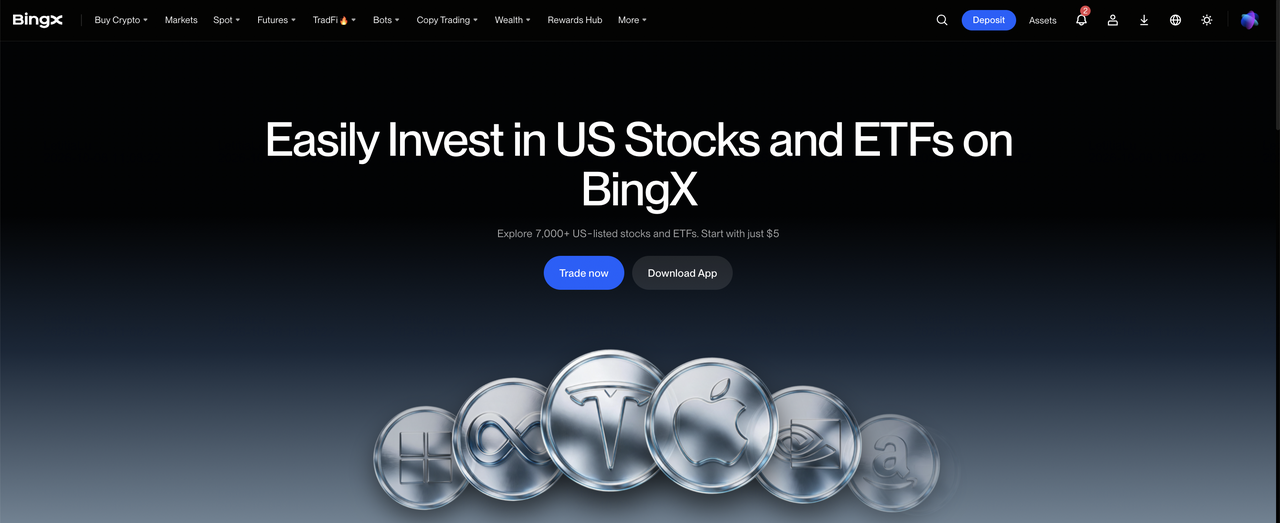
BingX Stocks Trading gives eligible users a simple way to buy and hold U.S. stocks and ETFs using USDT or USDC, with orders executed through Alpaca Securities LLC and trades settled in USDC. Fractional investing starts from 5 USDC, making well-known U.S. companies and diversified ETFs more accessible without requiring the cost of a full share. Everything sits within the same BingX account already used for crypto, creating a more convenient way to add traditional market exposure.
Because these are fully paid securities, there is no leverage, funding rate, or margin-based liquidation to manage. Returns come from changes in the value of the stock or ETF, together with any eligible dividends or distributions. For users looking to diversify beyond crypto, build longer-term positions, or gradually add U.S. market exposure, Spot Stock Trading offers a straightforward way to do so within the BingX ecosystem.
Read More: What Is BingX Stocks Trading? A Beginner's Guide to Trading U.S. Stocks and ETFs With Crypto
What Are Tokenized Stocks?
Tokenized stocks are blockchain-based instruments that provide economic exposure to stocks or ETFs through crypto markets. In a backed structure, the issuer holds or collateralizes the product with the referenced securities and issues tokens linked to their value. On BingX, selected tokenized stocks can be traded through the crypto Spot market, giving users a more crypto-native way to access stock-linked exposure alongside digital assets.
Examples include xStocks and Ondo Stocks. xStocks use tokenized instruments backed by underlying securities, while Ondo Stocks provide tokenized exposure to hundreds of U.S.-listed stocks and ETFs backed by corresponding securities and cash held with regulated financial institutions. Depending on the product, tokenized stocks may support fractional access, blockchain transfers, self-custody, and on-chain applications. Ownership rights, dividend treatment, redemption, custody, and regional availability depend on the issuer and specific token structure
Read More: Ondo Global Markets vs. xStocks: Which Tokenized Stock Platform Is Better in 2026?
BingX Stocks Trading vs. Tokenized Stocks: What Are the Key Differences?
The biggest difference is what the investor actually holds. BingX Spot Stock Trading provides exposure through U.S. stocks and ETFs held under a brokerage and custody arrangement, while tokenized stocks use blockchain-based instruments with issuer-defined economic rights. Key differences include:
- Ownership: Spot Stock Trading involves brokerage-held securities, while tokenized stocks do not provide direct ownership of the referenced shares.
- Dividends: Eligible spot holdings may receive dividends or ETF distributions, while products such as xStocks and Ondo Stocks may reflect them through reinvestment or total-return tracking.
- Transferability: Spot holdings remain within the brokerage structure, while supported stock tokens may be transferred on-chain.
- Settlement: Spot stocks follow traditional securities settlement, while tokenized products follow exchange and issuer-specific transfer or redemption rules.
|
Comparison |
BingX Stock Trading |
Tokenized Stocks on Spot |
|
Ownership |
Share ownership through the brokerage arrangement |
No direct ownership of the referenced company shares |
|
What is held |
U.S. stock or ETF shares |
Stock-linked blockchain token or financial instrument |
|
Custody |
Securities held through Alpaca’s custody arrangement |
Backing assets held by issuer-appointed custodians; tokens held on-platform or in supported self-custody |
|
Dividends |
Eligible dividends or ETF distributions may be credited under the brokerage rules |
Dividend treatment depends on the issuer; some products use reinvestment or token-value adjustments instead of direct cash dividends |
|
Leverage |
None |
None for Spot purchases |
|
Liquidation risk |
No margin-based liquidation |
No leverage-driven liquidation |
|
Costs |
Spread-based execution; possible ETF expenses and taxes |
Spot fees and spreads; possible network, withdrawal, or issuer charges |
|
Trading hours |
Supported 24/5 stock sessions |
Venue- and token-specific; some support 24/7 trading |
|
Settlement |
T+1 affects withdrawal of sale proceeds |
Exchange balances update after trading; transfers and redemptions follow token-specific rules |
|
Transferability |
Brokerage-held position |
Supported tokens may be transferable on-chain |
|
Best suited for |
Share ownership and longer-term portfolio building |
Crypto-native stock exposure and blockchain functionality |
BingX Stocks Trading is closer to traditional investing, with brokerage-held securities, eligible distributions, and conventional settlement. Tokenized stocks are more crypto-native, making them more relevant when transferability, self-custody, or blockchain-based access is part of the investment strategy.
BingX Stocks Trading vs. Tokenized Stocks: Which Product Fits Your Trading Style?
The better choice depends on what the position is meant to achieve. BingX Stocks Trading is generally better suited to users who want brokerage-held stocks or ETFs, while tokenized stocks may appeal more to users who prefer crypto-market access or supported on-chain functionality.
- Long-term investors. BingX Stocks Trading can suit users who want to build positions gradually, hold stocks or ETFs over time, and receive eligible dividends or distributions.
- Income-focused investors. BingX Stocks Trading provides a clearer route to eligible cash dividends and ETF distributions. Tokenized stocks may instead reflect dividends through reinvestment or total-return mechanisms.
- Crypto-market traders. Tokenized stocks may suit users who want stock-linked exposure through the Spot market and a structure closer to other digital assets.
- On-chain users. Tokenized stocks may be more useful when supported blockchain transfers, self-custody, or compatible on-chain applications are part of the strategy.
BingX Stocks Trading is the stronger fit when the priority is share ownership and traditional portfolio building. Tokenized stocks become more relevant when crypto-native access and blockchain functionality are the main advantages.
How to Start Trading U.S Stock on BingX?
BingX Spot Stock Trading is designed for users who want to buy and hold U.S. stocks and ETFs directly from the same account used for crypto. The process starts with account setup and funding, then moves into the Stocks market where an order can be placed and managed through the same interface.
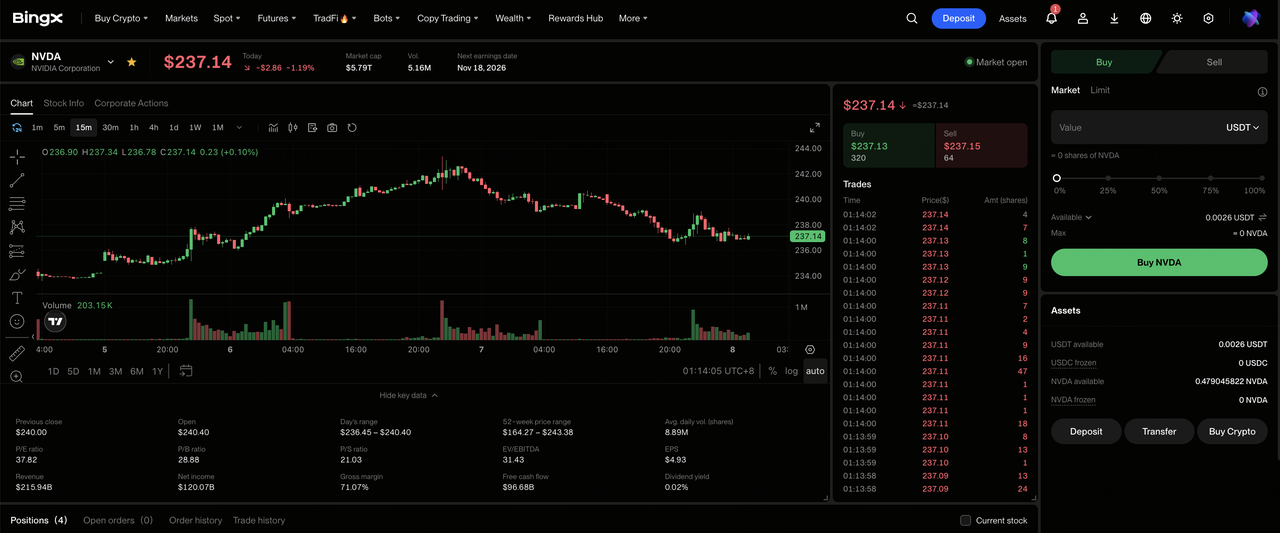
Step 1: Sign up and enable Stocks Trading. Sign up or log in to BingX, complete the required KYC, then open "TradFi > Stocks" and accept the Stock Trading Risk Disclosure.
Step 2: Prepare USDT or USDC. Make sure the Spot Account has enough USDT or USDC for the intended purchase. If needed, supported funds can be transferred from the Fund Account or Wealth Account.
Step 3: Find NVIDIA in the Stocks market. Open "TradFi > Stocks", search for NVIDIA, and confirm the company name and ticker before placing an order.
Step 4: Place the order. Choose "Buy", enter the purchase amount or share quantity, then select a market or limit order. A market order prioritizes execution at available prices, while a limit order executes only at the selected price or better when sufficient liquidity is available.
Step 5: Manage or sell the position. Once the order is filled, the NVIDIA holding appears under "Positions". Use "All Orders" to review open and completed orders, or select "Sell" when ready to reduce or close the position. T+1 settlement determines when sale proceeds become available for withdrawal.
How to Start Trading Tokenized Stocks on BingX?
BingX tokenized-stock Spot markets let users buy and sell stock-linked digital instruments through the crypto trading interface. The process is similar to regular Spot trading, with the added step of checking the token ticker, issuer, and any supported transfer or redemption rules.
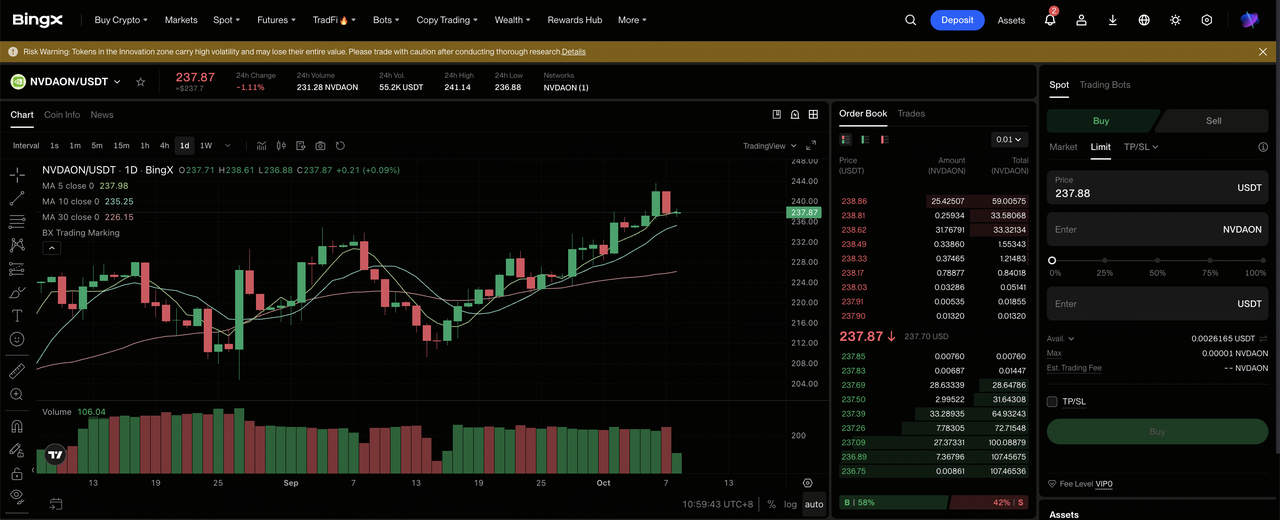
Step 1: Sign up and complete account setup. Sign up or log in to BingX, complete the required identity verification (KYC), and confirm that the selected tokenized-stock market is available for the account and region.
Step 2: Prepare USDT. Make enough USDT available in the Spot Account to cover the intended purchase and trading costs. Check the minimum order before placing the trade.
Step 3: Find the tokenized stock. Go to "Spot", search for NVDAON, and select NVDAON/USDT. Confirm the asset name and issuer so it is not confused with NVDA shares under BingX Stocks Trading.
Step 4: Place a buy or sell order. Choose a market or limit order, enter the amount or quantity, and review the price, fees, and available liquidity before confirming. Selling later uses the same Spot pair.
Step 5: Review and manage the holding. Check the Spot balance and order history after execution. For external transfers, confirm withdrawal and network support first. Redemption, dividends, and other corporate-action treatment follow the issuer’s terms.
Top 5 Risks to Know Before Choosing a Product
Both routes can lose value when the underlying stock falls. The additional risks come from how the holding is structured, where it is held, and which trading or withdrawal services are available.
- Stock prices can still fall sharply. Weak earnings, valuation changes, recessions, or company-specific problems can hurt both shareholdings and stock-linked tokens. The investment remains exposed to the underlying business regardless of the access route.
- Custody and issuer structures affect the legal claim. Spot stocks rely on the brokerage custody arrangement. Tokens add issuer-defined rights and collateral structures. Asset backing helps explain the product but cannot guarantee uninterrupted access or recovery in every circumstance.
- Liquidity can create different execution prices. Token quotes may diverge from the underlying security, especially outside stock-market sessions. Both products can have wider spreads during thin trading. Compare executable prices and order size before confirming.
- Blockchain transfers introduce additional technical risks. External token use can involve network selection, smart contracts, and compatible applications. Confirm support and transfer details before moving assets. A completed transfer may be difficult or impossible to reverse.
- Settlement and service rules affect the exit route. Share-sale proceeds follow T+1 withdrawal settlement. Token trading, exchange withdrawals, and issuer redemption have separate requirements. Listings and eligibility can change, so review current rules before relying on a particular exit method.
Final Thoughts
BingX Stocks Trading and tokenized stocks give users two different ways to access U.S. stocks and ETFs within the BingX ecosystem. BingX Stocks Trading is built around brokerage-held securities, fractional investing, and eligible dividends or ETF distributions. Tokenized stocks provide stock-linked exposure through crypto Spot markets, with supported products offering features such as blockchain transfers and on-chain functionality.
The better choice depends on how the stock exposure is meant to be held and used. BingX Stocks Trading is generally better suited to traditional portfolio building and share ownership, while tokenized stocks may appeal more to users who prefer a crypto-native structure or want supported blockchain features. The underlying company or ETF may be similar, but the ownership, custody, dividend treatment, and transfer options are different.
Related Reading
- What Is BingX Stocks Trading? A Beginner's Guide to Trading U.S. Stocks and ETFs With Crypto
- How to Buy U.S. Stocks on BingX With USDT or USDC: A Beginner's Guide
- BingX U.S. Stocks Trading vs. Stock Perpetuals: What Are the Key Differences?
- Crypto vs. U.S. Stocks: Why Crypto Traders Are Turning to U.S. Stocks?
- What Is a Multi-Asset Trading Platform? A Guide to Trading Crypto and TradFi on BingX
- Top 7 U.S. Stocks to Watch in 2026 and How to Buy on BingX
- Top 8 U.S. ETFs to Invest for Beginners in 2026 and How to Buy on BingX
FAQs About BingX Stocks Trading and Tokenized Stocks
1. Does buying a tokenized stock give ownership of the company?
No. Products such as xStocks provide economic exposure through a tokenized instrument rather than direct ownership of the referenced company’s shares. The rights attached to each token depend on its issuer terms. BingX Stocks Trading, by comparison, provides share ownership through its brokerage arrangement.
2. Can both products be bought with crypto?
Yes. BingX Stocks Trading supports purchases using USDT or USDC, with settlement in USDC. Tokenized stocks trade through crypto Spot pairs using the quoted currency, such as USDT for NVDAX/USDT.
3. Can investors receive dividends through both products?
Eligible holdings under BingX Stocks Trading may receive cash dividends or ETF distributions according to the product rules. Tokenized stocks may handle dividends differently, including through reinvestment, total-return tracking, or token adjustments depending on the issuer.
4. Can tokenized stocks be withdrawn to a blockchain wallet?
Only when withdrawals are supported for the specific token and network. A token may be transferable on-chain at the issuer level without every exchange supporting external withdrawals, so the available network and withdrawal status should be checked first.
5. Are tokenized stocks available 24/7?
Not always. Trading schedules depend on the token and venue. Spot trading, blockchain transfers, and issuer minting or redemption may also follow different operating hours.
6. Which product has lower risk?
Both BingX Stocks Trading and tokenized-stock Spot purchases avoid leverage-driven liquidation when fully paid, but both remain exposed to declines in the underlying stock. Tokenized stocks also introduce issuer, custody, and potential blockchain risks, so the overall risk depends on the specific product and how it is used.
