BingX TradFi gives users two distinct ways to access U.S. stock market opportunities from the same crypto-funded account. Spot Stock Trading is built for buying and holding U.S. stocks and ETFs with USDT or USDC, making it easier to add traditional market exposure alongside an existing crypto portfolio. Stock Perpetuals are designed for more active trading, offering USDT-margined long and short positions, leverage, and 24/7 access on selected instruments. Together, the two products give users more flexibility to choose between ownership-based investing and derivative trading depending on the market view and holding period.
The right product depends on what the position is meant to achieve. Spot stocks can suit users who want to build longer-term exposure, hold shares through earnings cycles, or receive eligible dividends and ETF distributions. Stock Perpetuals can be more useful for short-term directional trades, hedging, or expressing a bearish view without owning the underlying shares. This guide compares how the two products differ in ownership, leverage, fees, trading hours, settlement, and risk, then explains when each approach may make more sense on BingX.
Key Takeaways
BingX Spot Stock Trading and Stock Perpetuals both provide access to U.S. stock market opportunities, but they are built for different goals. The main differences come down to ownership, leverage, costs, and how actively the position needs to be managed.
- Spot Stock Trading gives direct stock and ETF exposure: Purchases are executed through the Alpaca brokerage arrangement and held under regulated custody. Eligible holdings may also receive dividends or ETF distributions.
- Stock Perpetuals provide price exposure without share ownership: Perpetuals track stock-linked price movements through derivative contracts, allowing long or short positions without owning the underlying shares.
- Leverage creates different risk profiles: Spot stock purchases are fully paid and have no margin-based liquidation. Stock Perpetuals can use leverage, which increases both potential gains and losses and introduces liquidation risk.
- Costs work differently for each product: Spot Stock Trading mainly involves spread-based execution costs, while Stock Perpetuals include trading fees and possible funding payments that can add up over longer holding periods.
- The better choice depends on the strategy: Spot stocks are better suited to longer-term portfolio building and ownership-based investing. Stock Perpetuals offer more flexibility for short-term trading, hedging, and directional views, but require closer margin and risk management.
What Is BingX Stock Trading?
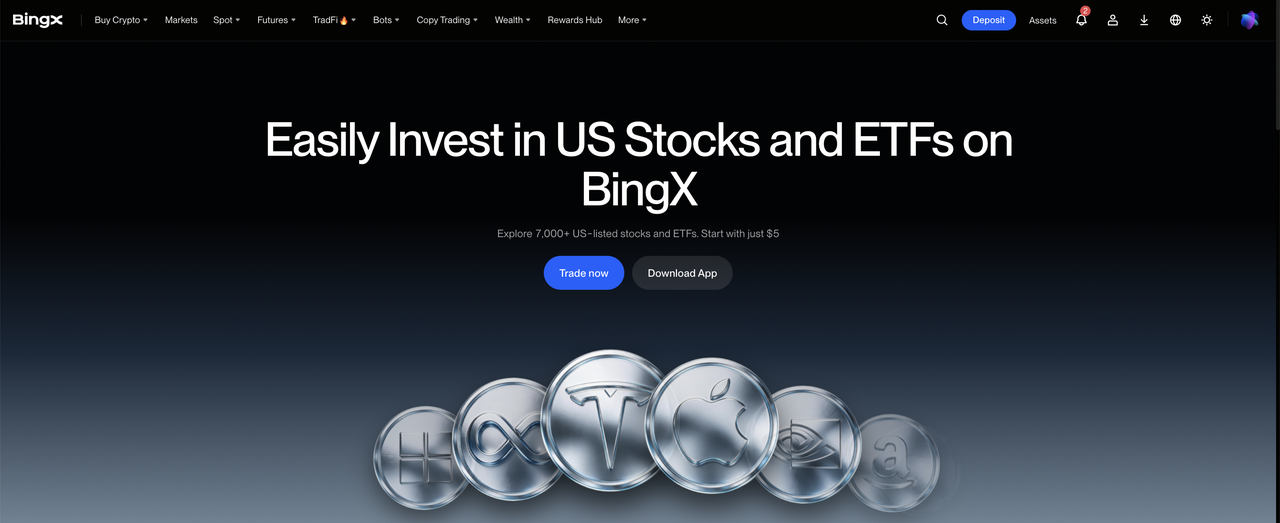
BingX Stocks Trading lets eligible users buy and hold U.S. stocks and ETFs through Alpaca Securities LLC using USDT or USDC, with settlement in USDC. Fractional investing starts from 5 USDC, making it possible to build positions gradually even when a full share trades at a much higher price.
Because these are fully paid securities, there is no leverage, funding rate, or margin-based liquidation to manage. Returns depend on the market value of the stock or ETF and any eligible dividends or distributions. This makes Spot Stock Trading better suited to users who want to build longer-term positions and add traditional market exposure alongside crypto.
Read More: What Is BingX Stocks Trading? A Beginner's Guide to Trading U.S. Stocks and ETFs With Crypto
What Are BingX Stock Perpetuals?
BingX Stock Perpetuals are USDT-margined derivatives that track stock price movements without a fixed expiry date. Users can open long positions when expecting prices to rise or short positions when expecting prices to fall, while leverage allows a larger market exposure with a smaller amount of margin.
Unlike Spot Stock Trading, perpetuals provide price exposure rather than ownership of the underlying shares, so they do not include shareholder voting rights or direct dividend entitlement. They are designed for more active trading and introduce margin requirements, funding payments, and liquidation risk. Available leverage, trading hours, and contract limits vary by instrument.
BingX Stocks Trading vs. Stocks Perpetuals: What Are the Key Differences?
The biggest difference is ownership versus price exposure. BingX Spot Stock Trading is designed for buying and holding U.S. stocks and ETFs, while Stock Perpetuals are derivatives used to trade price movements with long or short positions and optional leverage. That difference affects dividends, liquidation risk, costs, trading hours, and how closely a position needs to be managed.
|
Comparison |
BingX Stocks Trading |
BingX Stocks Perpetuals |
|
Holding and ownership |
Stock or ETF shares held through the broker |
Derivative contract with no underlying share ownership |
|
Direction |
Buy and later sell holdings |
Open long or short positions |
|
Leverage |
None |
Available |
|
Liquidation risk |
No margin-based liquidation |
Positions can be liquidated if margin becomes insufficient |
|
Income |
Eligible dividends or ETF distributions |
No shareholder dividend entitlement |
|
Costs |
Spread-based execution; possible ETF expenses and taxes |
Trading fees and possible funding payments |
|
Trading hours |
Supported 24/5 stock sessions |
Contract-specific; some instruments support 24/7 trading |
|
Settlement |
T+1 affects withdrawal of sale proceeds |
Perpetual contracts have no fixed expiry |
|
Best suited for |
Longer-term holding and portfolio building |
Active trading, hedging, and leveraged directional views |
BingX Stocks Trading vs. Stock Perpetuals: Which Product Fits Your Trading Style?
The better choice depends on the goal of the position. Spot Stock Trading is generally better suited to ownership and longer holding periods, while Stock Perpetuals are designed for shorter-term directional trading, hedging, and strategies that use leverage.
Different types of investors may prefer different products:
- Long-term investors: Spot Stock Trading is a better fit for users who want to hold companies or ETFs over several quarters or years, build positions gradually, and receive eligible dividends or distributions.
- Beginner stock investors: Spot Stock Trading offers a simpler structure because there is no leverage, funding rate, or liquidation price to manage. Fractional shares also make it easier to start with smaller amounts.
- Active traders: Stock Perpetuals may suit users trading earnings, macro events, or shorter-term price moves. Long and short positions provide more flexibility, but require closer monitoring of margin and risk.
- Bearish traders: Stock Perpetuals allow short positions, making it possible to trade a view that a stock price may fall without first owning the shares.
- Portfolio hedgers: Traders can use short perpetual positions to offset part of the risk in an existing stock or related portfolio exposure. Position sizing, funding, and basis differences still need to be considered.
In short, Spot Stock Trading is more suited to ownership and portfolio building, while Stock Perpetuals offer more flexibility for active trading, short positions, and hedging.
How to Start Trading U.S Stock on BingX?
BingX Spot Stock Trading is designed for users who want to buy and hold U.S. stocks and ETFs directly from the same account used for crypto. The process starts with account setup and funding, then moves into the Stocks market where an order can be placed and managed through the same interface.
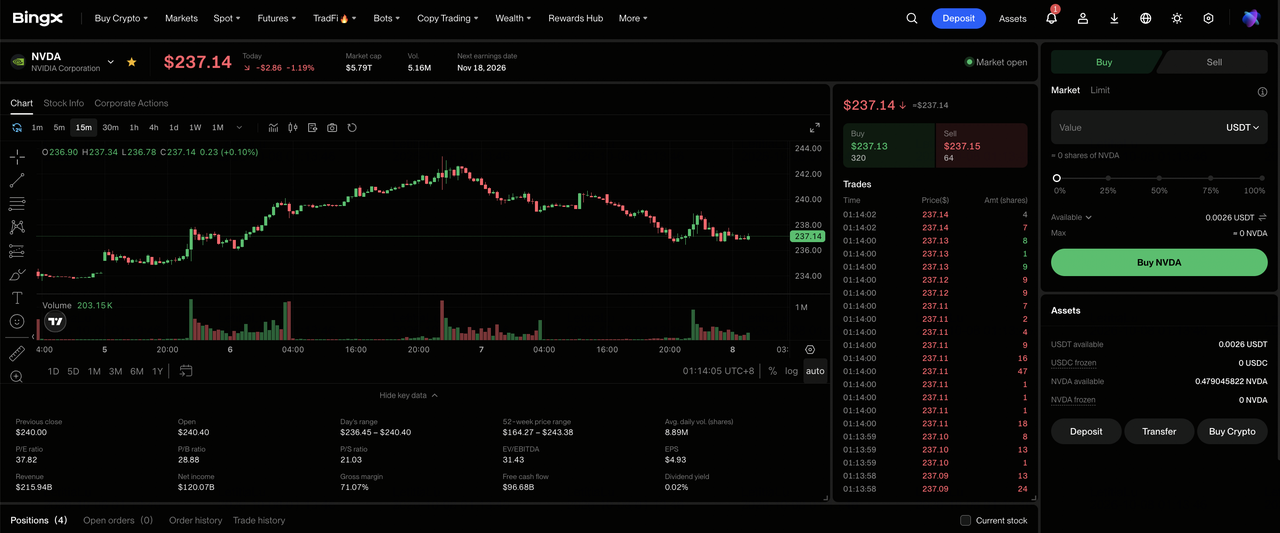
Step 1: Sign up and enable Stocks Trading. Sign up or log in to BingX, complete the required KYC, then open "TradFi > Stocks" and accept the Stock Trading Risk Disclosure.
Step 2: Prepare USDT or USDC. Make sure the Spot Account has enough USDT or USDC for the intended purchase. If needed, supported funds can be transferred from the Fund Account or Wealth Account.
Step 3: Find NVIDIA in the Stocks market. Open "TradFi > Stocks", search for NVIDIA, and confirm the company name and ticker before placing an order.
Step 4: Place the order. Choose "Buy", enter the purchase amount or share quantity, then select a market or limit order. A market order prioritizes execution at available prices, while a limit order executes only at the selected price or better when sufficient liquidity is available.
Step 5: Manage or sell the position. Once the order is filled, the NVIDIA holding appears under "Positions". Use "All Orders" to review open and completed orders, or select "Sell" when ready to reduce or close the position. T+1 settlement determines when sale proceeds become available for withdrawal.
How to Start Trading Stock Perpetuals on BingX?
BingX Stock Perpetuals are designed for users who want to trade U.S. stock price movements with long or short positions and optional leverage. The process starts with account setup and funding, then moves to the TradFi perpetual market where the position can be opened and managed.
Step 1: Sign up and complete account setup. Sign up or log in to BingX, complete the required KYC, and make sure Futures trading is available for the account and region.
Step 2: Prepare USDT for margin. Transfer enough USDT to the Futures account to cover the intended position and margin requirements. Position size and leverage determine how much margin is required.
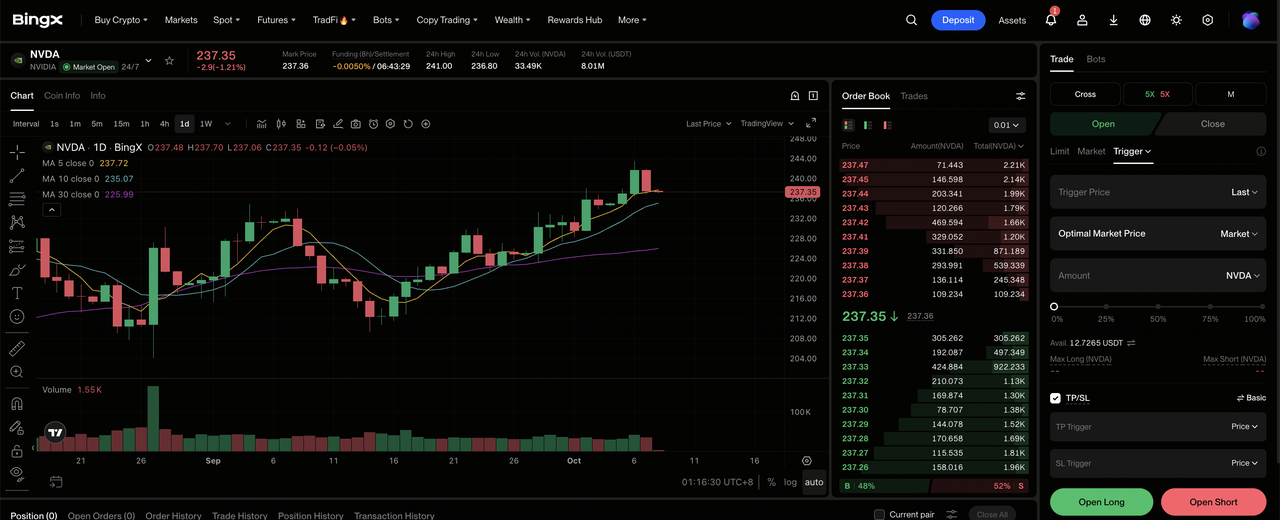
Step 3: Find NVIDIA in the TradFi market. Open "TradFi > Perpetuals", search for NVIDIA, and select the relevant stock perpetual contract.
Step 4: Open a long or short position. Choose "Open Long" if expecting NVIDIA's price to rise or "Open Short" if expecting it to fall. Set the leverage, enter the position size, then choose a market or limit order before confirming.
Step 5: Manage or close the position. After execution, monitor unrealized PnL, margin, liquidation price, and any funding payments. Use stop-loss and take-profit where appropriate, and select "Close" when ready to exit the position.
Top 5 Risks to Know Before Choosing a Product
Both Spot Stock Trading and Stock Perpetuals provide exposure to stock-market moves, but they carry different risks around ownership, leverage, costs, and execution.
- Stock prices can still fall sharply: Weak earnings, valuation changes, recessions, or company-specific problems can hurt both shareholdings and stock-linked perpetuals. Choosing a different product does not remove the underlying market risk.
- Leverage can magnify losses: Stock Perpetuals can be liquidated if margin falls below the required level. A longer-term bullish view may still fail if a short-term price move forces the position to close.
- Costs can affect returns differently: Spot stocks mainly involve spreads and possible ETF expenses, while perpetuals add trading fees and potential funding payments. The more frequently or longer a position is held, the more these costs matter.
- Trading hours and liquidity can affect execution: Spot stocks follow supported U.S. market sessions, while some perpetuals trade for longer hours. Liquidity can still vary, and sharp price gaps may lead to execution away from the expected level.
- Each product has different account and settlement rules: Spot stocks involve broker custody and T+1 settlement, while perpetuals use margin and contract-specific risk rules. Understanding how funds, positions, and withdrawals work helps avoid treating the two products as interchangeable.
Final Thoughts
BingX gives users two distinct ways to access U.S. stock market opportunities from the same platform. Spot Stock Trading focuses on buying and holding shares or ETFs, making it useful for building longer-term exposure, adding fractional positions, and receiving eligible dividends or distributions. Stock Perpetuals serve a different purpose, giving traders long and short exposure, leverage, and more flexibility around shorter-term market moves.
The choice comes down to how the position is meant to be used. Spot Stock Trading makes more sense when the goal is ownership and portfolio building, while Stock Perpetuals are more relevant for active trading, bearish views, or hedging. Having both available on BingX means the same stock idea can be approached differently depending on the time horizon, risk tolerance, and level of position management required.
Related Reading
- What Is BingX Stocks Trading? A Beginner's Guide to Trading U.S. Stocks and ETFs With Crypto
- How to Buy U.S. Stocks on BingX With USDT or USDC: A Beginner's Guide
- BingX U.S Stocks Trading vs. Tokenized Stocks: What Are the Key Differences?
- Crypto vs. U.S. Stocks: Why Crypto Traders Are Turning to U.S. Stocks?
- What Is a Multi-Asset Trading Platform? A Guide to Trading Crypto and TradFi on BingX
- Top 7 U.S. Stocks to Watch in 2026 and How to Buy on BingX
- Top 8 U.S. ETFs to Invest for Beginners in 2026 and How to Buy on BingX
FAQs About Spot Stock Trading and Stock Perpetuals
1. Do stock perpetuals give ownership of the company?
No. Stock Perpetuals provide price exposure through a derivative contract and do not give ownership of the underlying shares. Share ownership is available through BingX Spot Stock Trading under its brokerage and custody arrangement.
2. Can stocks be shorted through Spot Stock Trading?
No. Spot Stock Trading is designed for buying shares and selling existing holdings. Stock Perpetuals provide a separate way to take short positions when expecting a stock price to fall.
3. Is trading a stock perpetual at 1x the same as buying shares?
No. A 1x perpetual position is still a derivative contract with margin rules, funding mechanics, and contract-specific terms. It does not become a shareholding or include shareholder rights.
4. Can dividends be received through both products?
No. Eligible Spot Stock Trading holdings may receive dividends or ETF distributions according to the applicable rules. Stock Perpetuals do not provide shareholder dividend entitlement because the underlying shares are not owned.
5. Are all BingX stock perpetuals available 24/7?
No. Some BingX TradFi perpetuals support 24/7 trading, while others follow specific trading sessions. The current schedule should be checked on the individual contract page before placing an order.
6. Which product has lower risk?
Spot Stock Trading avoids leverage-driven liquidation because shares are fully paid, but the investment can still lose value if the stock or ETF falls. Stock Perpetuals add leverage, margin, funding, and liquidation risk, so the overall risk depends heavily on position size and how the trade is managed.
