
Bitcoin (BTC) is the world's largest cryptocurrency by market capitalization and the most commonly held digital asset by large investors in Taiwan. However, when transaction volumes scale up, the logic behind platform selection differs significantly from small-scale trading. Platforms with insufficient order depth can easily cause slippage during large sell orders, high fixed withdrawal fees directly erode returns in large-scale scenarios, and cumbersome KYC review processes may cause delays when funds need to be quickly deployed.
Large-scale BTC trading revolves around three core challenges: First is transaction cost, where VIP rates and OTC pricing mechanisms affect long-term expenses; Second is execution quality, where order depth determines actual average execution price; Third is capital conversion efficiency, where withdrawal path fees, speed, and compliance relate to whether assets can smoothly convert back to TWD or USD.
This article starts from the actual usage scenarios of Taiwan's large-scale BTC traders, systematically comparing mainstream platforms' VIP rates, BTC order depth, withdrawal costs, and KYC requirements, and organizing the compliance status of OTC trading, to help investors make more efficient choices between cost, execution quality, and capital security.
Key Takeaways
- The actual cost of large BTC trading consists of three components: trading fees, slippage, and withdrawal fees. Simply comparing listed rates can easily underestimate overall costs.
- BingX spot taker fee is 0.1%, with VIP rates decreasing based on monthly trading volume. USDT (TRC-20) withdrawal fees are less than $1, making it one of the common choices for Taiwan users to control overall costs.
- Large market orders can easily cause slippage when order depth is insufficient. It's recommended to check the BTC/USDT order book beforehand and execute in batches using limit orders to reduce price impact.
- In Taiwan's current environment, cash OTC trading is no longer feasible. Large currency exchanges should be completed through internal exchange processes.
- Complete advanced KYC verification before withdrawal to ensure withdrawal limits cover funding needs and avoid temporary restrictions affecting operational rhythm.
Extended reading: Where to Buy Bitcoin in Taiwan? 2026 Bitcoin Exchange Recommendations and Complete Purchase Process Tutorial
What to Know Before Trading Large Amounts of BTC
Compared to general small-scale spot operations, large-scale BTC trading has significantly higher requirements for various platform conditions, and the impact of each aspect amplifies with transaction amounts. Evaluation should not focus solely on individual rate numbers but should simultaneously judge from three core dimensions: rate structure, execution quality, and funding paths. Here are the key points to examine when actually choosing large-scale trading platforms:
- VIP Rates and Large Trading Conditions: Most mainstream platforms provide rate reduction mechanisms based on monthly trading volume. Large users can gradually reduce long-term trading costs by concentrating operations on a single platform. Additionally, some platforms offer institutional-level OTC pricing services where single transactions reaching a certain scale can execute directly at negotiated prices, completely avoiding order book slippage risk.
- Order Depth and Slippage Control Capability: BTC/USDT order book depth directly affects execution quality of large market orders. When market depth is insufficient, large sell orders will consume different price level orders layer by layer, causing actual average execution price to significantly deviate from quoted price. Priority should be given to platforms with abundant depth in mainstream trading pairs and stable bid-ask spreads, and use limit orders in batches to reduce price impact.
- Withdrawal Fees and Funding Path Design: After selling BTC for USDT or USD, the fee structure of withdrawal methods directly affects final returns. Common paths for Taiwan users include transferring USDT (TRC-20) to local exchanges for TWD conversion, or using SWIFT wire transfers for USD, both differing significantly in fees, arrival time, and funding flexibility.
- KYC Level and Withdrawal Restrictions: Large withdrawals typically require completion of advanced KYC verification to unlock higher daily withdrawal limits. If verification procedures are not completed in advance, it may delay operations when funds need rapid deployment, and should be listed as necessary preparation before large trading.
- Compliance and Asset Security Mechanisms: Whether platforms provide public reserve proof, user protection funds, and transparent risk control mechanisms directly affects the security of large assets. When used in Taiwan, priority should be given to platforms with clear compliance paths, ensuring the entire withdrawal process maintains complete banking flow records.
Best Platforms for Large BTC Trades in Taiwan (2026): Fees, Slippage, and Withdrawals
Based on the five major evaluation aspects mentioned above, we'll introduce the mainstream platforms most commonly used by Taiwan's large BTC traders. Each platform differs significantly in rate structure, order depth, withdrawal paths, and language support, and can be selected based on individual trading scale and funding needs for optimal platform configuration.
1. BingX
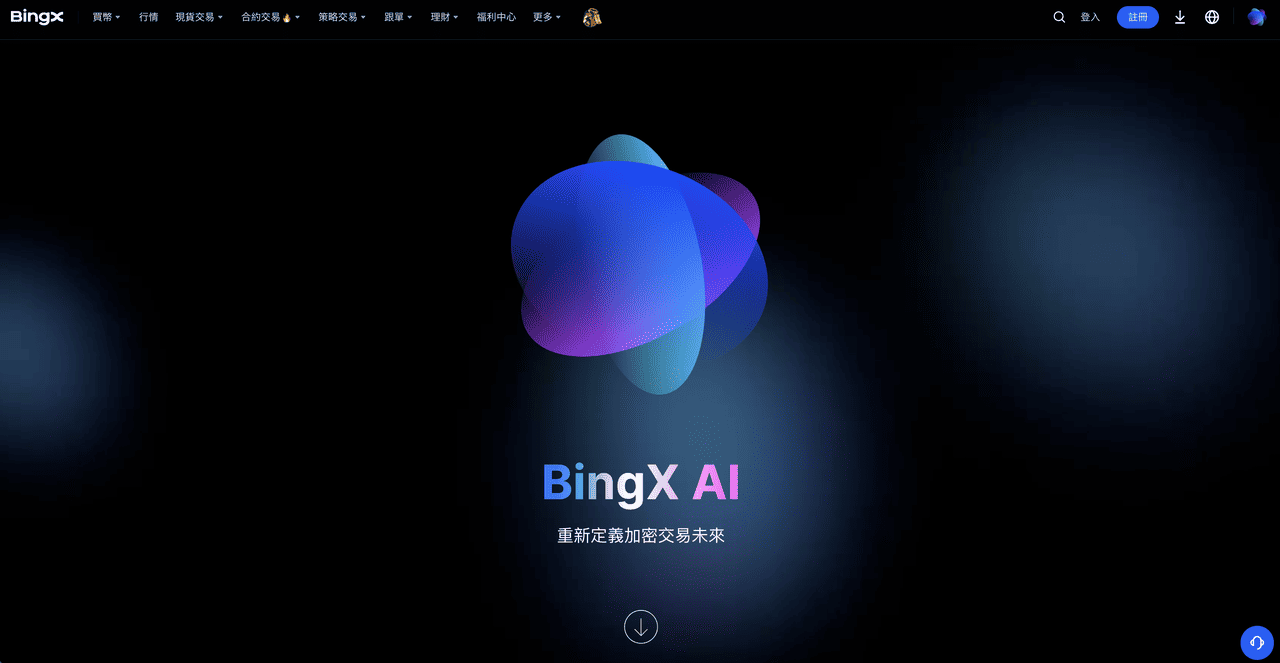
BingX is currently one of the platforms with relatively balanced performance in both fees and withdrawal costs for Taiwan's large BTC traders. Spot maker and taker fees are both 0.1%, with a VIP rate system based on monthly trading volume accumulation, where higher trading volumes result in lower rates, with a maximum reduction to 0%. For example, a single 100,000 USDT BTC market sell would incur 100 USDT in fees; as VIP levels increase, the long-term accumulated cost difference becomes quite significant. The BTC/USDT spot market has stable order depth, maintaining low bid-ask spreads under normal market conditions, with relatively controllable slippage risk for medium to large orders. Additionally, BingX provides a "Guaranteed Price Mechanism" that can lock execution prices under specific conditions, reducing slippage uncertainty from sudden market volatility.
Regarding withdrawal costs, BingX's USDT (TRC-20) withdrawal fee is less than $1, making it one of the low-cost mainstream paths for Taiwan users to transfer assets to MAX or BitoPro for TWD conversion. Large funds can control both slippage and on-chain fees through batch execution and batch withdrawals. The platform provides complete Traditional Chinese interface and 24-hour customer service, offering immediate Chinese support for account or withdrawal issues during large operations. In terms of asset transparency, BingX adopts 100% Merkle Tree Reserve Proof, allowing users to independently verify asset coverage.
- Spot Rates: Both maker and taker fees are 0.1%, with VIP system reducing based on trading volume, maximum reduction to 0%
- Order Depth: BTC/USDT depth is stable, medium to large order slippage controllable, with guaranteed price mechanism
- Withdrawal Cost: USDT (TRC-20) withdrawal fee less than $1, lower cost for common Taiwan withdrawal paths
- Localization Support: Complete Traditional Chinese interface + 24/7 customer service, comprehensive large operation support
- Asset Transparency: 100% Merkle Tree Reserve Proof, self-verifiable asset coverage
2. OKX
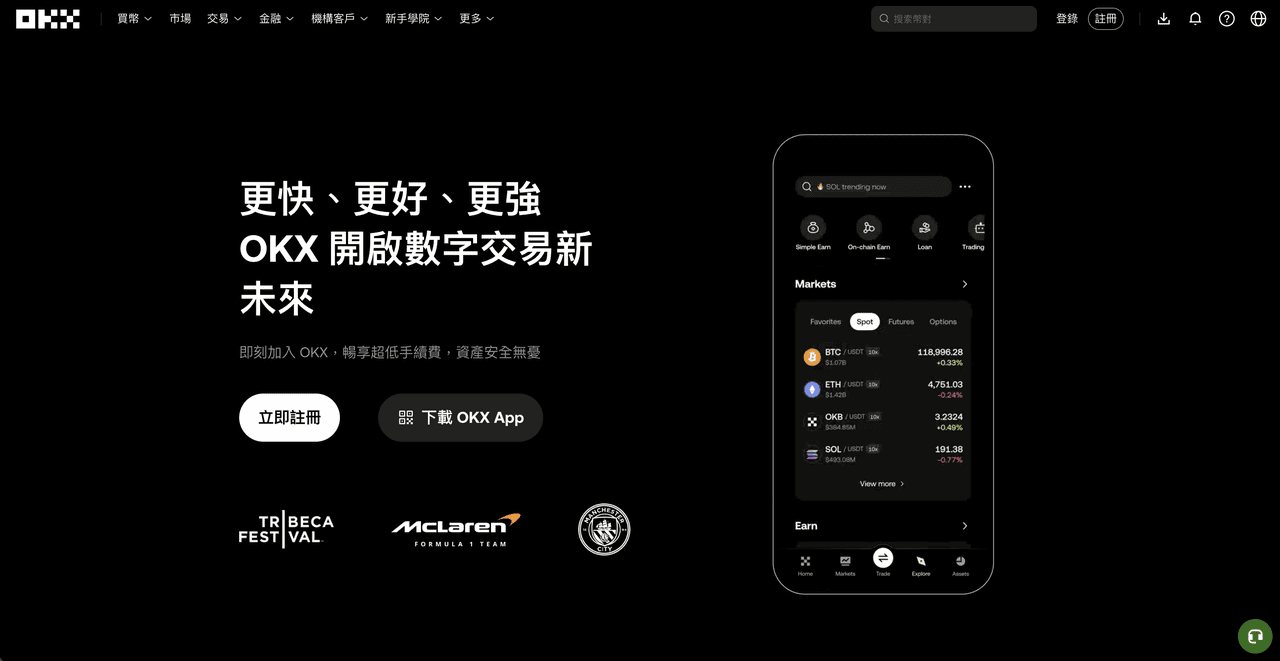
OKX is one of the top-ranked cryptocurrency exchanges globally by trading volume, with BTC/USDT spot and perpetual contract markets having industry-leading order depth. Slippage control capability for large market orders is among the relatively stable category among mainstream platforms. Spot taker fee is 0.1%, using a dual-track VIP system calculated by trading volume and platform token OKB holdings. High-level users can further reduce rates, with maker orders even achieving negative rates, attractive to high-frequency large traders pursuing extremely low trading costs.
In terms of user experience, OKX provides complete Traditional Chinese interface and supports copy trading and automated strategy tools, suitable for users with advanced strategy needs. For withdrawals, OKX's USDT (TRC-20) withdrawal fee is also less than $1, allowing transfer to Taiwan local exchanges for TWD conversion, with overall cost structure similar to mainstream international platforms.
Extended Reading: BingX vs OKX Comparison: Which Exchange is Better for Spot and Futures Trading? Fee and Pros/Cons Analysis (2026)
3. Kraken Pro
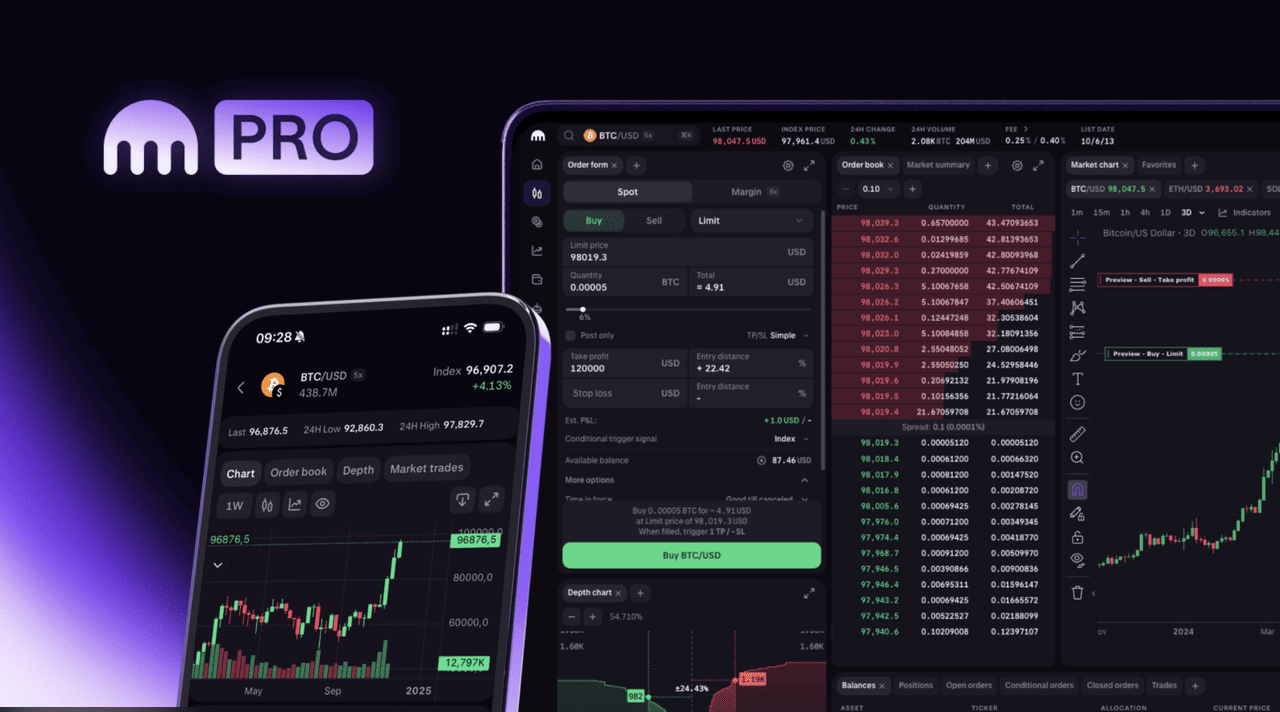
Founded in 2011, Kraken has maintained a record of zero customer fund losses, with security and regulatory framework closer to traditional financial institutions. It undergoes regular third-party audits and holds a Wyoming state banking license in the US. Spot taker fee starts at 0.40% and maker fee at 0.25%, with overall rates higher than most mainstream platforms, but can decrease significantly with increased monthly trading volume, with high-volume users achieving taker fees as low as 0.10%. The BTC spot market is primarily institutional users with stable order depth, keeping slippage risk for large trades within controllable ranges.
For withdrawals, Kraken offers SWIFT wire transfers (fixed around $25), allowing direct conversion to USD and transfer to bank accounts, suitable for large traders needing USD funds. Since it's a fixed cost, the proportion is relatively lower for larger single amounts. The platform currently doesn't provide Chinese interface and requires English operation, presenting some usage barriers for some Taiwan users.
Extended Reading: BingX vs Binance vs Kraken: 2026 Cryptocurrency Exchange Comparison, Which Platform is Best?
4. Binance
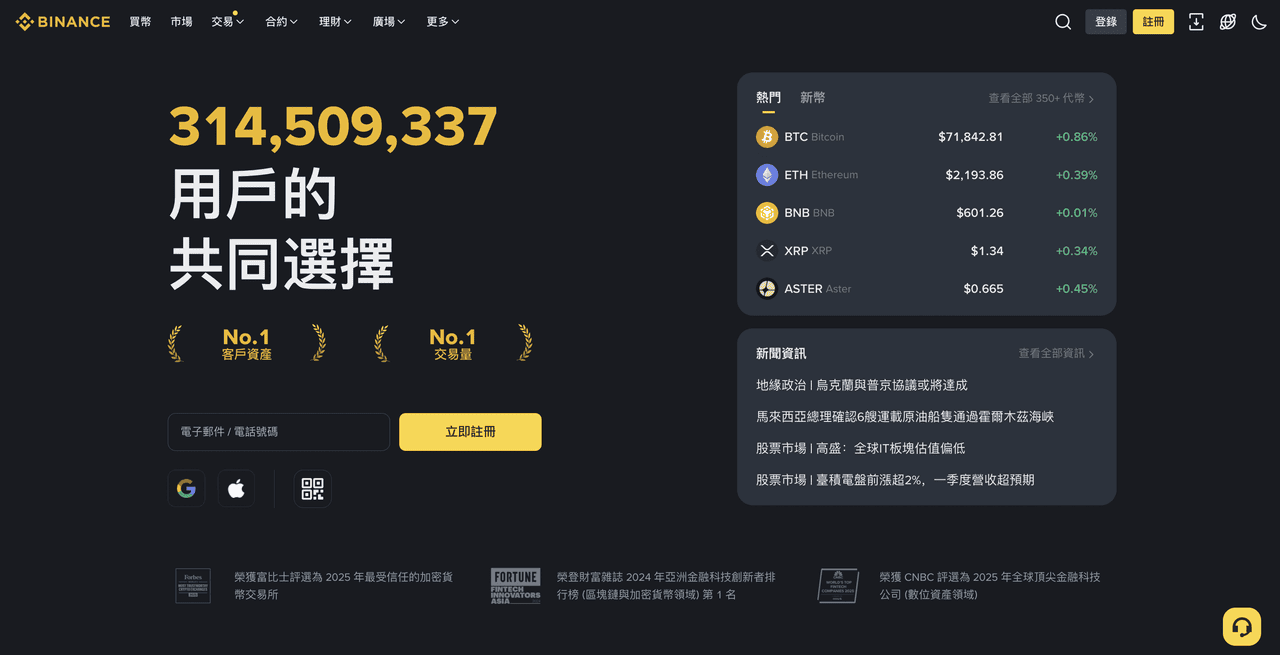
Binance is the world's largest cryptocurrency exchange by trading volume, with BTC/USDT order book depth leading the industry. Even institutional-level large trades have relatively limited slippage impact. Spot taker fee is 0.1%, with a 10% discount when paying with platform token BNB, reducing actual rate to 0.09%. The VIP system is tiered by monthly trading volume, allowing large users to further compress overall rates through long-term trading.
For traders with single amounts reaching certain scales (typically above $100,000), Binance provides OTC pricing services, allowing direct execution at negotiated prices to avoid order book slippage. For withdrawals, Binance's USDT (TRC-20) withdrawal fee is also less than $1, allowing transfer to Taiwan local exchanges for TWD conversion, with overall cost structure similar to mainstream international platforms.
Extended Reading: BingX vs. Binance Comparison: Which Exchange is Better for Spot and Futures Trading? Fee and Pros/Cons Analysis (2026)
5. MAX Exchange
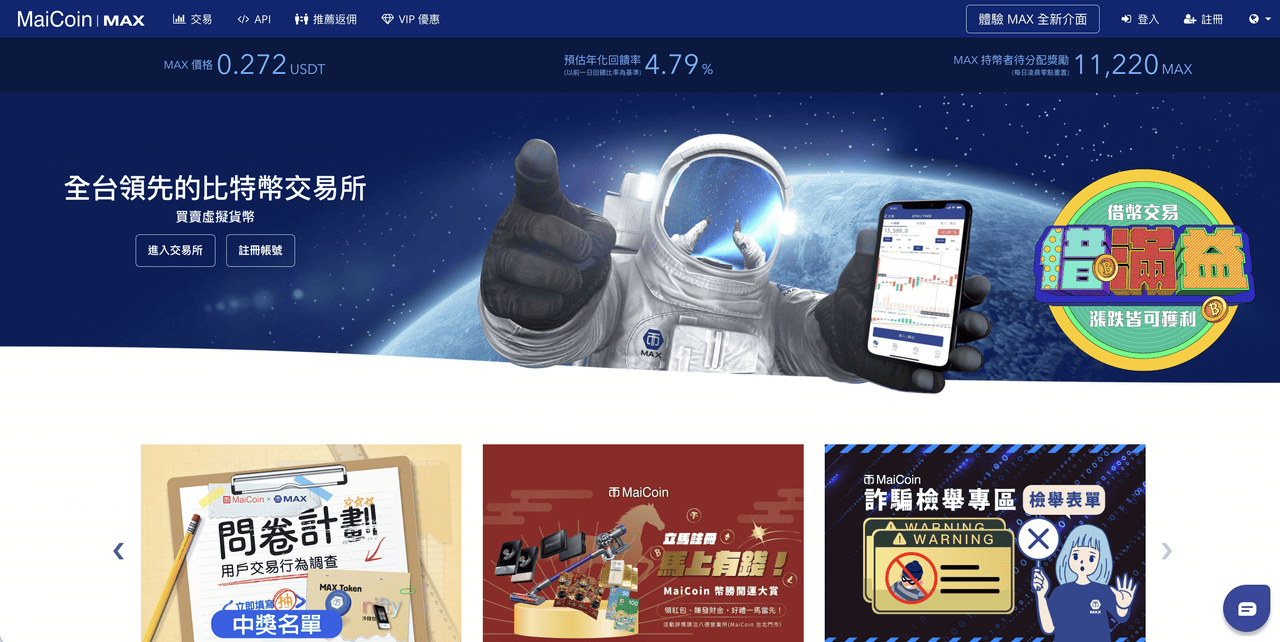
MAX is operated by Taiwan's MaiCoin Group and supports direct TWD deposits and withdrawals. In large BTC trading processes, MAX's main positioning is as a withdrawal bridging platform rather than the primary BTC trading venue. Due to the TWD liquidity and usage convenience of local exchanges, MAX typically serves as the node for final fund conversion to fiat currency, handling the final segment of the overall trading process.
In practical operations, large users often first complete BTC sales and convert to USDT on international exchanges with higher liquidity (like BingX), then withdraw USDT via USDT (TRC-20) to MAX, sell USDT for TWD within the platform, and withdraw to bank accounts. This segmented operation can balance both execution quality and withdrawal efficiency. Note that MAX's BTC/TWD spot market has relatively limited order depth, and bid-ask spreads may widen during market volatility, so it's rarely used as the primary platform for direct large BTC sales but is more suitable as the final cash-out segment.
6. BitoPro
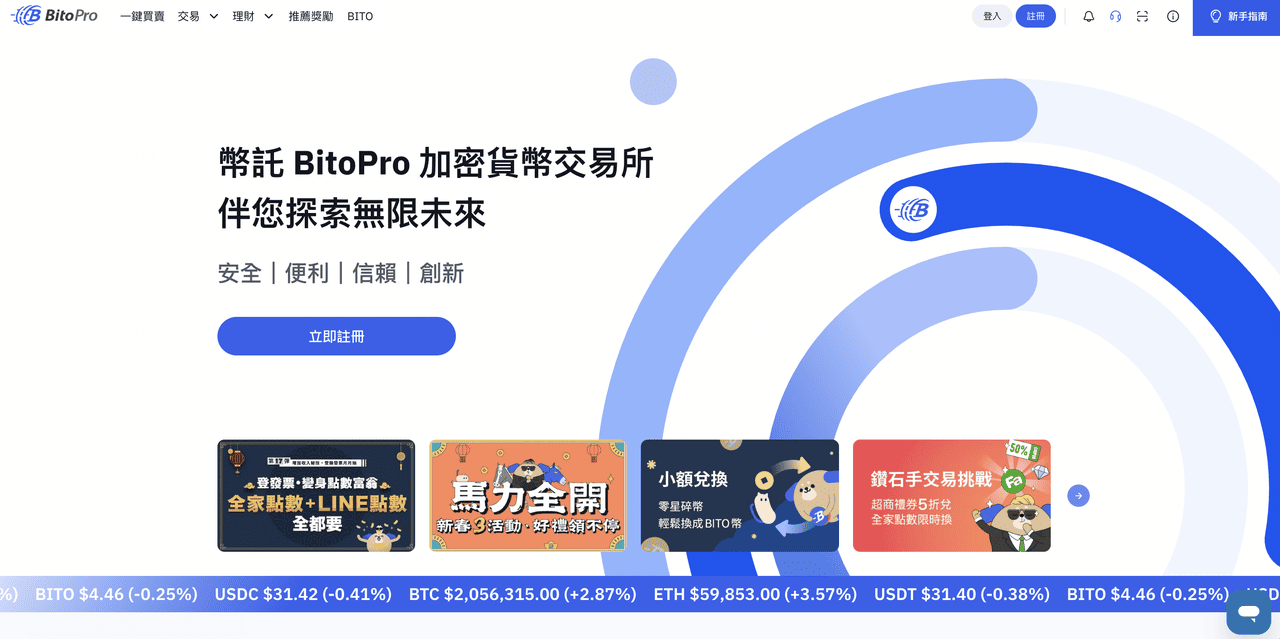
BitoPro is operated by Taiwan's BitoEX and supports direct TWD deposits and withdrawals. Its overall positioning is similar to MAX, primarily serving as a withdrawal bridging platform in large BTC trading processes rather than the main BTC trading venue. Due to the TWD deposit and withdrawal convenience of local exchanges, BitoPro is typically used to complete the final process of transferring funds back to bank accounts.
In practical operations, most users first complete BTC sales and convert to USDT on international exchanges with higher liquidity, then transfer to BitoPro, sell for TWD within the platform, and withdraw to bank accounts. BitoPro's spot maker and taker fees are approximately 0.2%, with relatively simple TWD deposit and withdrawal processes, and bank transfers typically complete within one business day. Note that its BTC order depth is relatively limited, and bid-ask spreads may widen during market volatility, so it's rarely used for direct large BTC sales but is more suitable as the final cash-out node.
Extended Reading: Taiwan Exchanges vs. International Exchanges: How to Choose the Right Cryptocurrency Trading Platform for You?
Fees and Liquidity Depth for Large BTC Trades in Taiwan (2026)
|
Platform |
Spot Taker Fee |
VIP Rate Mechanism |
BTC Order Depth |
USDT (TRC-20) Withdrawal Fee |
Chinese Support |
|
BingX |
0.10% |
Monthly trading volume accumulation |
High |
< $1 |
✓ Full Support |
|
OKX |
0.10% |
Trading volume + OKB holdings |
Very High |
< $1 |
✓ Support |
|
Kraken Pro |
0.40% → 0.10% |
Monthly trading volume accumulation |
High |
Around $1–2 |
✕ |
|
Binance |
0.10% (0.09% with BNB discount) |
Trading volume + BNB |
Very High |
< $1 |
✓ Support |
|
MAX |
0.20% |
Monthly trading volume accumulation |
Low~Medium |
Around $1 |
✓ Full Support |
|
BitoPro |
0.20% |
Monthly trading volume accumulation |
Low~Medium |
Around $1 |
✓ Full Support |
Which Platform Offers the Best Liquidity and Lowest Slippage for Large BTC Trades?
Slippage in large BTC trading mainly comes from insufficient order depth. When large market orders enter the market, they consume buy orders at different price levels layer by layer, causing average execution price to deviate from original quotes. For example, selling 1 BTC (approximately $60,000) in a single transaction, if platform depth is insufficient, actual execution price may be about 0.2%~0.8% lower than quoted price; when transaction scale further increases or market volatility intensifies, slippage impact also expands accordingly, becoming a non-negligible hidden cost.
Among mainstream platforms, Binance and OKX's BTC/USDT order depth belongs to the world's highest level, with relatively limited slippage impact for large trading; BingX provides stable and sufficient depth for mainstream trading pairs, with medium to large trades still able to effectively control slippage, and through the "Guaranteed Price Mechanism" can lock execution prices in specific scenarios. In comparison, MAX and BitoPro have more limited liquidity, making them more suitable as final cash-out segments rather than primary venues for large BTC trading. The key to reducing slippage lies in batch and limit execution. It's recommended when conducting large BTC trading on BingX to use limit orders slightly below current quotes, complete in 3 to 5 batches, and allow time for order book liquidity recovery, which can effectively control average execution price within expected ranges while using maker rates (0.1%) instead of market taker fees, further compressing per-transaction costs.
Extended Reading: Which Platform Has the Lowest Fees for Buying Bitcoin in Taiwan? BTC Price Difference, Fees, and Liquidity Comparison (2026)
|
Platform |
Order Depth |
Bid-Ask Spread (Normal) |
Slippage Risk |
Advanced Mechanisms |
Recommended Trading Scale |
|
BingX |
High |
< 0.05% |
Low |
✓ Guaranteed Price Mechanism |
Medium-Large (≤500K USDT) |
|
OKX |
Very High |
< 0.03% |
Very Low |
— |
Institutional-level (no obvious limit) |
|
Kraken Pro |
High |
< 0.05% |
Low~Medium |
— |
Medium-Large |
|
Binance |
Very High |
< 0.03% |
Very Low |
OTC Block Trading |
Institutional-level (no obvious limit) |
|
MAX |
Low~Medium |
0.1%~0.5% |
High |
— |
Small Amount (≤30K USDT) |
|
BitoPro |
Low~Medium |
0.1%~0.5% |
High |
— |
Small Amount (≤30K USDT) |
What Is the Fastest and Cheapest Way to Withdraw Large Amounts of BTC?
After large BTC sales, the choice of withdrawal path directly affects final actual received amounts. For Taiwan users, there are two main methods: first is transferring USDT via TRC-20 to local exchanges then converting to TWD; second is directly withdrawing USD through platforms supporting SWIFT wire transfers. Both differ significantly in fee structure and funding flexibility, and should be selected based on funding purpose and amount scale for the most suitable path.
Overall, USDT (TRC-20) remains the current lowest-cost and most efficient mainstream solution, with most platform withdrawal fees under $1 and typically completing fund conversion within one business day; using BingX as an example, transferring assets to MAX or BitoPro for TWD cash-out has clear cost advantages. In comparison, SWIFT wire transfers are suitable for scenarios requiring direct USD holding; although fixed fees are higher, the cost proportion is relatively controllable for large withdrawals.
|
Platform |
TRC-20 Withdrawal Fee |
ERC-20 Withdrawal Fee |
BTC Withdrawal Fee |
SWIFT Withdrawal |
TWD Withdrawal Capability |
|
BingX |
< $1 |
$5–10 |
Around 0.0005 BTC |
✕ |
Need transfer to local exchanges |
|
OKX |
< $1 |
$5–10 |
Around 0.0005 BTC |
✕ |
Need transfer to local exchanges |
|
Kraken Pro |
$1–2 |
$5–15 |
Around 0.0002 BTC |
Around $25 |
USD Wire Transfer |
|
Binance |
< $1 |
$5–10 |
Around 0.0005 BTC |
✕ |
Need transfer to local exchanges |
|
MAX |
Around $1 |
$5–10 |
Around 0.0005 BTC |
✕ |
✓ Direct TWD withdrawal |
|
BitoPro |
Around $1 |
$5–10 |
Around 0.0005 BTC |
✕ |
✓ Direct TWD withdrawal |
Note: BTC withdrawal fees fluctuate based on blockchain network congestion. It's recommended to check current fee levels before large withdrawals. SWIFT fees are fixed amounts, and the larger the single withdrawal amount, the lower the fixed fee proportion, making it more cost-effective for large withdrawal scenarios.
VIP Fees and KYC for Large BTC Trades: Which Platform Offers Better Value?
Fee optimization for large BTC trading mainly depends on two key factors: VIP level and KYC verification. VIP level typically accumulates based on trading volume, directly affecting long-term trading fee costs; KYC level determines daily withdrawal limits and funding flexibility. For large traders, these two are not just configuration items but core conditions affecting overall trading efficiency and fund liquidity, usually requiring completion before actual operations.
From platform mechanisms, BingX adopts a single trading volume accumulation VIP system with relatively simple structure, achieving maximum 0% rates; OKX and Binance combine platform tokens (OKB, BNB) to provide additional rate discounts, suitable for users willing to further optimize costs; Kraken has significant rate reduction at high trading volumes but overall base rates remain relatively high. Local exchanges like MAX and BitoPro lean more toward withdrawal nodes, with relatively limited VIP rate impact.
Extended Reading: Taiwan Cryptocurrency Exchange Comprehensive Evaluation: New User Registration Bonuses, VIP Rates, and Chinese Customer Service Complete Comparison (2026)
BTC VIP Fees & KYC Comparison Across Exchanges
|
Platform |
Base Taker Fee |
VIP Minimum Rate |
VIP Mechanism |
KYC Time |
Withdrawal Method |
Withdrawal Limit |
|
BingX |
0.10% |
→ 0% |
Trading volume only |
1–3 days |
Need transfer to local exchanges |
Based on KYC level |
|
OKX |
0.10% |
Negative rates possible |
Trading volume + OKB |
1–3 days |
Need transfer to local exchanges |
Based on KYC level |
|
Kraken Pro |
0.40% |
→ 0.10% |
Trading volume only |
3–5 days |
USD wire transfer (SWIFT) |
Based on account level |
|
Binance |
0.10% (0.09% with BNB) |
Decreases by level |
Trading volume + BNB |
1–5 days |
Need transfer to local exchanges |
Based on KYC level |
|
MAX |
0.20% |
Decreases by level |
Trading volume only |
1–2 days |
✓ TWD withdrawal |
Based on account level |
|
BitoPro |
0.20% |
Decreases by level |
Trading volume only |
1–2 days |
✓ TWD withdrawal |
Based on account level |
Is BTC OTC Trading Legal in Taiwan? Risks and Alternatives
OTC (Over-the-Counter) trading refers to large transaction modes completed by direct negotiation between buyers and sellers outside exchange order books. For large BTC holders, the theoretical advantage of OTC is completely avoiding order book slippage and obtaining customized negotiated rates for large funds. However, such transactions don't go through public market matching and have higher requirements for fund flow transparency and regulatory compliance, requiring extra caution under Taiwan's current regulatory framework.
Under Taiwan's current regulatory framework, virtual asset trading must be conducted through traceable banking flows, making traditional cash-based OTC trading difficult to operate legally. The Money Laundering Control Act has clear restrictions on unregistered OTC trading, with conducting OTC trading for others without VASP registration facing up to seven years imprisonment. Private P2P trading and physical coin merchant cash transactions have all fallen into regulatory red lines. Large fund operations should completely avoid these channels and maintain complete banking flow records for inspection.
For compliant alternatives, some international exchanges (like Binance) provide institutional-level OTC services, typically with thresholds above $100,000, requiring completion of institutional account identity verification with fully traceable fund flows, making them more acceptable large currency exchange options under Taiwan's regulatory framework, though tax declaration obligations still need confirmation. For most Taiwan individual investors, executing batch limit orders on BingX (combined with guaranteed price mechanisms to reduce slippage), then transferring via USDT TRC-20 to MAX or BitoPro for TWD conversion, is currently the most balanced compliant large withdrawal method between cost control and fund transparency.
How to Trade Large Amounts of BTC on BingX: A Low-Slippage Guide
After completing registration and logging into BingX, you can conduct BTC spot trading in the Traditional Chinese interface. The platform's BTC/USDT maker and taker fees are both 0.1%, and combined with limit orders can effectively control execution costs; withdrawing USDT via TRC-20 has fees under $1, making it a common low-cost path for large funds to transfer to Taiwan local exchanges. Here's the actual operation process from large BTC selling to withdrawal.
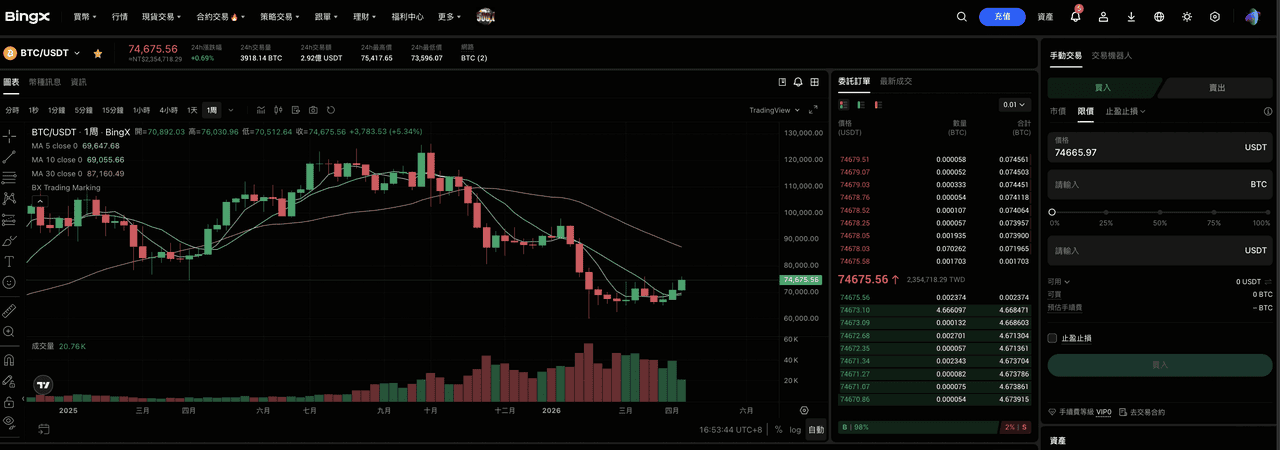
- Complete Advanced KYC Verification and Confirm Withdrawal Limits: In "Personal Center" → "Identity Verification", complete advanced KYC to unlock higher daily withdrawal limits. It's recommended to complete this at least one week in advance and confirm USDT daily withdrawal limits are sufficient to cover expected withdrawal amounts, avoiding audit period impact on fund deployment.
- Enter BTC/USDT Spot Page and Observe Market Depth: Enter the BTC/USDT spot trading page, check order book volume and bid-ask spreads, confirm market liquidity is sufficient to handle large sell orders, avoiding one-time execution during periods of poor liquidity causing price deviation.
- Use BingX AI to Assist in Determining Selling Range: Before placing orders, you can use BingX AI to view BTC price trend summaries, technical analysis, and recent volume changes as auxiliary basis for determining optimal timing for batch selling.
- Sell BTC in Batches Using Limit Orders: Use limit orders to split total selling volume into 3 to 5 batches, with several minutes between each batch, allowing order book time to replenish liquidity after each batch execution, reducing single large sell impact on average execution price while executing at maker rates to control trading fee costs.
- Convert Assets to USDT and Choose TRC-20 Withdrawal: After selling completion, go to "Assets" → "Withdraw", select USDT and confirm using TRC-20 network (fees under $1), avoiding mistakenly selecting ERC-20 which incurs $5-10 additional costs. For large withdrawals, it's recommended to first test the complete path with a small amount to confirm address and network settings are correct.
- Transfer to Local Exchanges for TWD Conversion: Transfer USDT to MAX or BitoPro, sell for TWD and withdraw to Taiwan bank accounts. The entire fund flow is traceable through banks, complying with Taiwan VASP compliance requirements, and it's recommended to keep complete records of each transfer and conversion.
5 Key Factors to Consider Before Trading Large Amounts of BTC
- Withdrawal Paths Need Complete Pre-planning: Large BTC operations involve withdrawal limits, on-chain transfer times, and local conversion processes. Any delays in any segment may affect overall fund deployment. It's recommended to confirm platform restrictions and time costs before operations, avoiding funds getting stuck in intermediate processes.
- Wrong Withdrawal Networks May Cause Asset Loss: USDT withdrawals need to ensure networks and receiving addresses match completely, such as TRC-20 corresponding to TRC-20 addresses. Before large operations, it's recommended to conduct small-amount tests first, confirming the entire process is correct before scaling up amounts.
- Non-compliant OTC Trading Has Higher Risks: Through OTC trading not matched by platforms, while potentially avoiding slippage in specific scenarios, it also increases counterparty risk and fund flow uncertainty. For most users, completing large trades through exchanges with sufficient liquidity is typically more stable in execution efficiency and fund security.
- Platform Rates and Rules May Change Anytime: Trading fee structures, VIP thresholds, and withdrawal limits change with market competition and strategic adjustments. Actual operations should reconfirm latest rules to avoid gaps between expected and actual execution costs.
- Tax and Fund Records Need Advance Planning: Large trades typically involve fund flows and profit recognition. It's recommended to keep complete trading and transfer records and understand related declaration methods in advance to reduce subsequent processing costs.
Conclusion: Why BingX Is a Top Choice for Large Bitcoin Trades
For Taiwan's large BTC traders, the core criteria for choosing trading platforms isn't just individual rate numbers, but the actual advantages after summing costs of all segments in the overall operation process. BingX provides complete Traditional Chinese interface, allowing large operations including order placement, risk control settings, and account issues to be completed in native language environment, effectively reducing operational error risks; spot taker fee of 0.1% combined with monthly trading volume accumulation VIP system allows users with continuous large operations to gradually reduce rates; BTC/USDT order depth performs stably at medium to large trading scales, and combined with limit order batch selling and guaranteed price mechanisms, can control average execution price within expected ranges while reducing market volatility impact on actual returns.
Regarding withdrawal costs, BingX's USDT TRC-20 withdrawal fee under $1, combined with MAX or BitoPro as final TWD conversion bridging platforms, is currently the most common and lowest-cost large compliant withdrawal path in Taiwan. BingX AI provides BTC market trend summaries, technical analysis, and trading assistance signals, giving large investors more reference when determining optimal timing for batch selling, reducing additional slippage costs from poor timing. Combined with 100% Merkle Tree Reserve Proof and user protection funds, it provides clear multiple guarantees in asset security and transparency.
Regardless of which platform is ultimately chosen, completing advanced KYC verification in advance, executing large sales in batches using limit orders, choosing the lowest-cost withdrawal network through USDT TRC-20, and completing conversions through compliant channels while maintaining complete records throughout, remain more critical fundamentals in large BTC trading than any rate comparisons. For Taiwan investors hoping to effectively control large conversion costs under compliant premises, BingX is currently the most balanced choice in overall performance.
Related Reading
- Where to Buy Bitcoin in Taiwan? 2026 Bitcoin Exchange Recommendations and Complete Purchase Process Tutorial
- Taiwan Cryptocurrency Futures Trading Platform Complete Comparison and Recommendations (2026): Trading Fees, Liquidity, and Security Comparison
- Which Platform Has the Lowest Fees for Buying Bitcoin in Taiwan? BTC Price Difference, Fees, and Liquidity Comparison (2026)
- Which Taiwan Exchange is Most Suitable for Large Ethereum Trading? Complete Comparison and Recommendations of Platform Fees and Liquidity (2026)
- Taiwan Cryptocurrency Exchange Comprehensive Evaluation: New User Registration Bonuses, VIP Rates, and Chinese Customer Service Complete Comparison (2026)
