
The global artificial intelligence landscape in 2026 is undergoing a profound structural realignment. The speculative, high-flying phase of early generative AI deployment has given way to an era of strict capital discipline, infrastructure optimization, and aggressive platform monetization. In this macroeconomic climate, corporate value is no longer measured solely by raw frontier model capabilities, but by the efficiency of cloud ecosystems, localized data center scaling, and institutional platform control. At the absolute apex of this foundational enterprise transition stands Benjamin "Ben" Mann, a core technical co-founder of Anthropic.
Mann’s personal wealth accumulation presents a compelling and highly distinct case study within the technology sector. Unlike legacy corporate tech executives whose fortunes are built on multi-decade corporate ladders and salaried compensation grants, Mann’s financial architecture represents the absolute pinnacle of early-stage AI engineering and technical infrastructure capitalization. By anchoring himself to the fundamental architectural layer of large language models (LLMs) and navigating the hyper-scale venture cycles of the 2020s, Mann has secured immense personal paper liquidity and institutional leverage. As Anthropic navigates the complex capital demands of the 2026 AI compute loop and prepares for its impending public debut, evaluating Mann's net worth offers critical insights into modern corporate governance, venture capital valuation mechanics, and the financial structures driving global frontier intelligence.
Who Is Ben Mann?
Benjamin Mann is an American computer scientist, software engineer, and AI safety pioneer who has fundamentally shaped the technical framework of modern frontier language models. He completed his academic training in computer science at Columbia University, establishing a rigorous mathematical and algorithmic foundation that would define his subsequent engineering career at the absolute frontier of machine learning.
Mann initially spent six years as a software engineer at Google, where his operational focus centered on complex infrastructure and product engineering. During this tenure, he notably contributed to Google's carpooling platform, Waze Carpool, and operated as a key technical lead within Google’s internal corporate incubator, Area 120.
The defining turning point in Mann’s career occurred upon his deep engagement with foundational AI safety literature, most notably Nick Bostrom’s Superintelligence. Recognizing that the development of transformative AI systems required rigorous alignment frameworks rather than unchecked scale, Mann executed a deliberate professional pivot toward AI alignment and safety systems. To pursue this technical mission, he joined the Machine Intelligence Research Institute (MIRI) and subsequently OpenAI. At OpenAI, Mann operated as a core member of the technical staff, focusing heavily on the engineering infrastructure, computational efficiency, and core safety architectures of the landmark GPT-3 model.
In January 2021, structural disagreements regarding OpenAI's increasingly commercialized path and a perceived internal deprioritization of safety systems led a core breakaway group of senior researchers to depart. Led by siblings Dario Amodei and Daniela Amodei, this group—which included Chris Olah, Jared Kaplan, Sam McCandlish, Tom Brown, Jack Clark, and Ben Mann—established Anthropic as a Public Benefit Corporation (PBC). Mann joined this founding tier as a primary architectural lead, anchoring the early engineering frameworks that allowed Anthropic to compete directly with legacy hyperscalers.
Anthropic Valuation 2026: How Claude Revenue Growth Could Shape Ben Mann’s Net Worth
To accurately evaluate the scale of Ben Mann’s personal wealth in 2026, one must first analyze the historic capital appreciation of Anthropic. Since its inception in 2021, Anthropic has raised roughly $125 billion to $132 billion across 18 financing rounds, establishing the firm as one of the most heavily capitalized private enterprises in global financial history.
This venture velocity accelerated exponentially between 2025 and mid-2026, driven by an aggressive compute-for-equity expansion loop and massive enterprise adoption. The strategic funding trajectory is tracked below:
|
Funding Round |
Date |
Post-Money Valuation (USD) |
Lead / Key Investors |
Core Strategic Context |
|
Series E |
March 2025 |
$61.5 Billion |
Lightspeed Venture Partners |
Established baseline institutional valuation; validated enterprise API scaling. |
|
Series F |
September 2025 |
$183 Billion |
Iconiq Capital, Fidelity, Lightspeed |
Secured $13B in primary capital. Passed major sovereign wealth benchmarks. |
|
Strategic |
November 2025 |
$350 Billion (Implied) |
Nvidia, Microsoft |
Massive compute-for-equity swaps. $30B Azure capacity commitment; $10B Nvidia compute allocation. |
|
Series G |
February 2026 |
$380 Billion |
GIC, Coatue, D.E. Shaw, Founders Fund |
$30B cash injection. Enabled a massive $5B–$6B employee and founder tender offer. |
|
Strategic |
April 2026 |
$380B+ (Base) |
Amazon, Google |
Multi-gigawatt TPU/GPU allocations. Amazon total investment reached $33B+; Google injected $40B. |
|
Series H |
May 2026 |
$965 Billion |
Altimeter, Dragoneer, Sequoia, Capital Group |
Final private round. Implied secondary market marks briefly surpassed the historic $1 Trillion threshold. |
This unprecedented valuation surge is fundamentally supported by rapid revenue expansion. Anthropic's annualized run-rate revenue, which stood at approximately $1 billion in January 2025, climbed exponentially to $9 billion by December 2025, and reached $30 billion by early April 2026.
By May 2026, driven largely by the heavy monetization of the enterprise Claude API and the explosive adoption of Claude Code (which captured an astonishing $2.5 billion in ARR within a mere nine months of launch), Anthropic's annualized run-rate surpassed $47 billion.
By completely surpassing OpenAI's reported $25 billion annualized revenue mark in April 2026, Anthropic established itself as the leading pure-play enterprise AI firm in the global market. On June 1, 2026, Anthropic capitalized on this operational dominance by confidentially filing a draft S-1 prospectus with the Securities and Exchange Commission (SEC) for an Initial Public Offering (IPO) targeted for October 2026. Wall Street investment bankers anticipate the public listing will target an opening valuation exceeding $1 trillion, representing the most highly anticipated debut on the public equity markets in decades.
Ben Mann's Net Worth in 2026: Key Estimates
To understand Ben Mann's actual financial standing in 2026, we have to look at the difference between paper wealth (equity tied up in Anthropic) and liquid wealth (cash in the bank). Because Anthropic remains a private Public Benefit Corporation (PBC) ahead of its October IPO, we cannot simply look up its stock price on Google Finance. Instead, financial analysts track the separation of his core assets to identify real-world net worth.
|
Asset Type |
Estimated Value |
Financial Reality |
|
Anthropic Private Equity |
~$8.0 Billion (Gross) |
Paper Wealth: Based on an estimated 0.83% ownership tied to Anthropic's $965B valuation. Subject to standard private market illiquidity haircuts until the October 2026 IPO. |
|
Realized Cash Reserves |
High Tens of Millions |
Liquid Cash: Pocketed via the official $5B–$6B employee tender offer in February 2026. This allowed Mann to lock in real-world profits before the 2027 IPO lock-up expiration. |
|
Speculative Crypto Holdings |
$0.00 |
None: Specialized databases frequently confuse him with a former IBM executive. Mann's wealth is entirely driven by enterprise AI equity, not crypto assets. |
Ben Mann’s Anthropic Stake: Estimated at 0.8% to 1.2%
How much of Anthropic does Ben Mann actually own? Because the company's official cap table (shareholder registry) is still confidential, analysts look at his peers to find the answer:
- The Baseline Tiers: Major wealth indices, including Bloomberg, track Anthropic's core co-founding researchers (like Chris Olah, Jack Clark, Jared Kaplan, Tom Brown, and Sam McCandlish) as holding identical ownership tiers. Each individual stake is estimated at 0.83% of the company. At a $965 billion valuation, that equals roughly $8.0 billion each.
- The Eighth Co-Founder: While early marketing materials only highlighted seven primary researchers, official legal registries track Ben Mann as the eighth co-founder. Because he built GPT-3's infrastructure at OpenAI and led Anthropic's early product engineering, experts estimate his equity matches the other co-founders, landing firmly between 0.8% and 1.2% fully diluted.
Ben Mann Net Worth 2026: Anthropic’s $965B Valuation Implies About $8B
As Anthropic's valuation climbed, so did the founders' positions on global wealth trackers:
- Early 2026: When Anthropic hit a $380 billion valuation in February, top executives like CEO Dario Amodei held stakes worth roughly $7.0 billion, landing them securely on the Forbes Billionaires List.
- Mid-2026: Following the massive $965 billion Series H round in May, matching Mann's estimated 0.83% stake to the new company value puts Ben Mann's gross paper wealth at approximately $8.0 Billion. His official position on real-time billionaire trackers will be formally locked in once Anthropic's public IPO filings are unsealed later this year.
Ben Mann Cash Wealth: Anthropic Tender Offer Created Early Liquidity
There is a big difference between "paper wealth" (shares you own but cannot sell yet) and actual cash in the bank. Mann successfully balanced his portfolio using a company-backed buyout.
In February 2026, alongside its Series G funding round, Anthropic organized an official $5 billion to $6 billion tender offer (an internal company buyback). This program allowed early employees and founders to sell a small portion of their private shares back to incoming investors at a valuation of approximately $350 billion. By participating in this buyback, Mann converted a fraction of his paper equity into tens of millions of dollars in cold hard cash. This move provided him with immediate personal liquidity, protecting his personal balance sheet from market volatility before the official IPO lock-up period ends in early 2027.
How Does Ben Mann's Wealth Compare to Other Global AI Leaders?
To contextualize Ben Mann’s wealth and operational influence within the global technology ecosystem, his assets and structural control mechanisms must be compared with other prominent technology leaders in 2026.
|
Tech Leader |
Primary Enterprise |
Estimated 2026 Net Worth |
Primary Wealth Composition Type |
Equity Control Mechanism |
Core Operational Focus |
|
Elon Musk |
Tesla, SpaceX, xAI |
$839B – $1.053T |
Public / Private Industrial Equity |
~20% Tesla; 42% SpaceX |
Megawatt compute clusters & physical hardware layers. |
|
Mark Zuckerberg |
Meta Platforms |
$194B – $222B |
Public Equity |
~13% direct; dual-class shares |
Open-source foundation models (Llama ecosystem). |
|
Jensen Huang |
Nvidia |
$154B – $173B |
Public Equity |
3.0% - 3.6% direct & family trusts |
GPU supply chain logistics & chip architecture dominance. |
|
Dario Amodei |
Anthropic |
$7.0B – $15.5B |
Private PBC Paper Equity |
1.8% economic; Class B shares |
Enterprise safety models & corporate leadership. |
|
Ben Mann |
Anthropic |
~$8.0 Billion |
Private PBC Paper Equity |
~0.83% estimated fully diluted equity |
Frontier product incubation & experimental alignment (Labs). |
|
Sam Altman |
OpenAI |
$3.4 Billion |
Independent Venture Portfolio |
0% direct OpenAI equity |
Consumer app ecosystems & sovereign compute partnerships. |
|
Satya Nadella |
Microsoft |
$1.3B – $1.56B |
Public Performance Grants |
~0.01% direct; performance stock awards |
Hyperscaler partner integration & cloud distribution. |
|
Sir Demis Hassabis |
Google DeepMind |
$500M – $1.0B |
Corporate Salary & GSUs |
Alphabet stock & legacy M&A payouts |
Multimodal science-first foundational models. |
This comparison highlights several structural differences in the nature of tech wealth in 2026:
1. Pure-Play Private AI Equity vs. Public Industrial Holdings
Unlike legacy billionaires like Elon Musk and Mark Zuckerberg, whose wealth is highly liquid and traded daily on public exchanges, Ben Mann’s $8.0 billion net worth represents private paper valuation. Prior to the formal execution of the confidential S-1 IPO filing in late 2026, this wealth is subject to private market valuation adjustments. However, the sheer scale of Mann's private holding is notable, easily surpassing the accumulated net worth of established public corporate executives such as Microsoft CEO Satya Nadella.
2. The Sam Altman Paradox
While Sam Altman wields massive global influence as the CEO of OpenAI (valued at $852 billion as of March 2026), he famously holds 0% direct equity in the company. Altman’s $3.4 billion net worth is instead derived from historical independent venture investments in entities like Helion Energy, Reddit, and Stripe. In contrast, Ben Mann’s wealth is highly concentrated within his direct co-founder equity stake in Anthropic. This ties his personal balance sheet directly to Anthropic's post-IPO equity performance.
Anthropic Founders’ 80% Giving Pledge: How Ben Mann’s AI Wealth Could Become Philanthropic Capital
A defining characteristic of the wealth generated by Anthropic's founders is its targeted redistribution. In January 2026, alongside the announcement of the company’s $380 billion Series G valuation, all seven core co-founders, along with Ben Mann, formalized a binding pledge to donate 80% of their personal wealth to philanthropic efforts.
At the company's current $965 billion valuation, the combined value of these co-founder pledges represents approximately $53.8 billion. This represents a capital pool nearly ten times larger than the entire historical distribution of Coefficient Giving (formerly Open Philanthropy). For Mann individually, this commitment represents a future philanthropic allocation of approximately $6.4 Billion.
This commitment is deeply rooted in Mann’s long-standing alignment with the Effective Altruism (EA) movement. In 2019, Mann published a widely read personal essay titled "Why I now identify as an Effective Altruist," formalizing his philosophical alignment with the movement's focus on long-termism, existential risk mitigation, and the mathematical optimization of philanthropic impact.
This philosophy directly mirrors his early operational history at Anthropic; during the company's formative development, Mann and security researcher Jeffrey Ladish operated as the company’s entire, part-time information security team, manually implementing strict protocols designed to secure early model weights from state-sponsored exfiltration. While the actual distribution of these pledged billions remains subject to post-IPO lock-up provisions and the establishment of dedicated philanthropic vehicles, the scale of this commitment places Mann among the most significant philanthropic forces in the global technology sector.
Related Reading
- What Is Anthropic Pre-IPO and How to Trade It on BingX?
- What Is Anthropic CEO Dario Amodei’s Net Worth in 2026?
- What Is Sam Altman’s Net Worth in 2026?
- What Is OpenAI Pre-IPO and How to Trade It on BingX?
- OpenAI Pre-IPO Outlook 2026: Trillion-Dollar Artificial Intelligence Race Enters The Final Stretch
FAQs on Ben Mann’s Net Worth
1. How much is Anthropic co-founder Ben Mann worth in 2026?
As of mid-2026, Ben Mann’s personal net worth is estimated to be approximately $8.0 billion. This wealth places him firmly within the ranks of the world's elite AI billionaires. Because Anthropic is still a private Public Benefit Corporation (PBC) preparing for an October 2026 IPO, this fortune is primarily composed of private paper equity, valued at the company's recent $965 billion Series H financing round.
2. What percentage of Anthropic does Ben Mann own?
Ben Mann is estimated to hold a fully diluted equity stake of approximately 0.83% within Anthropic’s capital structure. This aligns him directly with the core co-founder equity tier held by the company's primary founding researchers (such as Chris Olah, Jack Clark, and Jared Kaplan).
3. What is Ben Mann’s operational role at Anthropic Labs?
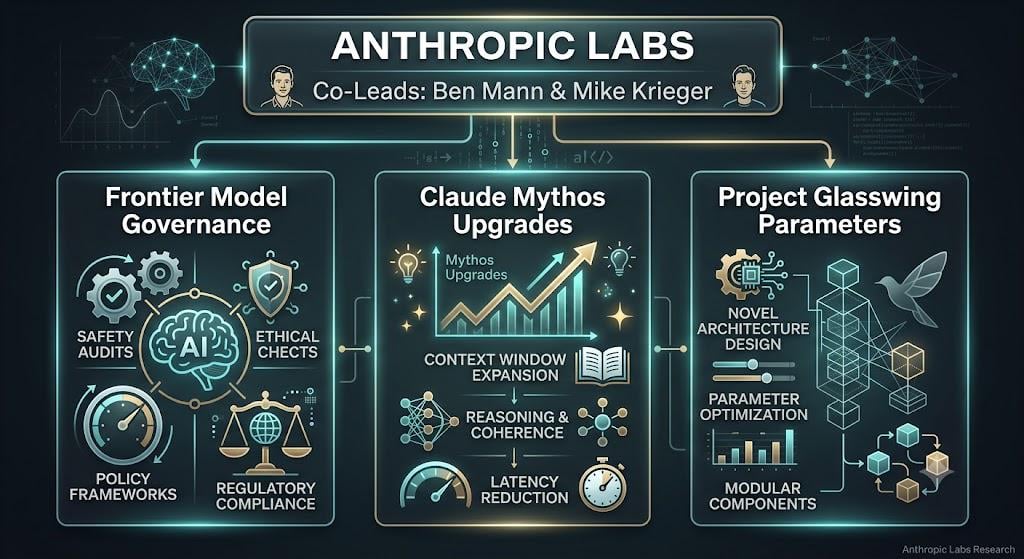
Following a corporate leadership realignment, Ben Mann transitions to co-lead "Anthropic Labs" alongside Mike Krieger (the co-founder of Instagram). In this highly specialized capacity, Mann focuses on frontier model incubation, the controlled governance of next-generation models like Claude Mythos, and high-stakes experimental alignment frameworks under Project Glasswing.
4. What is the 80% Effective Altruism pledge signed by Ben Mann?
In January 2026, Ben Mann and Anthropic's core co-founders formalized a binding philanthropic pledge to donate 80% of their personal wealth to charitable efforts. For Mann individually, based on his current $8.0 billion valuation, this represents a future philanthropic allocation of approximately $6.4 billion, targeted toward mitigating existential risk, AI-driven systemic inequality, and long-term global development.
5. Does Ben Mann hold a significant amount of Bitcoin or cryptocurrency?
No. Ben Mann’s multi-billion-dollar net worth is entirely built upon industrial AI enterprise equity within Anthropic PBC. He has no public history of structural involvement with Web3 protocols, decentralized financial platforms, or speculative cryptocurrency holdings.
6. Why is there confusion regarding Ben Mann's involvement in the blockchain space?
Billionaire wealth tracking databases occasionally introduce conflation errors due to an individual with the same name who served as the Chief Operating Officer of IBM East Africa. That individual presented extensively on blockchain and distributed ledger technology (DLT) in Kenya in 2018. The Anthropic co-founder Benjamin Mann, however, uses the term "tokens" strictly within the context of natural language processing (NLP) and autoregressive token-sampling architectures.
