



Accenture (ACN) sells consulting, technology implementation and managed services to large enterprises and public-sector clients. Its long-running outsourcing and digital-core work remains important, while enterprise AI, cybersecurity and industry-specific reinvention extend the opportunity. Client budgets, project timing and the effect of AI automation on billable work determine whether larger pipelines become durable revenue and better cash returns.
The latest quarter showed broad demand recovery with an uneven cash result. Accenture fiscal Q4 FY2026 revenue reached $18.68 billion, above the $18.40 billion guidance high, while new bookings rose 4% to $22.17 billion and GAAP EPS climbed 46% to $3.29. Yet free cash flow fell to $2.85 billion from $3.81 billion, making the fiscal 2027 test whether AI and managed-services work can sustain growth without weakening pricing or cash conversion.
The ACN stock forecast for 2026 now centers on two competing views:
- The enterprise-reinvention case: $22.17 billion of quarterly bookings, a 1.2 book-to-bill ratio and a 3% to 6% fiscal 2027 local-currency growth guide support a renewed demand cycle and operating leverage.
- The conversion-pressure case: AI may shorten projects or lower billing rates, while a $0.96 billion year-over-year quarterly free-cash-flow decline leaves the quality of growth open to question.
This guide breaks down the ACN stock forecast, 2026 price scenarios, key risks and analyst outlooks, drawing on Accenture's October 1 fiscal Q4 FY2026 earnings release, financial exhibit and market data through October 20, plus how to buy ACN stocks on BingX TradFi with USDT.
Top 5 Things for Accenture Investors to Know in October 2026
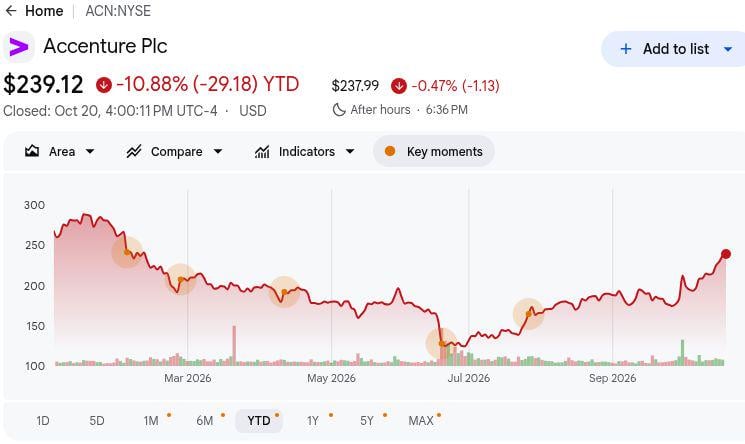
- ACN closed at $239.12 on October 20, down 10.88% YTD: The stock rebounded sharply from its 52-week low of $118.15 but remained below its $291.09 high. Sustaining the recovery will depend on stronger operating results and evidence that Accenture can adapt to AI-driven industry changes.
- Q4 revenue reached $18.68 billion, exceeding the $18.40 billion guidance high: Revenue increased 6% in U.S. dollars and 7% in local currency, supported by growth across geographic markets and service categories. The broad improvement suggests resilient enterprise demand, with future growth depending on converting bookings into revenue.
- New bookings increased 4% to $22.17 billion: A 1.2 book-to-bill ratio included $9.40 billion in Consulting and $12.77 billion in Managed Services bookings. Stronger managed-services demand supports revenue visibility and recurring business opportunities, although the timing of contract delivery remains important.
- Fiscal 2027 guidance calls for 3% to 6% revenue growth in local currency: Management also expects a 15.9% to 16.1% operating margin and $11.0 billion to $11.8 billion in free cash flow. Performance near the upper end would strengthen the earnings outlook, while slower growth could limit further share-price gains.
- Quarterly free cash flow declined $0.96 billion to $2.85 billion: Full-year free cash flow nevertheless increased to $11.62 billion from $10.87 billion, supporting $11.5 billion in shareholder returns. Sustained cash generation will be important for funding acquisitions, maintaining shareholder distributions, and supporting Accenture's long-term investment strategy.
What Is Accenture (ACN)?

Accenture provides strategy, consulting, technology engineering and ongoing managed services to roughly 9,000 clients. It helps organizations redesign processes, migrate applications and data, secure systems and operate complex digital platforms. Its Reinvention Services span Cybersecurity, Digital Core, Finance, Industry and Enterprise, Song, Supply Chain and Engineering, and Talent. Consulting revenue reflects transformation projects, while Managed Services converts longer client contracts into recurring delivery. The model uses a global workforce of about 814,000 people, making utilization, skills and project pricing crucial to operating margin.
Accenture is extending that model into applied AI and smaller enterprise accounts. Accenture Edge targets organizations with $300 million to $3 billion in annual revenue; its October Workday forward-deployed engineering program and expanded Dell private-AI collaboration address implementation and infrastructure needs. These initiatives create routes to advisory, build and operating fees as clients deploy agents and modernize data estates. The partnerships and market opportunity are announced programs, not booked sales. Revenue arrives only when client contracts are signed, milestones are delivered and managed workloads move into production.
Accenture (ACN) Q4 FY2026 Earnings Overview: Revenue Beat and Strong Bookings Offset Weaker Cash Flow
Accenture delivered $18.68 billion of Q4 revenue versus a $17.75 billion to $18.40 billion company range, with GAAP EPS of $3.29 versus $2.25 a year earlier. New bookings rose 4% to $22.17 billion, and Managed Services revenue grew 7% to $9.40 billion. Fiscal 2027 local-currency growth guidance of 3% to 6% supports the demand view, but Q4 free cash flow fell to $2.85 billion from $3.81 billion.
|
Financial Metric |
Guidance / Consensus |
Reported / Actual |
Surprise |
|
Q4 FY2026 revenue |
17.75B–18.40B company guide |
$18.68B |
Above. $0.28B over guide high; up 6% YoY. |
|
Q4 GAAP diluted EPS |
$2.25 a year earlier |
$3.29 |
Improved. Up 46% YoY. |
|
Q4 new bookings |
$21.31B a year earlier |
$22.17B |
Expanded. Up 4% in dollars; book-to-bill 1.2. |
|
Consulting revenue |
$8.77B a year earlier |
$9.28B |
Expanded. Up 6% in dollars. |
|
Managed Services revenue |
$8.82B a year earlier |
$9.40B |
Expanded. Up 7% in dollars. |
|
GAAP operating margin |
11.6% a year earlier |
15.30% |
Improved. Up 370 basis points. |
|
Q4 free cash flow |
$3.81B a year earlier |
$2.85B |
Lower. Down $0.96B YoY. |
|
Q1 FY2027 revenue outlook |
$18.68B in Q4 FY2026 |
18.95B–19.60B |
Higher. Midpoint is $0.60B above Q4. |
|
FY2027 local-currency growth |
5% in FY2026 |
3%–6% guide |
Mixed. Range spans slower and faster growth. |
- Revenue of $18.68 billion exceeded the guidance high by $0.28 billion: Dollar sales grew 6% and local-currency sales 7%, with both Consulting and Managed Services expanding. The breadth argues against a one-off rebound, but the fiscal 2027 range still requires sustained client project approvals.
- GAAP diluted EPS rose 46% to $3.29: Operating income increased to $2.86 billion from $2.05 billion, and a lower share count also helped. The comparison benefits from $0.78 of prior-year optimization costs, so the 9% gain over adjusted prior EPS of $3.03 better gauges recurring progress.
- Bookings of $22.17 billion produced a 1.2 book-to-bill ratio: Managed Services signings of $12.77 billion exceeded Consulting signings of $9.40 billion. That mix can improve visibility for ongoing delivery, although contract commencement and scope still determine when the signed work becomes reported revenue.
- GAAP operating margin expanded 370 basis points to 15.3%: The prior-year GAAP comparison was 11.6%, but the comparable adjusted margin was 15.1%, leaving a 20-basis-point underlying increase. Fiscal 2027 guidance of 15.9% to 16.1% makes productivity and pricing a more demanding test than the headline gain suggests.
- Quarterly free cash flow declined $0.96 billion to $2.85 billion: Operating cash flow was $3.10 billion against $3.91 billion a year earlier, even as the fiscal year delivered $11.62 billion of free cash flow. Fiscal 2027's $11.0 billion to $11.8 billion outlook tests whether collections and investment spending normalize.
Accenture (ACN) 2026 Investment Outlook: $300 Bull Case vs. $175 Bear Case
Accenture's central test is whether enterprise AI adoption creates more integration and managed-services work than automation removes from traditional consulting. The $22.17 billion booking quarter supports demand, while the 3% to 6% fiscal 2027 growth range and weaker quarterly cash flow leave room for different earnings outcomes. These price levels are editorial scenarios, not Wall Street promises.
The Bull Case: AI Implementation Pushes ACN Toward $300
The Bull Case assumes AI implementation expands client spending rather than simply reducing billable hours. Accenture Edge extends the company's midmarket reach, while Workday agent engineering and Dell private-AI projects develop into recurring contracts. Converting $22.17 billion in quarterly bookings into Consulting and Managed Services revenue could improve workforce utilization, operating margins, and cash generation.
ACN could approach $300 if fiscal 2027 local-currency revenue growth reaches 6%, operating margin meets or exceeds 16.1%, and free cash flow remains above $11.0 billion. Stronger AI contract conversion and recurring managed-services demand would reinforce this outlook.
The Base Case: Steady Growth Keeps ACN Between $230 and $260
The Base Case assumes cloud, digital transformation, and managed-services demand remains resilient while AI monetization develops gradually. Q4's 1.2 book-to-bill ratio supports revenue visibility, although uneven client spending and delivery costs could limit margin expansion and further valuation gains.
ACN could trade between $230 and $260 if fiscal 2027 local-currency growth stays within 3% to 6%, operating margin reaches 15.9% to 16.1%, and free cash flow remains near $11.0 billion to $11.8 billion. Faster organic growth could support the upper end, while weaker cash conversion may pressure the lower end.
The Bear Case: AI Disruption and Pricing Pressure Pull ACN Toward $175
The Bear Case assumes AI automation reduces traditional consulting hours faster than new implementation projects generate revenue. Delayed client approvals, pricing concessions, and slower conversion of the $22.17 billion bookings pipeline could weaken utilization and profitability. Higher acquisition and workforce investment costs may further pressure cash flow.
ACN could fall toward $175 if fiscal 2027 local-currency growth drops below 3%, operating margin misses 15.9%, or free cash flow falls below $11.0 billion. Persistent Consulting weakness and declining Managed Services bookings would signal that AI disruption is outpacing new revenue opportunities.
ACN Stock Price Forecasts for 2026 By Wall Street Analysts
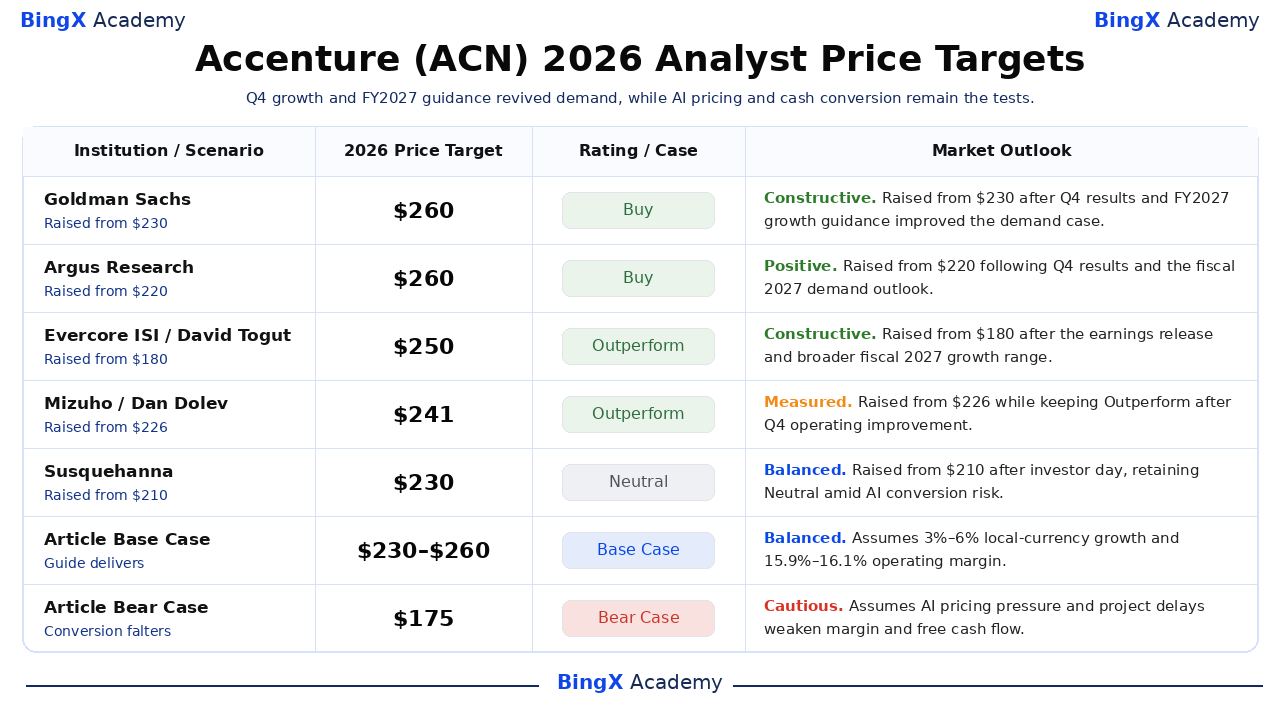
These are dated third-party target actions, not forecasts guaranteed for calendar year-end. The selected $201 to $260 range is narrow beside the article's $175 bear and $300 bull scenarios, which are separate editorial tests. Several firms raised targets after the fiscal Q4 release or October investor day; ratings still differ on growth, cash conversion and the effect of AI on service pricing.
|
Institution / Scenario |
2026 Price Target |
Rating / Case |
Market Outlook |
|
Goldman Sachs |
$260 |
Buy |
Constructive. October 2: raised from $230 to $260 after Q4 revenue exceeded guidance and the FY2027 growth outlook improved the demand case. |
|
Argus Research |
$260 |
Buy |
Positive. October 2: raised from $220 to $260 following the Q4 result and a stronger fiscal 2027 demand framework. |
|
Evercore ISI |
$250 |
Outperform |
Constructive. October 2: raised from $180 to $250 after the earnings release and broader fiscal 2027 growth range. |
|
Mizuho |
$241 |
Outperform |
Measured. October 6: raised from $226 to $241 while maintaining Outperform after Q4 operating improvement. |
|
Susquehanna |
$230 |
Neutral |
Balanced. October 15: raised from $210 to $230 after the investor day, the firm retained Neutral amid AI disruption and conversion risks. |
|
TD Cowen |
$201 |
Hold |
Cautious. October 15: raised from $193 to $201 after investor day, the firm retained Hold as near-term growth and valuation remained debated. |
|
Article Base Case |
230–260 |
Base Case |
Balanced. Assumes fiscal 2027 growth and margin track guidance while AI work converts gradually. |
|
Article Bear Case |
$175 |
Bear Case |
Cautious. Assumes AI pricing and project delays weaken growth, margins and cash conversion. |
How to Buy Accenture (ACN) Stock on BingX
Buy and hold Accenture shares through BingX Stocks Trading using USDT or USDC. Accenture offers exposure to enterprise AI adoption, cloud transformation, and growing managed-services demand. With fractional investing and no leverage or funding fees, eligible users can build positions based on their investment goals and outlook for Accenture's long-term growth.
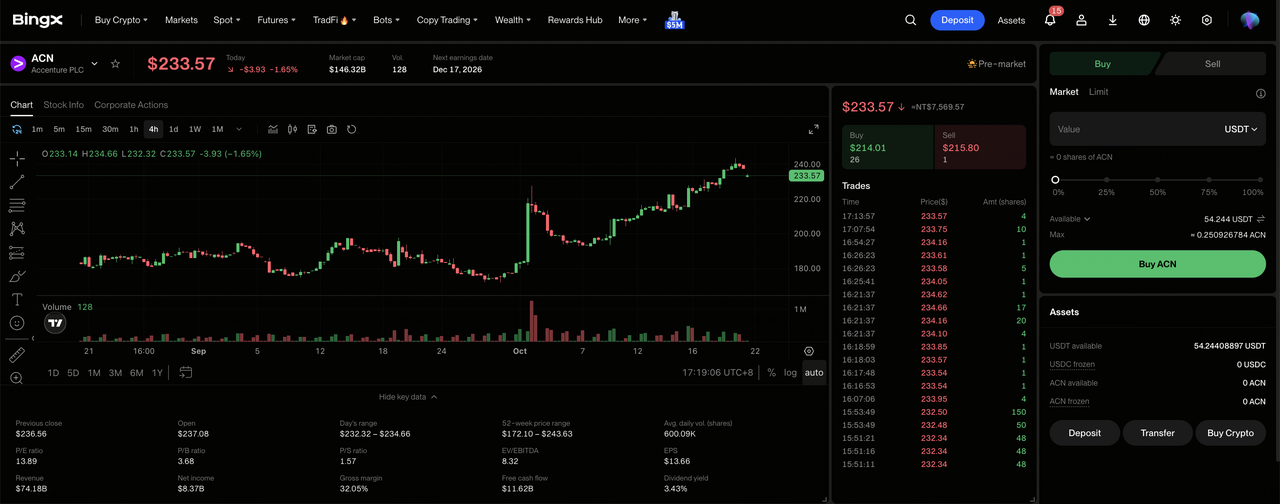
Step 1: Access BingX Stocks Trading. Sign up or log in to BingX, complete the required identity verification, and navigate to "TradFi > Stocks". Accept the Stock Trading Risk Disclosure if accessing the product for the first time.
Step 2: Prepare USDT or USDC. Ensure your Spot Account has sufficient funds for the purchase. Transfer USDT or USDC from your Fund or Wealth Account if needed. Fractional purchases start from 5 USDC or 0.0001 shares.
Step 3: Select Accenture (ACN). Open the Stocks market, search for ACN, and select Accenture (ACN). Review the current share price, trading session, and available order types.
Step 4: Buy Accenture Shares. Select "Buy", enter the investment amount or share quantity, and choose a market or limit order. Market orders execute at available prices during supported trading hours, while limit orders execute at the specified price or better when sufficient liquidity is available.
Step 5: Review and Manage Your Holdings. Open "Stocks > Positions" to monitor your ACN shares and unrealized profit or loss. Use "All Orders" to review transactions or sell shares when needed. T+1 settlement generally affects when sale proceeds become available for withdrawal, rather than when shares can be sold.
Top 5 Risks to Watch for Accenture Investors in 2026
Accenture's enterprise relationships, diversified services, and strong cash generation support its long-term outlook. However, AI-driven pricing changes, project delays, workforce costs, and acquisition spending could pressure profitability and slow its recovery.
- AI automation could pressure consulting margins: As AI replaces traditional consulting tasks, clients may demand lower prices or productivity savings. Revenue per project and margins could decline even as AI demand increases.
- Slower bookings conversion could limit growth: Q4 bookings of $22.17 billion signal healthy demand, but client approvals and implementation delays could postpone revenue. Extended delays may push fiscal 2027 growth below the 3% guidance floor.
- Workforce costs could constrain margins: Accenture's approximately 814,000 employees require ongoing reskilling and utilization management. Rising staffing costs could challenge its 15.9% to 16.1% operating margin target.
- Acquisition spending could reduce financial flexibility: Accenture returned $11.5 billion to shareholders in fiscal 2026 and expects at least $9.5 billion in fiscal 2027. Integration costs could strain liquidity if free cash flow misses the $11.0 billion to $11.8 billion outlook.
- Currency movements and client budgets could slow growth: Q4 revenue grew 7% in local currency versus 6% in U.S. dollars, highlighting FX exposure. Enterprise spending cuts could delay projects and weigh on revenue and valuation.
Final Thoughts: Should You Invest in Accenture in 2026?
Accenture exited fiscal 2026 with broader service demand: Q4 revenue exceeded guidance, both Consulting and Managed Services grew, and the $22.17 billion booking total produced a 1.2 book-to-bill ratio. The company generated $11.62 billion of annual free cash flow and plans fiscal 2027 operating margin of 15.9% to 16.1%. These are substantial foundations for an enterprise AI implementation business, although announcements still need to become paid client delivery.
The $300 bull case needs growth near the 6% guidance ceiling with expanding margins and cash flow; the $175 bear case gains force if automation erodes pricing or bookings fail to become revenue. Between those outcomes, $230 to $260 reflects execution near management's range. Conservative investors can watch the next quarter's $18.95 billion to $19.60 billion revenue guide, bookings mix and cash collection before treating the recovery as durable.
Risk Reminder: Trading and investing in equities like ACN involves a high risk of capital loss. Client spending, AI pricing, contract timing, workforce utilization, acquisitions and currency can create sharp price moves. Conduct independent research before allocating capital.
Related Reading
- IBM (IBM) Price Prediction 2026: Can Software and Quantum Growth Push IBM Toward $350?
- Workday (WDAY) Price Prediction 2026: Can AI Adoption Push WDAY Toward $225?
- Salesforce (CRM) Price Prediction 2026: Can Agentforce-Led Growth Push CRM Toward $330?
- Oracle (ORCL) Price Prediction 2026: Can AI Cloud Growth Push ORCL Toward $260?
- Microsoft (MSFT) Stock Outlook for 2026: Can Azure AI and Copilot Growth Drive MSFT Stock to $550+?
